



In Honor of Frank Serpico’s 90th Birthday: A Personal Reflection on Courage, Corruption, and the Duty to Speak
Today I want to honor Frank Serpico on his 90th birthday—a man whose courage changed policing in America and whose example helped shape my own path.
For those who may not know, Frank Serpico is a former New York City Police Department officer who became internationally known for exposing widespread police corruption in the 1960s and early 1970s. At a time when silence was expected and retaliation was certain, Serpico spoke out against bribery, misconduct, and the code of silence that protected it. His efforts helped lead to the Knapp Commission investigation, which uncovered systemic corruption inside the NYPD. His story later became widely known through the film Serpico starring Al Pacino.
But to many of us, Frank Serpico is more than history. He is proof that one honest person can shake an entire system.
He had been a hero of mine for years. Then life presented me with something unexpected.
During the Occupy Wall Street movement, I became affiliated with activists organizing a local Occupy event featuring guest speakers. One of the speakers scheduled to appear was Frank Serpico himself. I was tasked with networking and communicating with the guests. Unfortunately, Mr. Serpico was unable to attend the event—but something more meaningful happened instead.
We stayed in contact.
Phone conversations followed, and through those discussions I gained something rare: firsthand wisdom from a man who had already lived through the machinery of institutional retaliation.
At the same time, I had begun working in independent citizen journalism. Through another unlikely connection, I networked with Journalist & NYT Best Selling Author Naomi Wolf, who was launching DailyClout. Naomi taught me how to write rigorous, effective opinion pieces—articles that didn’t just identify problems, but also gave readers practical action steps for what citizens could do next.
So at once, I was learning two disciplines:
How to investigate and write.
And how corruption protects itself.
Around that same time, issues of police corruption were being raised in my own community by a lone city commissioner. I regularly attended government meetings and watched this official passionately raise concerns—only to be ignored, mocked, ridiculed, and attacked.
That reaction told me everything.
When institutions respond to allegations with hostility instead of transparency, there is usually a reason.
What I was witnessing reminded me exactly of what happened to Frank Serpico: isolate the truth-teller, smear the messenger, defend the machine.
I reached out to that commissioner and introduced myself as an independent investigative journalist. I wanted to hear his story. I didn’t expect a call back.
He called.
After a lengthy conversation, he ended with instructions: documents would be left at a designated place and time. I was to retrieve them, review them, and prepare questions.
That was the beginning of my full-scale investigation into the Battle Creek Police Department.
I used the journalism discipline I had learned. I used publishing opportunities made available through friends. I used research methods, investigative instincts, and lessons Frank Serpico had shared about how corruption operates and how power responds when challenged.
I attended commission meetings. I spoke publicly on the record. I filed hundreds of FOIA requests—so many that I earned the nickname “FOIA Queen.” I wrote articles and published stories detailing misconduct, failures, and questionable conduct involving city hall and the police department.
The fallout was significant.
Multiple city and police personnel resigned, retired early, were terminated, or moved on elsewhere.
And what happened to me?
I was arrested.
Then prosecuted.
Then prosecuted again.
What followed, in my view, was retaliation dressed up as law enforcement. Courtrooms, political pressure, public humiliation, legal expense, damage to reputation, and years of personal cost.
But there was also clarity.
Because once you witness systemic abuse up close, theory becomes reality.
You understand that corruption is not just bribery or theft. It is also selective enforcement. It is intimidation. It is using procedure as punishment. It is making examples out of people so others stay silent.
Still, I did not stop. I pursued civil litigation. I continued speaking publicly. I refused to be silenced by secrecy agreements or intimidation. And now, in 2026, serious scrutiny continues around my city and its police department. I continue to assist where lawful and appropriate.
This story is about more than me.
It is about the power of citizen journalism.
It is about whistleblowers.
It is about how ordinary people—with no badge, no title, no fortune, and no institutional backing—can still expose wrongdoing if they are persistent enough.
It is also about altruism.
I never did this for money. I made nothing from what I published. I spent my own money on records requests, legal fights, and advocacy. It cost me time, freedom, peace, reputation, and tens of thousands of dollars.
Why do it?
Because communities deserve honest government.
Good officers deserve clean departments.
Citizens deserve truth.
And silence helps only the corrupt.
Frank Serpico’s mentorship was not wasted on me. The lessons I learned from him, combined with the civic journalism discipline I learned elsewhere, continue to shape my mission today. I now hope to work toward stronger whistleblower protections—not only shielding those who speak up, but imposing serious consequences on those who retaliate against them.
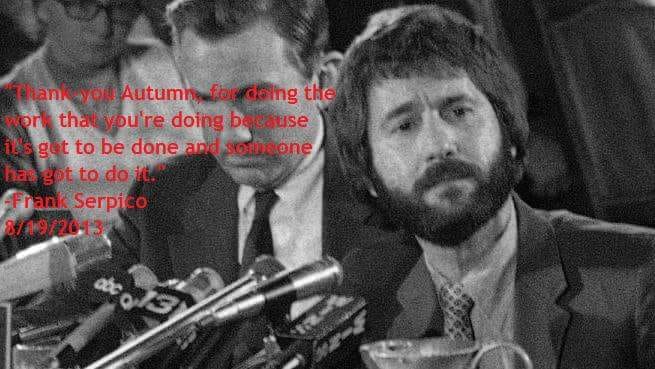
Thank-you Autumn for doing the work that you’re doing because its got to be done and someone has got to do it. | Frank Serpico to me 8/19/2013
Because retaliation is the weapon that keeps corruption alive.
And because Frank Serpico was right:
“We must create a atmosphere where the corrupt cop fears the honest cop, not the other way around.”
Happy 90th Birthday, Frank.
Your courage still echoes.
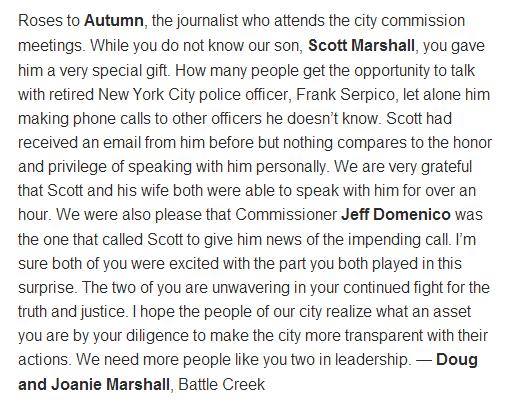
One of our country’s most important freedoms is that of free speech.
Agree with this essay? Disagree? Join the debate by writing to DailyClout HERE.