



Europe Finally Regrets Trusting Beijing
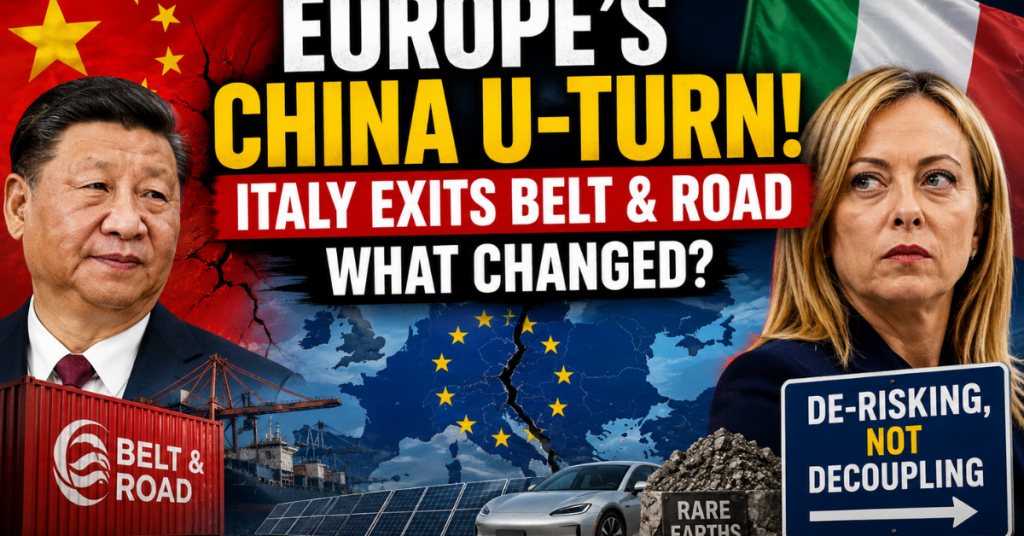
When Giorgia Meloni pulled Italy out of China’s Belt and Road Initiative, it was more than a diplomatic adjustment. It was a warning shot to the rest of Europe.
Back in 2019, Italy stunned both Washington and Brussels by becoming the only G7 nation to formally join Chinese President Xi Jinping’s signature global infrastructure project. The move was celebrated at the time as proof that Europe was beginning to look eastward for economic opportunity and geopolitical independence. Italian leaders promised new investments, expanded exports, and access to China’s massive consumer market.
The decision reflected a broader European mood during the late 2010s. Across the continent, political leaders increasingly embraced the concept of “strategic autonomy,” arguing that Europe had become too dependent on the United States for trade, defense, technology, and diplomacy. China was viewed by many not as a threat, but as an alternative pole of economic power capable of balancing American influence.
But five years later, the mood in Europe has changed dramatically.
Italy formally exited the Belt and Road Initiative in late 2023 after Meloni’s government concluded the arrangement had delivered few meaningful economic benefits while increasing long-term strategic vulnerabilities. Rome’s withdrawal was widely interpreted as a symbolic realignment back toward the transatlantic bloc and away from Beijing’s orbit.
The reversal did not happen in isolation. A cascade of global crises forced European governments to reassess their assumptions about authoritarian powers and economic dependency.
The COVID-19 pandemic exposed how reliant Europe had become on Chinese manufacturing and pharmaceutical supply chains. Russia’s invasion of Ukraine shattered the longstanding belief that economic integration automatically reduced geopolitical risk. Meanwhile, China’s growing alignment with Moscow under the so-called “no limits partnership” deepened European concerns that Beijing was not merely a commercial actor, but a strategic rival increasingly willing to challenge Western interests.
European leaders now openly compare dependence on Chinese supply chains to Europe’s disastrous reliance on Russian natural gas before 2022.
For years, Germany and much of the EU believed cheap Russian energy created stability through interdependence. Instead, Moscow’s control over critical energy supplies became a geopolitical weapon once war erupted in Ukraine. Policymakers increasingly fear a similar scenario unfolding with China’s dominance over sectors such as rare-earth minerals, battery technology, solar panels, electric vehicles, pharmaceuticals, and industrial manufacturing.
European Commission President Ursula von der Leyen has repeatedly warned that China now possesses enormous economic leverage over Europe. Brussels has increasingly adopted the language of “de-risking” rather than outright decoupling, signaling that Europe still wants trade with China but no longer wants dangerous strategic dependence.
That shift is already producing major policy changes.
The European Union has imposed tariffs on Chinese electric vehicles, tightened investment screening rules, restricted Chinese access to strategic infrastructure, and expanded subsidies for domestic manufacturing. Governments in Rome, Berlin, and Paris are increasingly scrutinizing Chinese involvement in ports, telecommunications, energy infrastructure, and advanced technology sectors.
Italy itself became a test case for this transformation.
Under Meloni, Rome blocked greater Chinese influence over major Italian firms and adopted a far more skeptical stance toward Beijing’s investment ambitions. Analysts note that Italy’s withdrawal from the Belt and Road Initiative effectively ended one of the most visible symbols of Chinese influence inside a major Western economy.
Yet Europe’s relationship with China remains complicated.
Despite the rhetoric about de-risking, European economies remain deeply tied to Chinese markets and industrial production. Italy continues pursuing trade deals with Beijing even after leaving the Belt and Road framework. During Meloni’s 2024 visit to China, both countries signed new industrial cooperation agreements involving sectors such as electric mobility, artificial intelligence, and renewable energy.
That contradiction highlights Europe’s central dilemma.
European leaders increasingly view China as both an economic necessity and a strategic vulnerability. They do not want full economic separation, but they also fear repeating the catastrophic mistake they made with Russian energy dependence.
The result is a new European strategy built around selective disengagement: maintain commercial ties where beneficial, but reduce exposure in sectors tied to national security, critical infrastructure, energy transition, and industrial resilience.
In many ways, Italy’s Belt and Road reversal represents the collapse of an era.
A decade ago, large parts of Europe believed globalization would soften geopolitical rivalries and integrate authoritarian powers into a stable international system. Today, many European leaders increasingly view economic dependency itself as a national security threat.
The continent that once feared overreliance on Washington now fears overreliance on Beijing even more.