



DOJ Email Raises New Questions About Mar-a-Lago Raid
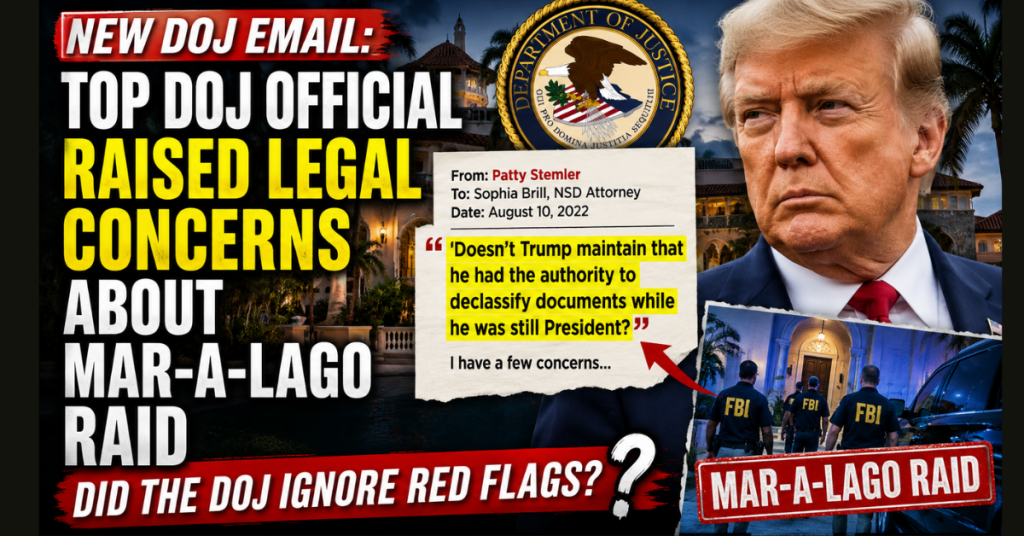
A newly revealed internal Justice Department email is reigniting debate over one of the most controversial law enforcement actions in modern American politics: the FBI’s 2022 raid on President Donald Trump’s Mar-a-Lago residence.
According to documents recently uncovered as part of a federal investigation into alleged government weaponization, a senior Biden Justice Department official privately warned colleagues just days after the raid that Trump may have had the constitutional authority to declassify the documents seized by the FBI.
The email came from Patty Stemler, a longtime DOJ veteran widely regarded inside the department as one of its most experienced appellate attorneys. Stemler reportedly expressed concern not only about the legal basis for the raid itself, but also about whether prosecutors were venturing into constitutionally dangerous territory by treating presidential declassification authority as subordinate to bureaucratic procedure.
“I have a few concerns,” Stemler wrote in the August 10, 2022 email obtained by Just the News.
Her central question cut directly to the heart of the case:
“Doesn’t Trump maintain that he had the authority to declassify documents while he was still President?”
A Constitutional Gray Area
At the center of the dispute is a legal issue that has divided constitutional scholars for years: how absolute is presidential declassification authority?
Trump and his allies argued from the beginning that the president possesses sweeping constitutional authority over classified materials as commander-in-chief. They claimed Trump had standing orders during his presidency allowing documents removed from the Oval Office to his residence to be treated as declassified.
That position was repeatedly dismissed by much of the media at the time. Yet the newly surfaced DOJ email suggests at least some senior legal figures inside the Biden administration privately acknowledged the issue was not so easily brushed aside.
Stemler specifically questioned whether existing federal declassification procedures legally constrained a sitting president at all.
That concern aligns with longstanding constitutional arguments made by legal scholars across administrations. Even President Barack Obama’s Executive Order 13526, which governs federal classification procedures, explicitly exempts the sitting president and vice president from many of the procedural requirements imposed on agencies and bureaucrats.
Trump attorney Evan Corcoran also warned DOJ officials before the raid that “the President has absolute authority to declassify documents,” arguing that criminal prosecution over such matters could raise serious separation-of-powers concerns.
Internal Doubts Inside DOJ
The significance of Stemler’s email goes beyond the legal theory itself.
She was not a random staff attorney. Stemler spent decades inside DOJ leadership circles and was reportedly brought back after retirement by Attorney General Merrick Garland to consult on sensitive Trump-related investigations. Bloomberg Law previously referred to her as a DOJ “fixer” relied upon during major institutional crises.
Her unease therefore raises new questions about how unified the Justice Department truly was behind the unprecedented FBI raid.
Stemler also questioned whether prosecutors were violating ethical standards by publicly emphasizing the “classified” nature of the seized documents before any indictment had been secured.
That concern became particularly relevant after the Biden DOJ released widely circulated photos showing documents with classification markings spread across the floor at Mar-a-Lago. Trump allies accused investigators of staging the images for political effect.
The Raid That Changed American Politics
The August 2022 Mar-a-Lago raid marked the first time in American history that a former president’s home had been searched by the FBI.
Attorney General Merrick Garland later confirmed he personally approved the decision to seek the warrant.
The operation quickly became a political earthquake. Supporters viewed it as necessary accountability over the handling of classified records. Critics saw it as a dangerous escalation in the use of federal law enforcement against political opponents.
Trump consistently maintained that he had declassified the materials and argued the Presidential Records Act gave him broad authority over the documents in question.
The legal battle eventually led to special counsel Jack Smith filing criminal charges against Trump in 2023 over alleged improper retention of classified materials. But the case collapsed in July 2024 after Judge Aileen Cannon ruled Smith had been unlawfully appointed as special counsel.
Smith later abandoned his appeal following Trump’s 2024 election victory.
Why This Matters Now
The newly discovered email is unlikely to settle the constitutional debate surrounding presidential declassification powers. But it does complicate the public narrative that the legal issues were always clear-cut.
At minimum, the documents reveal that even senior DOJ insiders privately recognized substantial unresolved constitutional questions surrounding the Mar-a-Lago investigation almost immediately after the raid occurred.
For Trump supporters, the email will likely reinforce longstanding claims that the investigation was politically motivated and legally shaky from the beginning.
For critics of Trump, it may simply reflect healthy internal debate within a functioning legal institution.
Either way, the disclosure adds another layer to one of the most politically explosive federal investigations in modern U.S. history.
Subscribe to DailyClout so you never miss an update!