



The California Energy Crisis No One Can Ignore
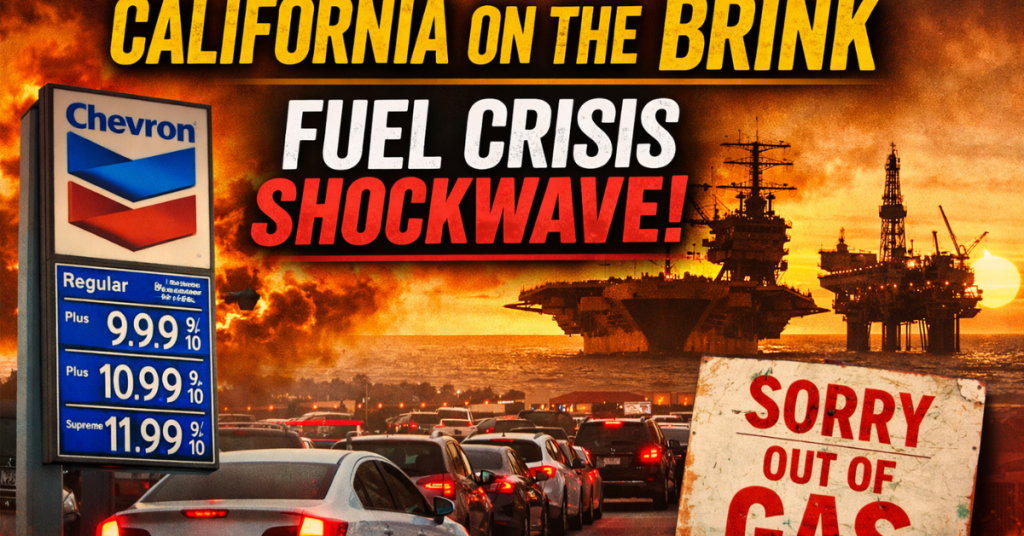
California has spent years positioning itself as the global model for aggressive climate policy. Now, according to new analysis from leading academics, that experiment may be colliding with physical reality—and the consequences could ripple far beyond state lines.
A recent paper from University of Southern California professor Dr. Michael Mische and University of California, Berkeley professor Dr. James Rector warns that California is facing a looming fuel shortage severe enough to threaten not just consumers, but national security.
At the center of the concern is a simple, sobering metric: supply.
California’s combined gasoline and crude oil inventories have reportedly dropped to just 9–10 days of supply, significantly below historical norms. When adjusted for reduced imports tied to global instability, that shortfall could be even worse—potentially 30% below normal levels.
That’s not a long-term projection. It’s an immediate pressure point.
A System Built on Restrictions
For years, California has steadily reduced its in-state oil production through regulatory pressure, environmental mandates, and refinery closures. The state still sits on vast untapped reserves, but strict policies have made extraction economically and politically impractical.
Instead, California has leaned heavily on imported fuel.
That strategy works—until it doesn’t.
Global disruptions, including tensions in the Middle East, have tightened supply chains. When imports slow down, California doesn’t have the domestic infrastructure to compensate. The result is a fragile system now being pushed to its limits.
And unlike other states, California operates with a unique gasoline formulation (CARBOB) that only a handful of refineries can produce. That isolation further restricts flexibility during shortages.
The Price Shock Scenario
If current trends continue, the consequences could be immediate and dramatic.
Researchers warn that gasoline prices could surge to $15 per gallon in a worst-case scenario.
That kind of spike wouldn’t just affect drivers. It would ripple through:
- Air travel, via jet fuel shortages
- Freight and logistics costs
- Consumer goods pricing
- Regional fuel supply chains
Neighboring states are particularly vulnerable. Nevada depends on California for roughly 80% of its gasoline, while Arizona relies on it for nearly half.
In other words, what happens in California doesn’t stay in California.
National Security Implications
This is where the story shifts from economic to strategic.
California isn’t just another state. It represents nearly 15% of the U.S. economy and houses critical infrastructure, including major ports and military bases.
A sustained fuel shortage would impact:
- Military readiness on the West Coast
- Global shipping through key ports
- Supply chains tied to imports and exports
That’s why some analysts argue the crisis has crossed into federal territory.
The proposal on the table is aggressive: use the Defense Production Act (DPA) to override state-level restrictions and stabilize energy supply.
The Federal vs. State Clash
The DPA gives the federal government broad authority to intervene in industries deemed essential to national security.
According to the researchers, potential federal actions could include:
- Expanding offshore oil production
- Reopening or federalizing refinery operations
- Overriding state environmental restrictions
- Adjusting fuel standards to allow broader supply access
Some steps have already begun. Federal authority has reportedly been used to restart certain offshore operations, adding tens of thousands of barrels per day back into California’s supply.
But legal resistance is mounting.
California officials have pushed back, filing lawsuits aimed at blocking expanded production and maintaining environmental standards. The battle is shaping up as a classic conflict between state policy goals and federal authority.
Policy vs. Reality
At the heart of the issue is a deeper philosophical divide.
California’s leadership has remained committed to long-term climate goals, including reducing fossil fuel dependence and accelerating electric vehicle adoption.
Critics argue that this transition is being forced faster than infrastructure and market realities can support.
Supporters counter that short-term pain is necessary to achieve long-term environmental gains.
But the current situation raises a difficult question:
What happens when policy goals collide with physical supply constraints?
Because unlike financial systems or digital markets, energy operates on hard limits. You either have fuel—or you don’t.
The Bigger Picture
Even if global supply stabilizes tomorrow, experts warn that California’s problems won’t disappear overnight.
Restarting refineries, rebuilding inventories, and restoring supply chains could take months, not weeks.
That lag exposes a structural vulnerability:
A system designed around reduced domestic production becomes highly sensitive to global disruptions.
And in a world of increasing geopolitical instability, those disruptions are becoming more frequent, not less.