



‘Trivial, Baseless, And Insulting’: Justice Alito Tears Into Ketanji Brown Jackson
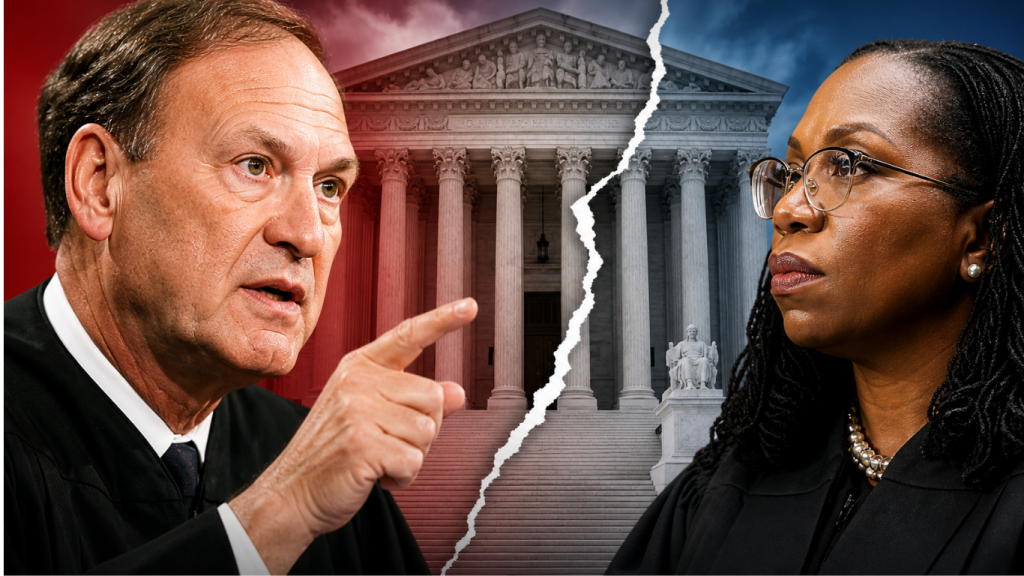
A sharp exchange inside the Supreme Court of the United States has brought renewed attention to internal divisions among the justices, as Samuel Alito criticized Ketanji Brown Jackson over her dissent in a procedural ruling tied to Louisiana’s congressional map.
The dispute stems from a court order allowing Louisiana to move forward with redrawing a congressional map that had previously been ruled unconstitutional. The order effectively cleared the way for the state to act quickly ahead of upcoming election timelines.
In an unusually direct response to a dissent on a procedural matter, Alito wrote that Jackson’s objections “cannot go unanswered,” arguing that her position would leave elections in place under a map already found to violate the Constitution.
At the center of the disagreement is the court’s decision to bypass its standard waiting period under Supreme Court Rule 45.3, which typically allows about a month before a judgment takes effect. In this case, the Court accelerated that timeline, citing agreement among most parties involved.
Alito defended the move as consistent with past practice, noting that the Court has shortened the waiting period in other cases when circumstances warranted it. He argued that Jackson’s criticism lacked a substantive legal basis, calling her reasoning “trivial at best” and, in part, “baseless and insulting.”
Jackson, in her dissent, took a broader view of the Court’s role. She argued that immediately enforcing the decision risked entangling the Court in the political and logistical process of redistricting. She suggested the move could be seen as endorsing a rushed effort to alter election maps, raising concerns about the Court’s neutrality in politically sensitive matters.
“The Court’s decision to buck our usual practice… is tantamount to an approval” of the state’s actions, Jackson wrote, warning that such steps could blur the line between judicial review and political influence.
The case also touches on ongoing legal tensions around redistricting, an issue the Court has grappled with in prior rulings such as Rucho v. Common Cause, where the justices declined to set standards for partisan gerrymandering claims, leaving many disputes to the political process.
Notably, Jackson was the lone dissenting voice on the procedural order. Justices across ideological lines, including Elena Kagan and Sonia Sotomayor, did not join her opinion, instead aligning with the majority in allowing the expedited implementation.
Alito’s response went beyond legal disagreement, taking aim at the tone of Jackson’s dissent. He accused her of using charged rhetoric without sufficient grounding in precedent, writing that “it is the dissent’s rhetoric that lacks restraint.”
The exchange reflects a broader pattern of increasingly pointed language among members of the Court in recent terms. Since joining the bench in 2022, Jackson has at times drawn criticism from colleagues across the ideological spectrum for the framing of her dissents, even as she has sought to articulate concerns about institutional limits and the Court’s role in politically sensitive cases.
The Louisiana redistricting dispute itself remains part of a larger national conversation over election maps, voting rights, and the judiciary’s role in overseeing both. While the Court’s procedural order does not resolve the underlying legal questions, it highlights how even technical rulings can expose deeper philosophical divides among the justices.
As states continue to navigate redistricting challenges, the tension seen in this case suggests those debates will remain both legally complex and politically charged in the years ahead.