



Renal – MicroReport 9
Main Findings
-
Adverse Events were reported to Pfizer during a 90-day period, following the December 1, 2020, public rollout of its COVID-19 experimental “vaccine” product.
-
In the Pfizer 5.3.6 document, these AEs were categorized by System Organ Classes (SOC), in other words, by systems in the body.
-
Of the 69 patients, 46 were women (67%) and 23 were men (33%).
-
There was one infant in this group. It should be noted the vaccine was not authorized for infants. The other age groups were 60 elderly (88%), seven adults (10%), and one unreported.
Renal Adverse Events of Special Interest
The renal AESIs were collected by searching only events labeled as Acute Kidney Injury or Acute Renal Failure. While these two conditions result from severe underlying disease processes, they name only the ultimate conditions. In clinical medicine, the kidneys have a number of important functions. They are involved in blood pressure control, maintenance of electrolyte balance, fluid volume stabilization, and elimination of waste products. The narrow search criteria do not detect damage to any of these basic kidney functions. Thus, Pfizer’s adverse event reports screen only for the most severe damage but miss important, less severe, kidney damage.
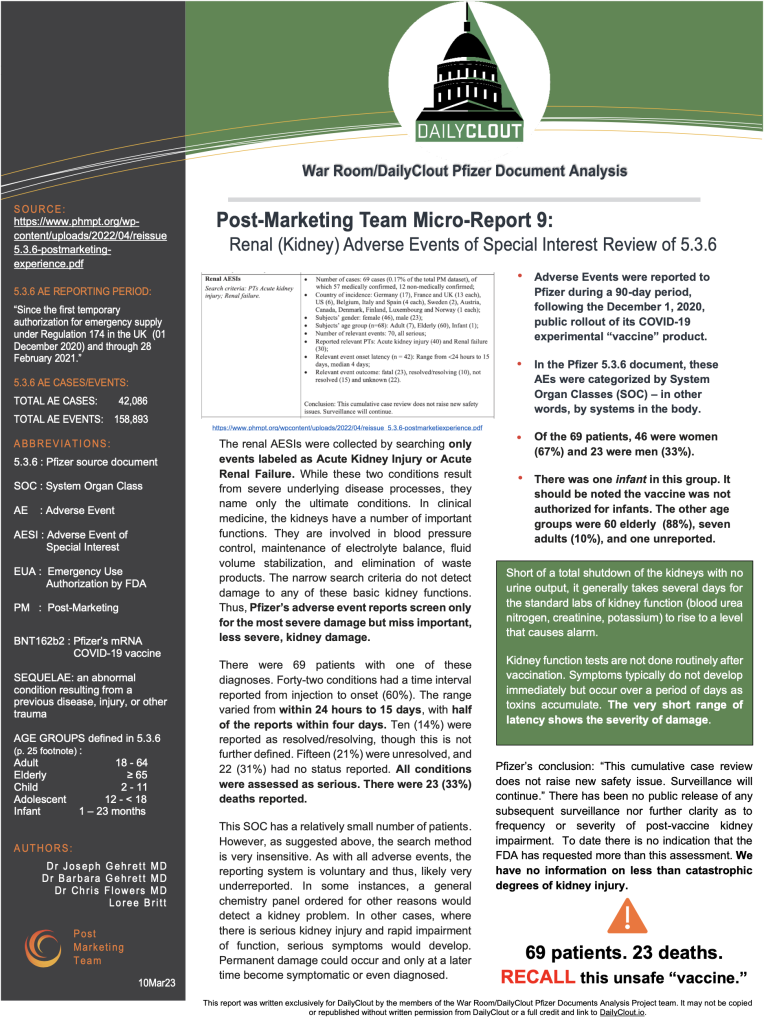
There were 69 patients with one of these diagnoses. Forty-two conditions had a time interval reported from injection to onset (60%). The range varied from within 24 hours to 15 days, with half of the reports within four days. Ten (14%) were reported as resolved/resolving, though this is not further defined. Fifteen (21%) were unresolved, and 22 (31%) had no status reported. All conditions were assessed as serious. There were 23 (33%) deaths reported.
This SOC has a relatively small number of patients. However, as suggested above, the search method is very insensitive. As with all adverse events, the reporting system is voluntary and thus, likely very underreported. In some instances, a general chemistry panel ordered for other reasons would detect a kidney problem. In other cases, where there is serious kidney injury and rapid impairment of function, serious symptoms would develop. Permanent damage could occur and only at a later time become symptomatic or even diagnosed.
Kidney Function and Severity of Damage
Short of a total shutdown of the kidneys with no urine output, it generally takes several days for the standard labs of kidney function (blood urea nitrogen, creatinine, potassium) to rise to a level that causes alarm.
Kidney function tests are not done routinely after vaccination. Symptoms typically do not develop immediately but occur over a period of days as toxins accumulate. The very short range of latency shows the severity of damage.
Pfizer’s Conclusion
“This cumulative case review does not raise new safety issue. Surveillance will continue.”
There has been no public release of any subsequent surveillance nor further clarity as to frequency or severity of post-vaccine kidney impairment. To date there is no indication that the FDA has requested more than this assessment. We have no information on less than catastrophic degrees of kidney injury.
Post-Marketing Team’s Conclusion
69 patients. 23 deaths.
RECALL this unsafe “vaccine.”
Reference Information
5.3.6 AE Reporting Period
“Since the first temporary authorization for emergency supply under Regulation 174 in the UK (01 December 2020) and through 28 February 2021.”
5.3.6 AE Cases/Events
| Category | Total |
|---|---|
| Total AE cases | 42,086 |
| Total AE events | 158,893 |
Abbreviations
-
5.3.6: Pfizer source document
-
SOC: System Organ Class
-
AE: Adverse Event
-
AESI: Adverse Event of Special Interest
-
EUA: Emergency Use Authorization by FDA
-
PM: Post-Marketing
-
BNT162b2: Pfizer’s mRNA COVID-19 vaccine
-
Sequelae: An abnormal condition resulting from a previous disease, injury, or other trauma
Age Groups Defined in 5.3.6 (p. 25 footnote)
| Age group | Age range |
|---|---|
| Adult | 18–64 |
| Elderly | 65 and older |
| Child | 2–11 |
| Adolescent | 12–17 |
| Infant | 1–23 months |