



Facial Parsalysis – MicroReport 8
Main Findings
-
Adverse Events were reported to Pfizer during a 90-day period, following the December 1, 2020, public rollout of its COVID-19 experimental “vaccine” product.
-
In the Pfizer 5.3.6 document, these AEs were categorized by System Organ Classes (SOC), in other words, by systems in the body.
-
The demographics of the cases included 295 (66%) female, 133 male (30%), and 21 (5%) not reported.
-
Age was reported for 411 persons with elderly 96 (21%), adult 313 (70%), and one each in the infant and child age groups.
Facial Paralysis and Bell’s Palsy
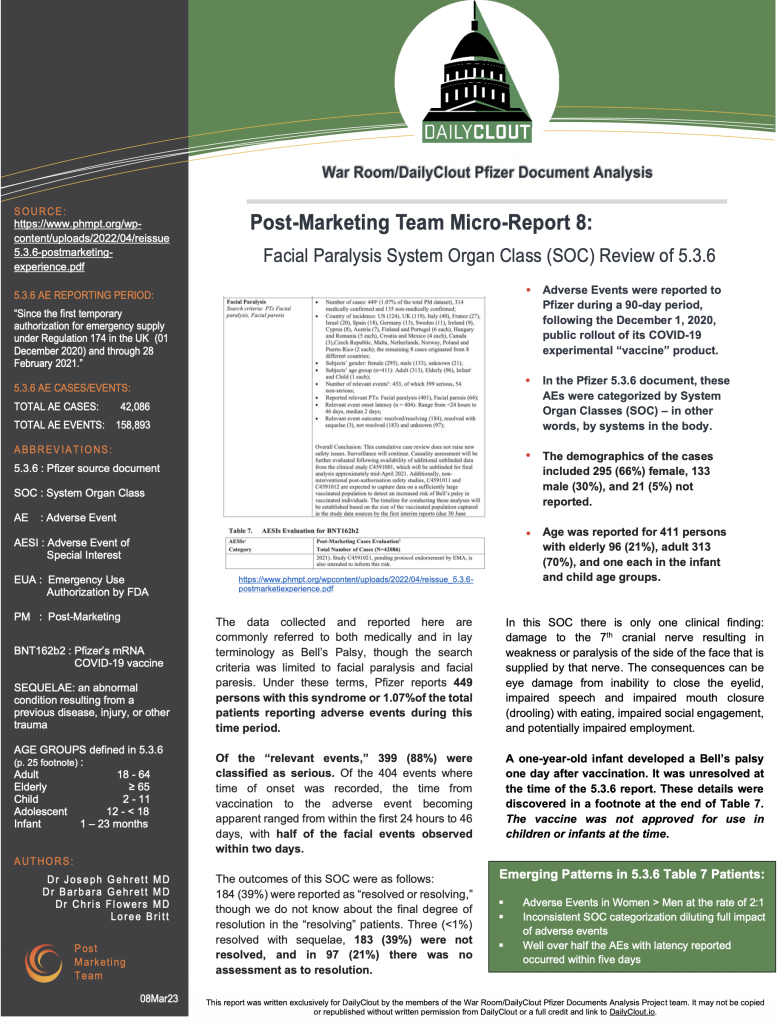
The data collected and reported here are commonly referred to both medically and in lay terminology as Bell’s Palsy, though the search criteria was limited to facial paralysis and facial paresis. Under these terms, Pfizer reports 449 persons with this syndrome or 1.07% of the total patients reporting adverse events during this time period.
In this SOC there is only one clinical finding: damage to the 7th cranial nerve resulting in weakness or paralysis of the side of the face that is supplied by that nerve. The consequences can be eye damage from inability to close the eyelid, impaired speech and impaired mouth closure (drooling) with eating, impaired social engagement, and potentially impaired employment.
Of the “relevant events,” 399 (88%) were classified as serious. Of the 404 events where time of onset was recorded, the time from vaccination to the adverse event becoming apparent ranged from within the first 24 hours to 46 days, with half of the facial events observed within two days.
A one-year-old infant developed a Bell’s palsy one day after vaccination. It was unresolved at the time of the 5.3.6 report. These details were discovered in a footnote at the end of Table 7. The vaccine was not approved for use in children or infants at the time.
Reported Outcomes
The outcomes of this SOC were as follows:
184 (39%) were reported as “resolved or resolving,” though we do not know about the final degree of resolution in the “resolving” patients. Three (less than 1%) resolved with sequelae, 183 (39%) were not resolved, and in 97 (21%) there was no assessment as to resolution.
Emerging Patterns in 5.3.6 Table 7 Patients
-
Adverse Events in Women > Men at the rate of 2:1
-
Inconsistent SOC categorization diluting full impact of adverse events
-
Well over half the AEs with latency reported occurred within five days
Pfizer’s Conclusion
In this SOC, as with a number of other medical conditions, the conclusion of Pfizer was:
“This cumulative review does not raise new safety issues. Surveillance will continue.”
Additionally, they state:
“Causality assessment will be further evaluated following availability of additional unblinded data from the clinical study C4591001, which will be unblinded for final analysis approximately mid-April 2021. Additionally, noninterventional post-authorisation safety studies, C4591011 and C4591012 are expected to capture data on a sufficiently large vaccinated population to detect an increased risk of Bell’s palsy in vaccinated individuals.
The timeline for conducting these analyses will be established based on the size of the vaccinated population captured in the study data sources by the first interim reports (due 30 June 2021).”
Source: Pfizer 5.3.6 Post-Marketing Experience Document
Post-Marketing Team’s Assessment
This SOC shows a relatively large number of events. This one syndrome made up 1% of the entire post-marketing patients reporting adverse events. The rate of facial weakness/paralysis clearly attracted enough attention so that, in spite of Pfizer’s usual denial of significance, they identified studies that would produce a larger data set. However, since finalizing the 5.3.6 report in February 2021, there has been no further summary data released for outside review. Furthermore, a search on ClinicalTrials.gov for the cited studies (C4591011 and C4591012) yielded no studies found (accessed February 23, 2023).
Another observation by the Post-Marketing Team involved Pfizer’s decision to remove this facial paralysis syndrome from the Neurologic SOC and report it separately, which dilutes the larger issue of neurologic events after vaccination.
Additionally, it is surprising that Pfizer used limited search criteria for this SOC. Usual medical as well as lay terminology would call this condition Bell’s palsy. However, the available search terms nowhere indicate a search under this diagnosis. Similarly, a closely related condition, Ramsay Hunt syndrome, was not searched. The failure to use all common terms may have resulted in the adverse events being understated.
Post-Marketing Team’s Conclusion
RECALL this unsafe “vaccine.”
Reference Information
5.3.6 AE Reporting Period
“Since the first temporary authorization for emergency supply under Regulation 174 in the UK (01 December 2020) and through 28 February 2021.”
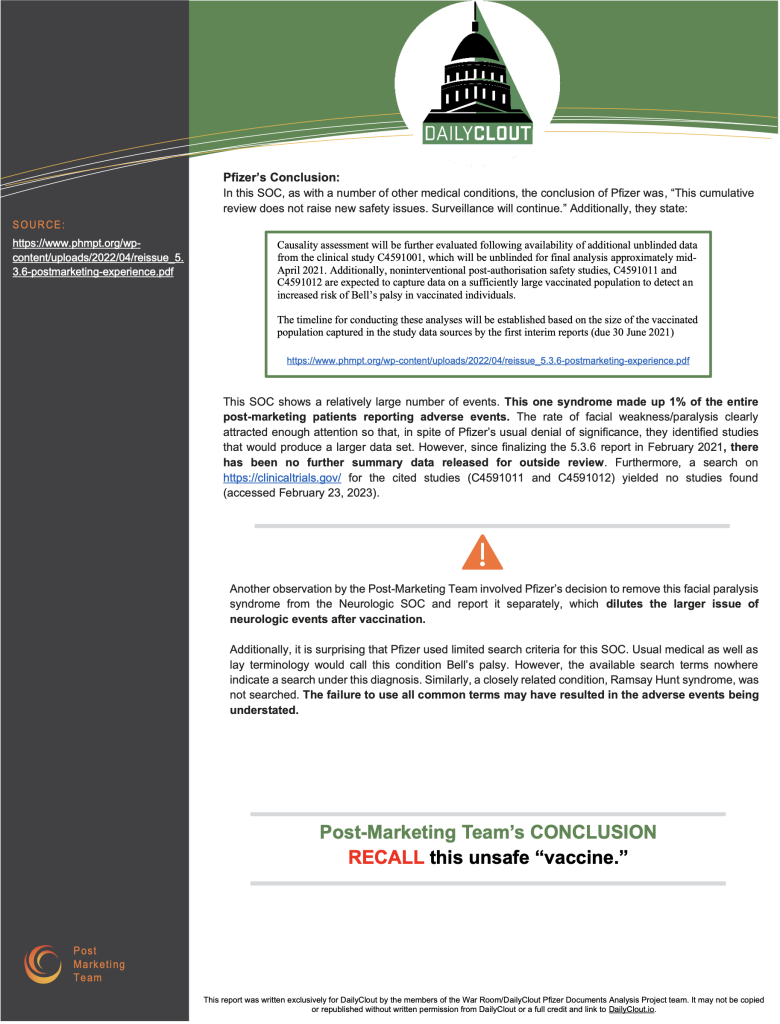
5.3.6 AE Cases/Events
| Category | Total |
|---|---|
| Total AE cases | 42,086 |
| Total AE events | 158,893 |
Abbreviations
-
5.3.6: Pfizer source document
-
SOC: System Organ Class
-
AE: Adverse Event
-
AESI: Adverse Event of Special Interest
-
EUA: Emergency Use Authorization by FDA
-
PM: Post-Marketing
-
BNT162b2: Pfizer’s mRNA COVID-19 vaccine
-
Sequelae: An abnormal condition resulting from a previous disease, injury, or other trauma
Age Groups Defined in 5.3.6 (p. 25 footnote)
| Age group | Age range |
|---|---|
| Adult | 18–64 |
| Elderly | 65 and older |
| Child | 2–11 |
| Adolescent | 12–17 |
| Infant | 1–23 months |