



Pregnancy and Lactation – MicroReport 17
Safety Concerns Identified by Pfizer
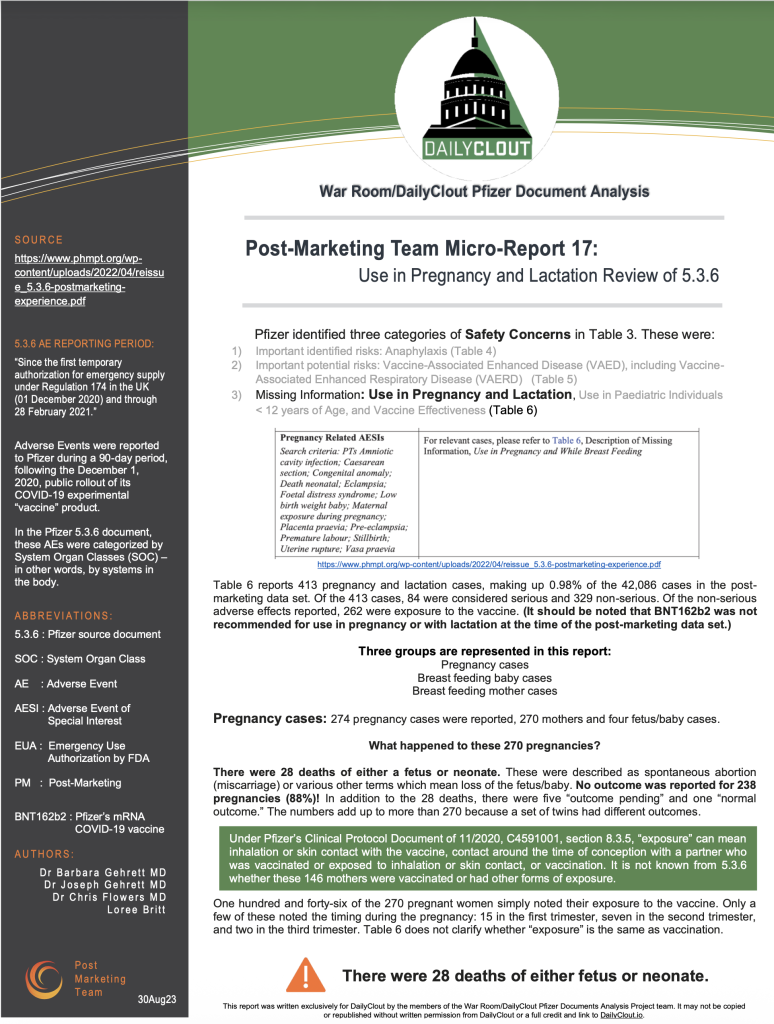
Pfizer identified three categories of Safety Concerns in Table 3. These were:
-
Important identified risks: Anaphylaxis (Table 4).
-
Important potential risks: Vaccine-Associated Enhanced Disease (VAED), including Vaccine-Associated Enhanced Respiratory Disease (VAERD) (Table 5).
-
Missing Information: Use in Pregnancy and Lactation, Use in Paediatric Individuals under 12 years of age, and Vaccine Effectiveness (Table 6).
Pregnancy and Lactation Cases
Table 6 reports 413 pregnancy and lactation cases, making up 0.98% of the 42,086 cases in the post-marketing data set. Of the 413 cases, 84 were considered serious and 329 non-serious. Of the non-serious adverse effects reported, 262 were exposure to the vaccine. (It should be noted that BNT162b2 was not recommended for use in pregnancy or with lactation at the time of the post-marketing data set.)
Three groups are represented in this report:
-
Pregnancy cases
-
Breast feeding baby cases
-
Breast feeding mother cases
Pregnancy Cases
Pregnancy cases: 274 pregnancy cases were reported, 270 mothers and four fetus/baby cases.
What Happened to These 270 Pregnancies?
There were 28 deaths of either a fetus or neonate. These were described as spontaneous abortion (miscarriage) or various other terms which mean loss of the fetus/baby. No outcome was reported for 238 pregnancies (88%)! In addition to the 28 deaths, there were five “outcome pending” and one “normal outcome.” The numbers add up to more than 270 because a set of twins had different outcomes.
Pfizer’s Definition of Exposure
Under Pfizer’s Clinical Protocol Document of 11/2020, C4591001, section 8.3.5, “exposure” can mean inhalation or skin contact with the vaccine, contact around the time of conception with a partner who was vaccinated or exposed to inhalation or skin contact, or vaccination. It is not known from 5.3.6 whether these 146 mothers were vaccinated or had other forms of exposure.
One hundred and forty-six of the 270 pregnant women simply noted their exposure to the vaccine. Only a few of these noted the timing during the pregnancy: 15 in the first trimester, seven in the second trimester, and two in the third trimester. Table 6 does not clarify whether “exposure” is the same as vaccination.
There were 28 deaths of either fetus or neonate.
Reported Clinical Events Among Vaccinated Mothers
The remaining 124 of the 270 mothers are specifically described as vaccinated. The timing during the pregnancy was reported in just 22 cases, with 19 during the first trimester, one in the second trimester and two in the third trimester. Of this group, 49 cases were rated nonserious and 75 rated serious. This means that 28% of the 270 pregnant women with adverse clinical events had serious events.
What were the serious clinical events reported in this group of 124 pregnant mothers? There were the above-mentioned 28 deaths of either fetus or neonate (23%). Other clinical events related specifically to pregnancy including one woman with uterine contraction during pregnancy and one with premature rupture of membranes.
The rest of the symptoms for nonserious and serious clinical events were not separated but reported together; so other than the deaths, it is speculation as to which of the following symptoms or combination of symptoms were responsible for the remaining 40+ serious clinical cases: 33 headache, 24 vaccination site pain, 22 pain in extremity, 22 fatigue, 16 myalgia (muscle aches), 16 pyrexia (fever), 13 chills, 12 nausea, 11 pain, nine arthralgia (joint aches), seven lymphadenopathy (swollen lymph nodes), six chest pain, six dizziness, six asthenia (weakness or lack of energy), and five malaise. Two other clinical events are included: seven drug ineffective (defined as getting COVID between 14 days after the first shot and six days after the second shot) and five COVID-19 (presumably infection more than a week after the second injection, in other words failure of full immunization). Clinical events were only listed if they occurred in more than five cases, leading one to ask what additional serious events are missing from the report.
Also recorded under Pregnancy cases are four fetal/baby serious adverse cases including two fetal growth restriction, two premature baby, and one neonatal death.
Breast Feeding Baby Cases
Breast feeding baby cases: 133 breast feeding baby cases were reported, with 116 simply reporting the exposure but no adverse reaction. Seventeen adverse reactions were reported, three classified as serious and 14 as nonserious. Again, the list of symptoms is not separated in the document into serious versus nonserious: pyrexia (fever), rash, infant irritability, infantile vomiting, diarrhea, insomnia, illness, poor feeding infant, lethargy, abdominal discomfort, vomiting, allergy to vaccine, increased appetite, anxiety, crying, poor quality sleep, eructation (burping), agitation, pain, and urticaria (hives). Without more details or a narrative report, we really do not know how sick these babies became.
Breast Feeding Mother Cases
Breast feeding mother cases: Adverse events were reported by six breast feeding mothers. One mother’s serious AE consisted of three clinical events: chills, malaise, and pyrexia (fever). Four women had suppressed lactation. One was considered a serious AE. These four mothers had various other symptoms in addition to suppressed lactation: pyrexia (fever), paresis (weakness short of complete paralysis, usually of an extremity), headache, chills, vomiting, pain in extremity, arthralgia (joint pain), breast pain, scar pain, nausea, migraine, myalgia (muscle pain), fatigue, and breast milk discoloration. No information on latency or age is provided. A final mother was included as a non-serious case with “very limited information.”
Pfizer’s Conclusion
“There were no safety signals that emerged from the review of these cases of use in pregnancy and while breast feeding.”
Post-Marketing Team’s Questions
-
Does it give you confidence in use of this product during pregnancy to know that almost 90% of pregnancies had an unknown outcome?
-
How would you feel if you were one of the parents who had lost a baby to spontaneous abortion or other causes after vaccination?
-
Parenthetically, how can Pfizer claim to know anything about safety signals when the company admits ignorance of 88% of pregnancy outcomes?
Comparison With DailyClout Report 69
Finally, how does the 5.3.6, Table 6 document on “Use in Pregnancy and Lactation” differ from the “Pregnancy and Lactation Cumulative Report” discussed in DailyClout Report 69? DailyClout Report 69
First, the Cumulative Report includes relevant cases “…from the time of drug product development to 28-Feb-2021.” 5.3.6 focuses only on 1 December 2020 to 28 February 2021, the first three months of release to the general population.
The Cumulative Report documents 53 spontaneous abortions and two premature births with neonatal death, compared to 26 and two, respectively, documented in 5.3.6. This is a very large difference considering that the bulk of inoculations occurred during the period of time included in 5.3.6. Pfizer’s Cumulative Report reported 41 baby/infant cases exposed via breastmilk who had adverse events, with 10 of the cases experiencing serious adverse events. The comparable figures from 5.3.6 Table 6 were 17 cases and three serious cases.
Why are there twice as many spontaneous abortions in the Cumulative Report? Why does the Cumulative Report have so many more baby and infant cases with adverse and serious adverse events? Most of the drug dosing occurred in the overlapping time period of 1 December 2020 to 28 February 2021, the time period of 5.3.6. Pfizer leaves us with many unanswered questions about the risk to pregnancy and breast feeding babies.
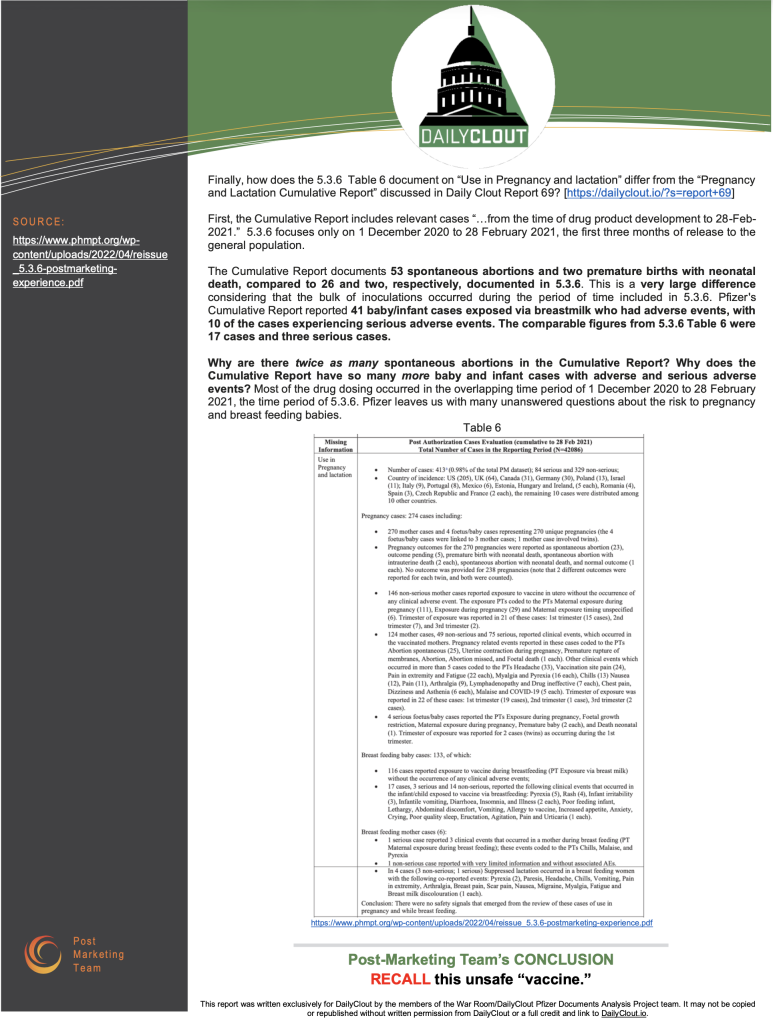
Pfizer’s Table 6: Use in Pregnancy and Lactation
Post-Authorization Cases Evaluation (cumulative to 28 February 2021)
Total number of cases in the reporting period: 413, including 84 serious and 329 non-serious.
Pregnancy Cases: 274
-
270 mother cases and four fetus/baby cases, representing 270 unique pregnancies.
-
Pregnancy outcomes for the 270 pregnancies were reported as spontaneous abortion (23), outcome pending (5), premature birth with neonatal death, spontaneous abortion with intrauterine death (2 each), spontaneous abortion with neonatal death, and normal outcome (1 each).
-
No outcome was provided for 238 pregnancies.
-
146 non-serious mother cases reported exposure to the vaccine in utero without the occurrence of any clinical adverse event.
-
124 mother cases, including 75 serious and 49 non-serious, reported clinical events that occurred in the vaccinated mothers.
-
Four serious fetus/baby cases reported fetal growth restriction, maternal exposure during pregnancy, premature baby, and neonatal death.
Breast Feeding Baby Cases: 133
-
116 cases reported exposure to the vaccine during breastfeeding without the occurrence of any clinical adverse events.
-
17 cases, including three serious and 14 non-serious, reported clinical events.
Breast Feeding Mother Cases: 6
-
One serious case reported three clinical events that occurred in a mother during breastfeeding: chills, malaise, and pyrexia.
-
One non-serious case was reported with very limited information.
-
In four cases, including one serious and three non-serious, suppressed lactation occurred in a breastfeeding woman with other co-reported events.
Pfizer’s conclusion: There were no safety signals that emerged from the review of these cases of use in pregnancy and while breast feeding.
Post-Marketing Team’s Conclusion
RECALL this unsafe “vaccine.”
Reference Information
5.3.6 AE Reporting Period
“Since the first temporary authorization for emergency supply under Regulation 174 in the UK (01 December 2020) and through 28 February 2021.”
Abbreviations
-
5.3.6: Pfizer source document
-
SOC: System Organ Class
-
AE: Adverse Event
-
AESI: Adverse Event of Special Interest
-
EUA: Emergency Use Authorization by FDA
-
PM: Post-Marketing
-
BNT162b2: Pfizer’s mRNA COVID-19 vaccine
-
Sequelae: An abnormal condition resulting from a previous disease, injury, or other trauma
Age Groups Defined in 5.3.6 (p. 25 footnote)
| Age group | Age range |
|---|---|
| Adult | 18–64 |
| Elderly | 65 and older |
| Child | 2–11 |
| Adolescent | 12–17 |
| Infant | 1–23 months |