Opinion
Murray Rothbard on consumers, voters and knowledge
March 18, 2026 • by Kevin Duffy
Consumers also take entrepreneurial risks on the market. Many critics of the market, while willing to concede the expertise of the capitalist-entrepreneurs, bewail the prevailing ignorance of consumers, which prevents them from gaining the utility ex post that they had expected ex ante. Typically, Wesley C. Mitchell entitled one of his famous essays: ‘The Backward Art of Spending Money.’ Professor Mises has keenly pointed out the paradox of interventionists who insist that consumers are too ignorant or incompetent to buy products intelligently, while at the same time proclaiming the virtues of democracy, where the same people vote for or against politicians whom they do not know and on policies which they scarcely understand.
To put it another way, the partisans of intervention assume that individuals are not competent to run their own affairs or to hire experts to advise them, but they also assume that these same individuals are competent to vote for these experts at the ballot box. They are further assuming that the mass of supposedly incompetent consumers are competent to choose not only those who will rule over themselves, but also over the competent individuals in society. Yet such absurd and contradictory assumptions lie at the root of every program for ‘democratic’ intervention in the affairs of the people.
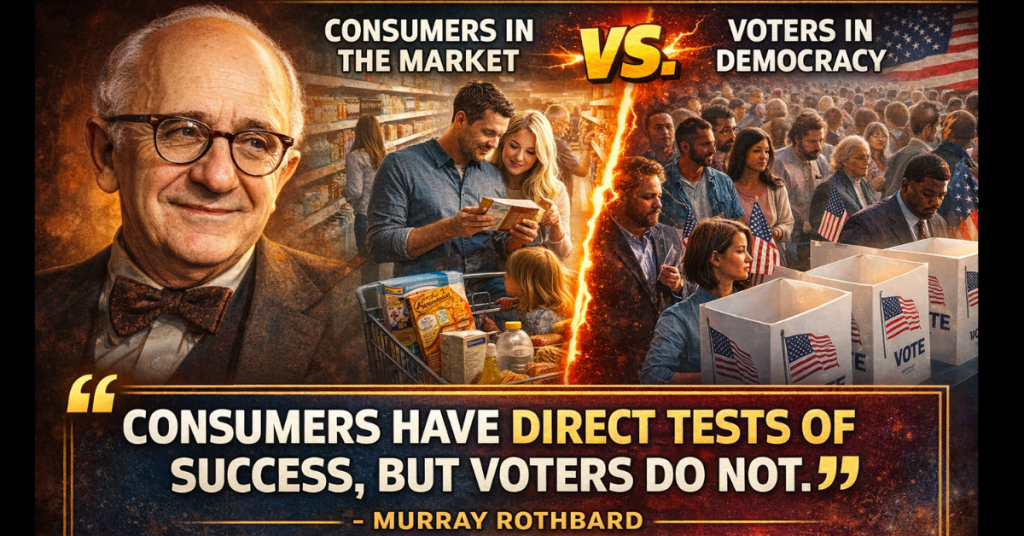
In fact, the truth is precisely the reverse of this popular ideology. Consumers are surely not omniscient, but they have direct tests by which to acquire and check their knowledge. They buy a certain brand of breakfast food and they do not like it; and so they do not buy it again. They buy a certain type of automobile and like its performance; they buy another one. And in both cases, they tell their friends of this newly won knowledge. Other consumers patronize consumers’ research organizations, which can warn or advise them in advance. But, in all cases, the consumers have the direct test of results to guide them. And the firm which satisfied the consumers expands and prospers and thus gains ‘good will,’ while the firm failing to satisfy them goes out of business.
On the other hand, voting for politicians and public policies is a completely different matter. Here there are no direct tests of success or failure whatever, neither profits and losses nor enjoyable or unsatisfying consumption. In order to grasp consequences, especially the indirect catallactic consequences of governmental decisions, it is necessary to comprehend complex chains of praxeological reasoning. Very few voters have the ability or the interest to follow such reasoning, particularly, as Schumpeter points out, in political situations. For the minute influence that any one person has on the results, as well as the seeming remoteness of the actions, keeps people from gaining interest in political problems or arguments. Lacking the direct test of success or failure, the voter tends to turn, not to those politicians whose policies have the best chance of success, but to those who can best sell their propaganda ability. Without grasping logical chains of deduction, the average voter will never be able to discover the errors that his ruler makes.
George J. Schuller, in attempting to refute this argument, protested that: ‘complex chains of reasoning are required for consumers to select intelligently an automobile or television set.’ But such knowledge is not necessary; for the whole point is that the consumers have always at hand a simple and pragmatic test of success: does the product work and work well? In public economic affairs, there is no such test, for no one can know whether a particular policy has ‘worked’ or not without knowing the a priori reasoning of economics.
~ Murray Rothbard, Man, Economy, and State (1962)