



Law Schools Face Massive DEI Shakeup
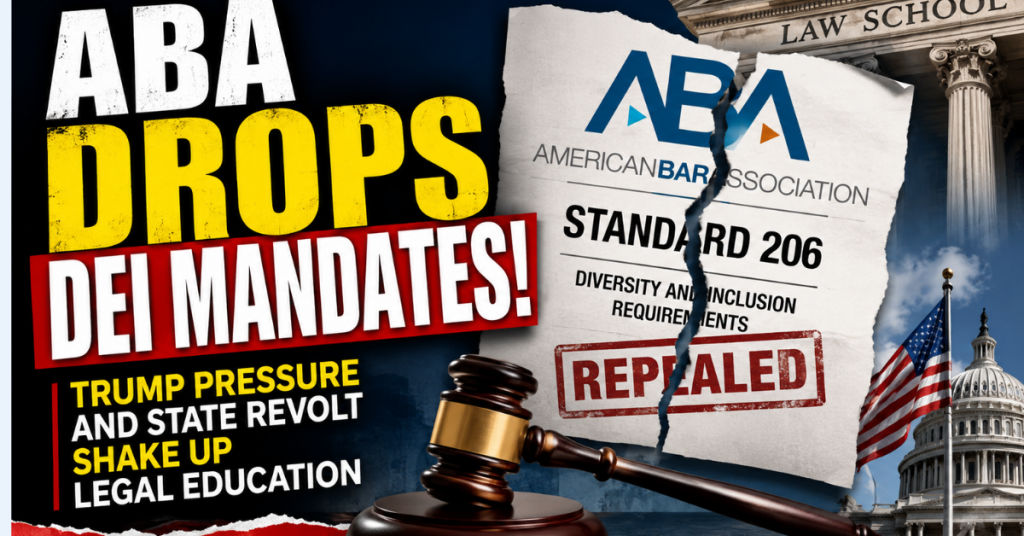
The American Bar Association is facing one of the most significant internal revolts in its modern history as mounting legal, political, and financial pressure forces the organization to reconsider some of its most controversial accreditation rules.
In a major shift, the ABA’s Accreditation Council has approved repealing Standard 206, a rule that effectively required law schools to demonstrate active commitments to diversity and inclusion initiatives in admissions and hiring. The organization is also moving toward eliminating another requirement mandating instruction on “bias, cross-cultural competency, and racism” for law students before graduation.
The move comes as several Republican-led states and the Trump administration escalate efforts to dismantle what critics describe as ideological gatekeeping within higher education and the legal profession.
According to reporting from Reuters, the ABA’s House of Delegates will debate the repeal later this year during its annual meeting in August.
Critics of the ABA say the organization has spent years embedding progressive political ideology into legal education under the banner of diversity, equity, and inclusion.
Supporters of repeal argue the writing has been on the wall ever since the Supreme Court’s 2023 ruling in Students for Fair Admissions v. Harvard, which struck down race-based college admissions policies.
Following that ruling, the ABA initially attempted to soften or rebrand its DEI language rather than abandon it entirely. But pressure intensified after President Donald Trump returned to office and his administration began scrutinizing universities, law schools, and major law firms over potentially unlawful DEI practices.
Then-Attorney General Pam Bondi reportedly warned that the Department of Justice could move against state bar systems that require graduates to attend ABA-accredited schools if the organization continued imposing standards potentially conflicting with federal law.
At the same time, state supreme courts have begun openly challenging the ABA’s long-standing near-monopoly over legal accreditation.
Texas became the first state to formally sever reliance on ABA accreditation standards earlier this year, allowing its own Supreme Court to determine qualifying law schools for bar eligibility. Florida soon followed, while courts in Tennessee and Ohio are reportedly reviewing similar changes.
The Federal Trade Commission even weighed in supporting Florida’s move, arguing that the ABA monopoly may inflate costs while imposing ideological mandates unrelated to legitimate educational goals.
Inside the ABA itself, the backlash has been fierce.
Internal memos reportedly acknowledged that eliminating Standard 206 was deeply unpopular among many ABA members, with only a tiny fraction of submitted comments supporting repeal. Opponents accused the organization of “capitulation” to the Trump administration and abandoning its commitment to social justice initiatives.
Yet critics of DEI mandates argue the legal profession has become increasingly politicized and detached from merit-based standards.
Organizations like Defending Education have argued that many law schools continue enforcing DEI programming despite the Supreme Court ruling. A recent investigation cited by critics claimed dozens of ABA-accredited schools still maintain mandatory DEI-related coursework or administrative offices dedicated to diversity initiatives.
Supporters of repeal see the ABA’s retreat as less of a philosophical evolution and more of a survival tactic.
The organization’s own internal documents reportedly warned that failure to adapt could threaten its continued federal recognition as an accreditor altogether. Without that authority, the ABA’s influence over legal education could rapidly erode as states pursue alternative systems.
What began as a debate over admissions policies has now evolved into a larger battle over who controls the legal profession itself: centralized national institutions or individual states pushing back against ideological conformity.
For decades, the ABA operated as one of the most powerful unelected gatekeepers in American professional life. That grip now appears weaker than it has in generations.