



The Cult of Luigi Mangione
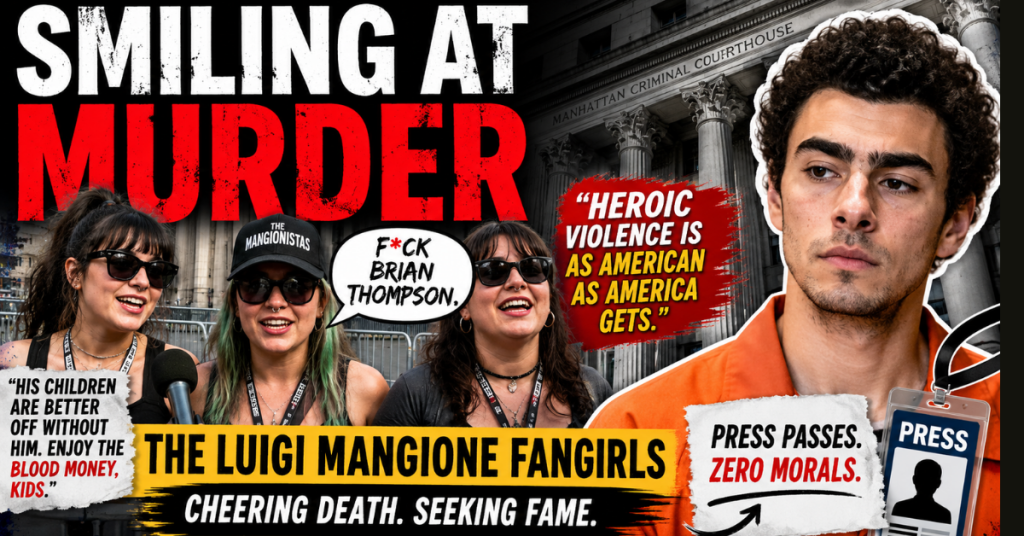
There was a time when publicly celebrating assassination would have ended a career, destroyed a reputation, and horrified polite society. Today, in certain ideological circles, it earns applause, social media engagement, and perhaps even status.
That reality was on full display outside the Manhattan Criminal Courthouse this week, where several self-described supporters of accused killer Luigi Mangione openly celebrated the death of UnitedHealthcare CEO Brian Thompson while speaking to reporters. Mangione is accused of murdering Thompson in December 2024, and his trial has become a bizarre cultural spectacle online.
According to video and reporting from the scene, one woman identifying herself as “Ashley” declared:
“I don’t give a flying fuck he died.”
Another supporter, Lena Weissbrot, claimed Thompson was “responsible for more deaths than Osama Bin Laden,” while suggesting violence can be “heroic.” A third supporter framed political violence as a potential defense of “democracy.”
The rhetoric is ugly enough on its own. But the deeper issue is what it reveals about a growing cultural sickness in parts of modern political discourse.
The Redefinition of Murder
Notice the linguistic maneuver these activists employ.
Brian Thompson is not described as a flawed human being, a controversial executive, or even simply an opponent. Instead, he is transformed into an abstract symbol of “social murder.” Once that label is accepted, actual murder becomes morally rebranded as resistance.
This is the same psychological mechanism that has fueled political extremism throughout history.
First, the target is stripped of humanity.
Then they are blamed for systemic suffering.
Then violence against them becomes framed not as cruelty, but as virtue.
The frightening part is how casually this language is now spoken in public.
Not whispered anonymously online.
Not hidden in extremist manifestos.
Openly. Smiling. With press credentials hanging around their necks.
The Performance of Radicalism
What unfolded outside the courthouse felt less like genuine revolutionary conviction and more like ideological theater.
The women appeared energized by the attention. They interrupted one another excitedly. They smiled while discussing death. They posed as brave truth-tellers confronting power.
This is modern performative radicalism in its purest form.
In many online activist spaces, outrage functions as social currency. The more extreme the statement, the greater the reward from the in-group. Approval comes through reposts, likes, praise, and viral attention.
The result is a culture where moral restraint becomes weakness, while cruelty masquerades as courage.
The supporters reportedly operate an Instagram account called “The Mangionistas,” dedicated to promoting Mangione and celebrating his case online.
This is not merely political disagreement anymore. It increasingly resembles fandom culture merging with revolutionary aesthetics.
“Heroic Violence” and Selective Morality
One of the most revealing comments came when Weissbrot argued Americans already celebrate “heroic violence,” referencing the killing of Osama bin Laden.
But this comparison collapses instantly under scrutiny.
Osama bin Laden orchestrated the murder of nearly 3,000 Americans in the September 11 terrorist attacks. Brian Thompson was a healthcare executive whose critics objected to the American insurance system and corporate healthcare practices.
To equate the two requires an ideological worldview where institutional frustration justifies personal annihilation.
That is an extraordinarily dangerous threshold for a society to cross.
Once individuals begin deciding that political anger morally authorizes assassination, civilization itself starts to fracture. Every grievance becomes a potential justification for bloodshed.
The Psychology Behind It
Perhaps the most disturbing aspect is how emotionally detached these statements appeared from the reality of death itself.
Brian Thompson was not merely a symbol.
He was a husband.
A father.
A human being with children who now live without him.
Yet some online circles increasingly train people to think in abstractions instead of humanity. Entire moral frameworks become organized around systems, oppressors, structures, and ideological categories rather than actual individuals.
Under that mindset, empathy becomes conditional.
If someone belongs to the “wrong” category, compassion is suspended.
History shows where this road leads.
Every revolutionary movement that normalized political violence began by convincing ordinary people that certain lives mattered less.
America’s Growing Appetite for Destruction
What makes this moment uniquely unsettling is that the rhetoric no longer feels fringe.
Political violence is increasingly flirted with rhetorically across parts of American culture. Assassination attempts, riots, extremist manifestos, online death celebrations, and ideological dehumanization are becoming disturbingly normalized.
And often, it is disguised beneath the language of compassion, justice, or liberation.
But societies cannot survive once murder becomes morally fashionable.
Civilization depends on the principle that political disagreement does not justify killing. Once that principle erodes, the only remaining currency is force.
That is not progress.
That is regression into tribal barbarism wearing the costume of moral enlightenment.