



Cuba Denies Drone Threat as U.S. Tensions Rise
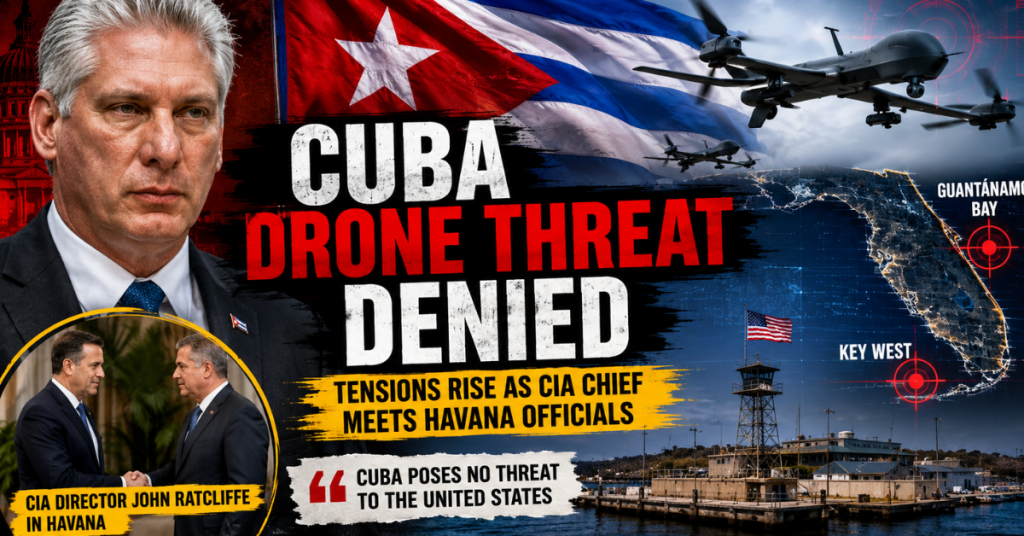
Cuba is denying claims that it has acquired hundreds of military drones and discussed possible strikes against U.S. targets, including Guantánamo Bay and Key West, Florida. The allegations, first reported by Axios and amplified by multiple outlets, have triggered a sharp response from Havana and renewed fears that the long-frozen U.S.-Cuba conflict could move into a more dangerous phase.
Cuban President Miguel Díaz-Canel Bermúdez responded Monday by insisting that Cuba “poses no threat” and has no aggressive plans against any nation, including the United States. He did not directly address the reported drones, but he framed the allegations as part of a broader campaign to justify pressure or possible military action against the island.
The report comes at a moment of severe instability inside Cuba. The island is facing crippling energy shortages, fuel scarcity, long blackouts, food stress, and public frustration. Reuters reported that protests erupted in Havana as power cuts deepened, while Cuban officials said the grid was in a critical state amid fuel shortages.
Ratcliffe Visit Adds to Mystery
The timing is especially notable because CIA Director John Ratcliffe reportedly met with Cuban officials in Havana last week. Cuba said the meeting occurred at the request of the U.S. government and that Cuban officials emphasized the island does not threaten U.S. national security. The Guardian reported the visit came as relations between Washington and Havana deteriorated and as Cuba publicly declared it was facing a severe fuel crisis.
A CIA official quoted by Anadolu said Ratcliffe warned that Cuba could no longer serve as a platform for hostile foreign activity in the Western Hemisphere. That statement points to the larger concern behind the drone story: not merely Cuba itself, but the possibility that Russia, Iran, or other U.S. adversaries could use Cuba’s location to pressure American interests close to home.
Havana Calls It a Pretext
Cuban officials have dismissed the drone allegations as fabrication. Foreign Minister Bruno Rodríguez called the claims fraudulent and accused Washington of manufacturing a narrative that could be used to justify aggression. Díaz-Canel warned that any U.S. military action against Cuba would have grave consequences, while also asserting Cuba’s right to defend itself.
That is the central tension. Washington sees drones, foreign influence, and proximity to Florida. Havana sees sanctions, energy strangulation, and a possible pretext for intervention.
The Cuba drone threat story is therefore not just about drones. It is about whether U.S. intelligence is identifying a real emerging military risk or whether the claim is being used to escalate pressure against a weakened island government.
A Crisis With No Margin for Error
Cuba’s internal collapse makes the situation more volatile. Reuters reported earlier this year that Venezuela has supplied roughly half of Cuba’s oil deficit, while U.S. pressure on Venezuela has intensified fuel shortages. More recently, Russia supplied fuel that offered only short-term relief, reportedly meeting just a fraction of Cuba’s monthly demand.
Meanwhile, an aid ship from Mexico and Uruguay arrived in Havana with food and hygiene supplies as the humanitarian situation worsened.
That makes the stakes unusually high. A desperate Cuba, a suspicious Washington, and foreign powers looking for leverage are a dangerous combination. If the drone allegations are accurate, the U.S. has reason to be alarmed. If they are exaggerated or politically framed, they could become the kind of spark that turns an intelligence dispute into a military crisis.
For now, Cuba denies the Cuba drone threat claims. The United States has not publicly released evidence. And 90 miles from Florida, one of America’s oldest adversaries is again at the center of a confrontation where secrecy, drones, energy collapse, and geopolitics are all colliding.
Subscribe to DailyClout so you never miss an update!