



Fauci Could Still Face Legal Trouble Despite Pardon Debate
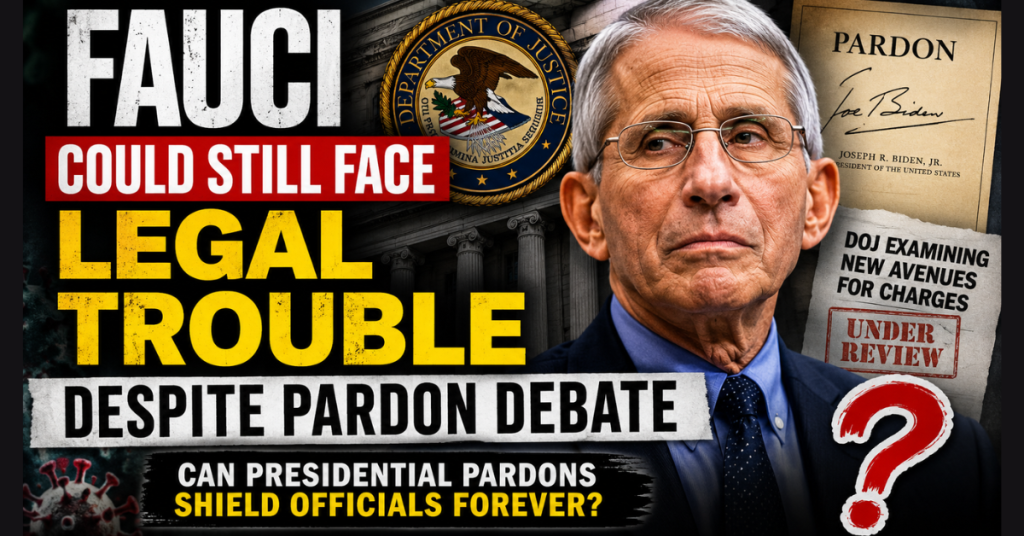
Dr. Anthony Fauci may have survived one major legal deadline, but the political and legal battle surrounding the government’s COVID-era decisions is far from over.
In recent weeks, reports have emerged that officials inside the Department of Justice are still examining possible avenues for criminal charges tied to congressional testimony, federal records handling, and pandemic-era communications involving gain-of-function research tied to Wuhan, China.
The renewed scrutiny comes after the indictment of Fauci’s former adviser, Dr. David Morens, who was charged with allegedly concealing and destroying federal records connected to COVID-19 research communications. Prosecutors claim Morens used private email accounts to evade Freedom of Information Act requests and obscure discussions related to controversial coronavirus research grants.
While Fauci himself has not been charged with any crime and continues to deny wrongdoing, the Morens case has reignited questions about transparency during the pandemic and whether top officials intentionally concealed information from Congress and the public.
At the center of the controversy is Fauci’s repeated testimony before Congress that the NIH did not fund gain-of-function research at the Wuhan Institute of Virology. Critics, including Rand Paul, argue later disclosures and internal emails contradicted those claims. Paul first referred Fauci to the DOJ for possible criminal investigation in 2023 and renewed those efforts again in 2025.
The statute of limitations on some of the most widely discussed allegations reportedly expired this week, particularly those connected to Fauci’s May 2021 Senate testimony. However, reports indicate DOJ officials may still be exploring newer or separate allegations tied to later testimony, private email usage, conspiracy claims, or federal records violations.
Complicating matters further is the continuing debate over former President Joe Biden allegedly issuing a broad preemptive pardon covering Fauci before leaving office. Critics of the pardon argue that even if federal protection exists, it would not shield anyone from potential state-level investigations. Others are questioning whether a pardon signed via autopen could face legal challenges, though constitutional scholars remain divided on that issue.
The broader issue extends far beyond Fauci himself.
For millions of Americans, the COVID era shattered public trust in government institutions, scientific agencies, and legacy media. Questions surrounding lockdowns, vaccine mandates, censorship of dissenting views, and the origins of the virus have only intensified demands for accountability.
Even some mainstream outlets now acknowledge that the once-dismissed lab leak theory has become a legitimate area of inquiry. Congressional investigations and government reports have increasingly pointed toward the possibility that a lab-related incident in Wuhan may have played a role in the outbreak.
That is why this debate is no longer simply about whether Fauci faces prosecution.
It is about whether presidential pardons can permanently place powerful officials beyond public accountability.
The Constitution grants presidents sweeping pardon powers for federal crimes, but pardons do not erase public scrutiny, congressional investigations, or historical judgment. They also cannot prevent state prosecutions or civil litigation in certain circumstances.
Legal experts note that the pardon power was designed to offer mercy, not necessarily immunity from public examination. Critics argue that using pardons preemptively for officials who were never formally charged risks creating the appearance of a protected political class.
Supporters of Fauci, meanwhile, maintain that he became a political scapegoat during a deeply chaotic global crisis. They argue there is no evidence he intentionally misled the public and warn that criminalizing scientific disagreements could have chilling effects on future public health leadership.
Regardless of where the investigations lead, one reality remains clear: the public appetite for answers about the origins of COVID-19 and the government’s handling of the pandemic has not disappeared.
And neither has the debate over whether accountability for powerful officials should ever have an expiration date.