



Could Hantavirus Become the Blueprint for Another Global Shutdown?
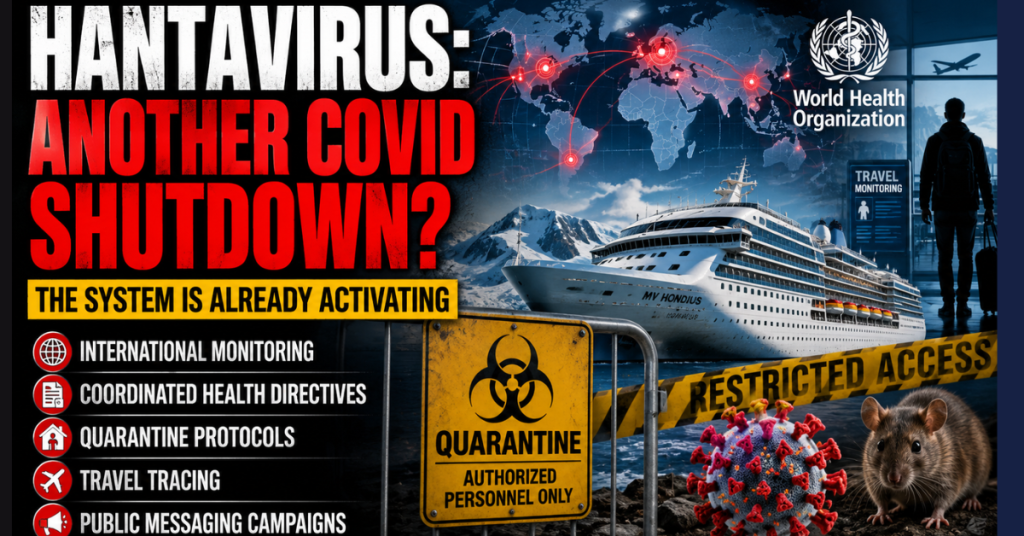
A hantavirus outbreak tied to an Antarctic cruise ship is once again exposing how quickly the infrastructure of global emergency response can spring back into action.
Health authorities insist this is not another COVID-19 scenario. And scientifically, they may be right. Hantavirus spreads very differently, and current officials say the public risk remains low. (who.int)
But for millions of people who lived through lockdowns, mandates, censorship battles, and sweeping emergency powers, the deeper concern is no longer just the virus itself.
It is the system surrounding it.
Because within days of the outbreak emerging, the familiar machinery of international pandemic-era governance was already visibly reactivating.
International Monitoring Is Already Underway
The World Health Organization issued a formal international outbreak notice and began coordinating directly with multiple governments regarding exposed travelers and response protocols. (who.int)
Passengers from the cruise ship are now being tracked across borders as officials attempt to reconstruct travel histories, exposure windows, and contact chains. (theguardian.com)
During COVID, this kind of international monitoring became normalized almost overnight.
Now many are asking: was it temporary — or permanent?
Coordinated Health Directives Are Returning
Health agencies across multiple countries rapidly aligned around shared response guidance, including monitoring periods, exposure definitions, isolation recommendations, and public communication strategies. (reuters.com)
That level of synchronized international coordination would have seemed extraordinary before 2020.
Today, it appears almost automatic.
Critics argue this reflects the emergence of a new global health governance model where international agencies increasingly shape domestic emergency responses long before elected legislatures become involved.
Quarantine Protocols Reappeared Almost Immediately
American passengers were transported under medical supervision and placed into quarantine monitoring after returning to the United States. (theguardian.com)
The WHO reportedly recommended a 42-day monitoring period for exposed individuals. (theguardian.com)
Again, officials maintain these measures are precautionary.
But for many citizens, quarantine systems no longer feel like extraordinary emergency tools. They feel institutionalized.
COVID transformed quarantine from a targeted medical practice into a normalized feature of governance, travel, employment, and public life.
And now the public is seeing those systems activate again with remarkable speed.
Travel Tracing Infrastructure Never Really Disappeared
Authorities are now engaged in extensive passenger tracing operations involving multiple countries and transit routes. (theguardian.com)
That includes:
- reconstructing travel itineraries
- identifying passenger contacts
- coordinating airline and border information
- tracking post-disembarkation movement
Much of this infrastructure was dramatically expanded during COVID.
At the time, governments insisted such systems were temporary emergency necessities.
Now critics argue they became permanent capabilities waiting for the next trigger event.
Public Messaging Campaigns Are Already Shaping Perception
Even before widespread transmission evidence exists, public messaging efforts are carefully emphasizing vigilance, surveillance, symptom monitoring, and compliance with health guidance. (who.int)
Officials simultaneously insist there is no cause for panic while activating many of the same communication structures seen during the early COVID years.
That contradiction is exactly what many skeptics now notice immediately.
Because after COVID, public trust in institutional messaging collapsed across large sections of the population.
Many citizens no longer separate:
- legitimate public health response
from - the political and social machinery that accompanied it
The Virus May Be Contained — But the System Remains
Scientifically, hantavirus may never become anything remotely resembling COVID-19.
But politically and institutionally, the response is revealing something larger:
The architecture for rapid global emergency coordination is no longer theoretical.
It already exists.
It is operational.
And it can be reactivated extremely quickly.
For supporters, that represents preparedness.
For critics, it represents the normalization of permanent emergency governance.