



The mRNA Debate Is No Longer Fringe
Just a few years ago, questioning mRNA vaccines in public life could get someone labeled “anti-science,” removed from social media platforms, or professionally marginalized. During the height of the COVID-19 pandemic, skepticism toward vaccine mandates or concerns about long-term safety data were often dismissed outright by much of the media and public health establishment.
That has changed dramatically.
Today, skepticism surrounding mRNA technology and public health institutions is no longer confined to political outsiders or fringe internet communities. Poll after poll now shows declining trust in federal health agencies, growing concern about vaccine guidance, and increasing public frustration over how COVID-era policies were handled.
The shift is happening across political lines.
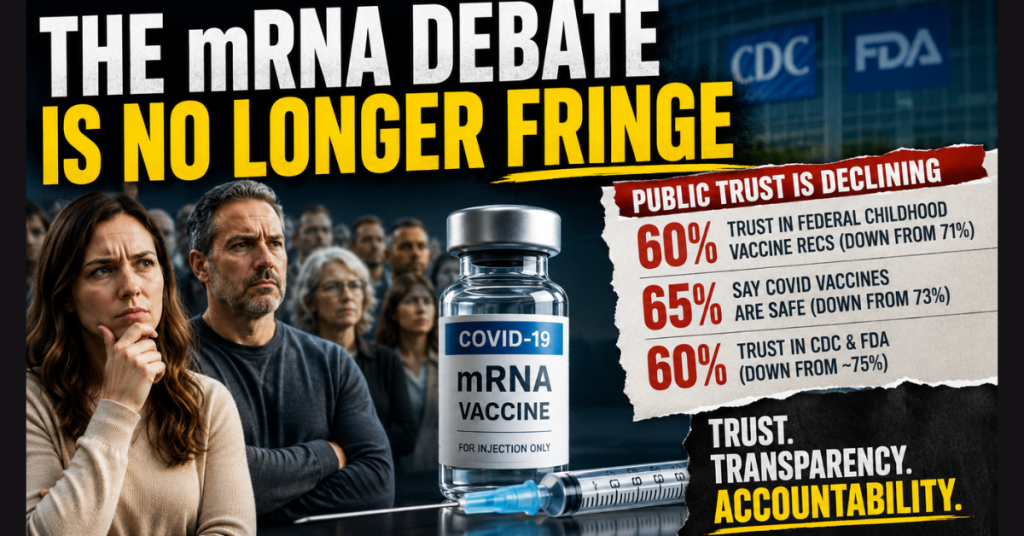
A recent Axios/Ipsos American Health Index poll found that public trust in federal childhood vaccine recommendations dropped from 71% in June 2025 to just 60% by March 2026. Among Democrats, trust fell from 81% to 66%. Independents dropped from 65% to 58%, while Republicans declined from 69% to 63%.
That is a remarkable collapse in confidence in less than a year.
The same survey found that only 8% of Americans now trust the CDC more than the American Academy of Pediatrics when it comes to vaccine guidance. Meanwhile, 35% said they trust the AAP more than federal agencies, while 16% said they trust neither.
Another survey from the University of Pennsylvania’s Annenberg Public Policy Center found that confidence in the safety of COVID-19 vaccines has continued to erode over time. In August 2022, 73% of Americans viewed the COVID vaccine as safe. By late 2025, that number had fallen to 65%.
The same study found declines in confidence even for long-established vaccines like MMR and flu shots, suggesting the broader issue is not merely about one product or one administration, but about institutional credibility itself.
Public trust in agencies like the CDC and FDA has also sharply deteriorated.
A University of Pennsylvania survey reported that trust in major federal health agencies fell from roughly 75% in 2024 to around 60% in 2026. While 67% of Americans still expressed confidence in career scientists within those agencies, only 43% said they trusted agency leadership.
That distinction matters.
Americans increasingly appear willing to trust individual doctors, researchers, and scientists while simultaneously distrusting the bureaucratic and political systems surrounding them. In fact, the same survey found that 86% of Americans still trust their own healthcare providers more than federal agencies or political appointees.
The reasons for this collapse in trust are not difficult to identify.
For years, Americans watched shifting public guidance on masks, lockdowns, vaccine mandates, boosters, natural immunity, school closures, and censorship policies. Social media platforms aggressively suppressed dissenting opinions during the pandemic, only for some previously censored positions to later enter mainstream discussion.
Many Americans now feel they were pressured rather than persuaded.
Others believe pharmaceutical companies wielded excessive influence over public health messaging, especially given the enormous financial stakes surrounding COVID-era vaccine contracts. Meanwhile, concerns about transparency, adverse event reporting, and long-term data collection continue fueling public suspicion.
Even among people who support vaccines generally, there is increasing discomfort with the idea that questioning pharmaceutical products should ever be treated as socially taboo.
The political consequences are becoming impossible to ignore.
What began as skepticism from portions of the political right has increasingly spread into independents, moderates, and even traditionally pro-establishment voters. The debate has evolved from “Are vaccines effective?” into something much larger:
Can Americans still trust the institutions managing public health?
That may ultimately become one of the defining political and cultural questions of the post-COVID era.