



“250 Years Later, the Battle of Brooklyn Comes Alive Again”
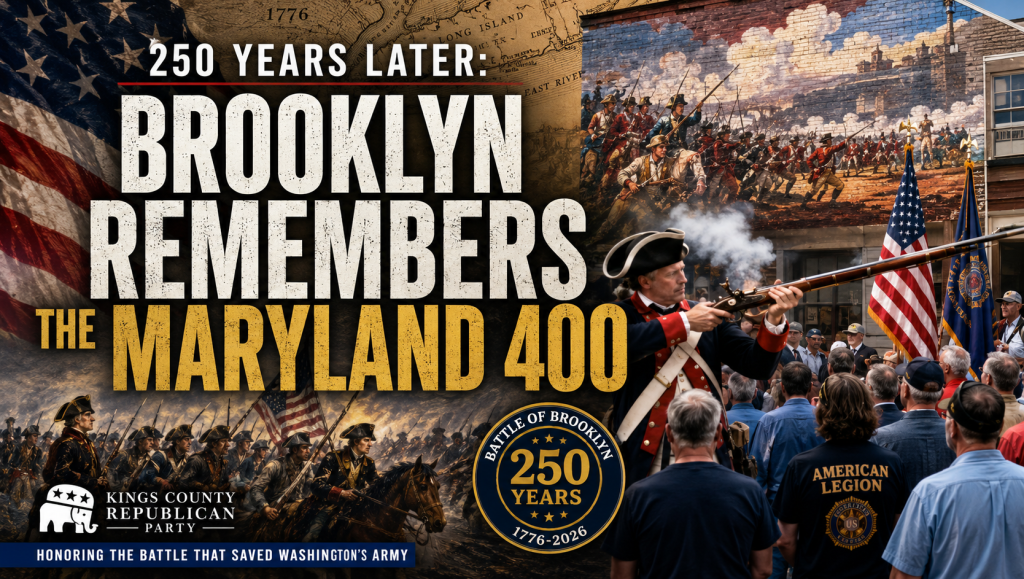
On historic Brooklyn ground, patriots, veterans, historians, elected officials, candidates and Republican activists gathered to remember the Maryland 400 and the desperate fight that helped save George Washington’s army.
The rain threatened to spoil a barbecue. It couldn’t wash away 250 years of American history – yet the rain held up for the celebration and dry skies prevailed.
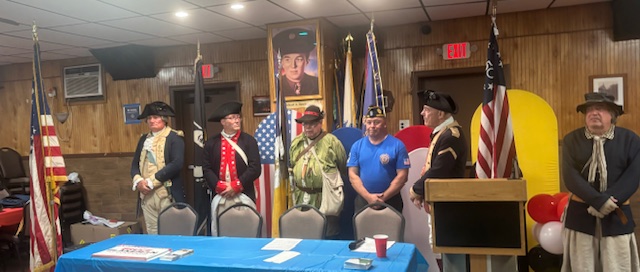
On August 27, 2026 — exactly 250 years after the Battle of Brooklyn began — Brooklyn Republicans, veterans, historians and patriots gathered at Michael A. Rawley Jr. American Legion Post 1636 in Gowanus for an evening that was about far more than food and fellowship.
It was a journey back to 1776.
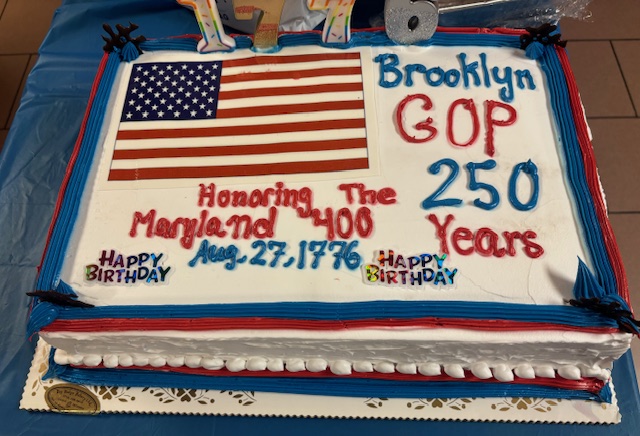
Hosted by the Kings County Republican Party, under Chairman Liam McCabe, the gathering brought together Republican leaders, candidates, elected officials and members of the DJT Club with president Jimmy Wagner and Community First Republican Club led by Ari Kagan, all coming together to mark the 250th anniversary of one of the most important battles ever fought on American soil.
And there could hardly have been a more appropriate place.
The Legion stands on historic ground associated with the Maryland 400 — the legendary Continental soldiers who made a desperate stand against overwhelming British and Hessian forces during the Battle of Long Island, also known as the Battle of Brooklyn.
Two hundred and fifty years earlier, George Washington’s army was trapped.
British forces had landed on Long Island in overwhelming numbers and moved to outflank the American defenses through Jamaica Pass. As the British advance swept across Brooklyn, American troops desperately tried to slow the attack.
Near the Old Stone House, General William Alexander, known as Lord Stirling, and his Maryland soldiers repeatedly attacked the advancing British forces.
The Marylanders knew what they were facing. They charged anyway.
Their bayonets bought precious time for thousands of American soldiers to retreat toward the defenses at Brooklyn Heights and eventually escape across the East River. Hundreds of Maryland soldiers were killed, wounded or captured.
The British won the battlefield. But Washington saved his army. That escape would prove critical to the survival of the American Revolution.
Historian Patrick K. O’Donnell brought the story to life during the evening, explaining how the British maneuvered around the American lines, how the Marylanders made their repeated charges and how their sacrifice became a crucial rear-guard action. His research into the Maryland regiment eventually became the book Washington’s Immortals, chronicling the soldiers whose sacrifice helped prevent Washington’s army from being crushed.
Then history became almost theatrical.
Patriots dressed in Revolutionary-era clothing circulated among the crowd, including a reenactor portraying General George Washington. For a moment, the modern city seemed to fade away.
But perhaps the most memorable part came when the crowd went outside and into the Legion’s backyard.
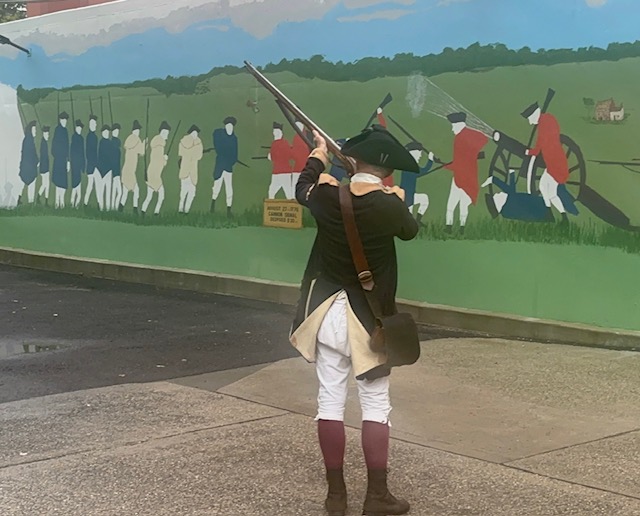
There, painted across the exterior wall of the building, was a dramatic mural depicting the Battle of Brooklyn — a fitting backdrop for an evening devoted to remembering the men who fought and died on the very ground beneath Brooklyn’s modern streets.
The crowd was then treated to a live demonstration by a Revolutionary War soldier in period uniform.
The reenactor didn’t simply fire a musket. He demonstrated the disciplined military procedure behind it — loading the weapon, preparing it for firing, bringing it into position, firing and then lowering and resetting it as a soldier of the Continental era would have done.
What might sound simple on paper was anything but simple in practice.
Watching the drill unfold made the reality of 1776 tangible. These were not soldiers with modern rifles or rapid-fire weapons. Every shot required a deliberate sequence of movements, discipline and courage — often while standing in formation and facing an enemy firing back.
It was history you could hear, see and almost smell.
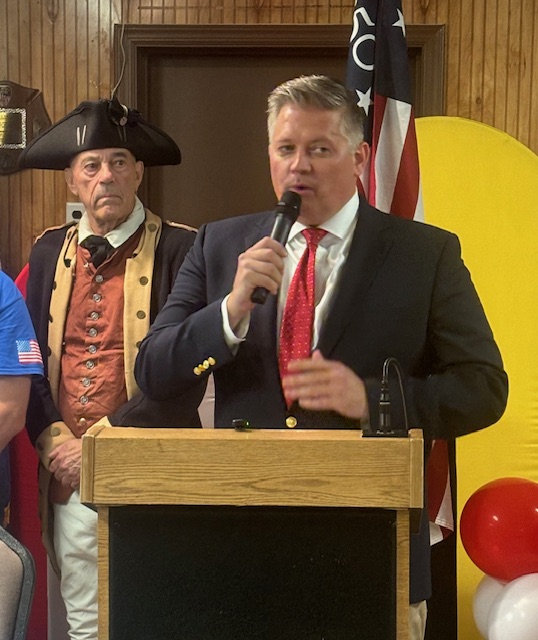
Inside, David Nelson, president of the Battle of Brooklyn Chapter of the Sons of the American Revolution, spoke about the men whose sacrifice has been remembered by generations. The nearby burial grounds, he noted, are a reminder that some of those who fought here never received the kind of graves or monuments that later generations might expect.
Christopher Hardy, commander of American Legion Post 1636 and a retired Air Force lieutenant colonel, helped connect that Revolutionary sacrifice with the mission of today’s veterans organization: remembering those who served and ensuring their sacrifices are not forgotten.
Norman Gobin, whose family connection reaches back to the Battle of Brooklyn, was also among those present, adding another personal link between the men of 1776 and Brooklyn today.
The evening also featured remarks from State Senator Steve Chan, a U.S. Marine veteran and former NYPD officer, Assemblymen Alec Brook-Krasny, Michael Novakhov and Lester Chang, along with Republican Attorney General candidate Saritha Komatireddy.
Republican candidates Norman “Sayf” Ramsay, running for State Assembly, and Melvin Rivera, a congressional candidate, also addressed the gathering. Both spoke about their communities, their reasons for entering public life and the importance of standing up for the principles they believe in. Other candidates such at Tom Stanten, who’s district the event took place, and Ronald Seifort – both vying for NYS Senate seats in their respective districts.
Yet politics ultimately took a back seat to history.
As the evening unfolded — from the barbecue, to the speeches, to the Revolutionary uniforms, to the mural and the crack of a musket in the backyard — the Maryland 400 stopped being names in a history book.
They became men. Men who stood their ground when retreat was the only realistic option. Men who understood that their sacrifice might give their fellow soldiers one more hour, one more mile, one more chance to escape.
The Battle of Brooklyn was a defeat for the American forces. But the Revolution did not end there. Washington lived to fight another day. And America lived to become America – the greatest experiment in government by the people and for the people endures.
Two hundred and fifty years later, on the same Brooklyn soil, a new generation gathered to remember. The battle is over. The memory isn’t. Yet, other new present-day battles loom large in order to preserve this republic for another 250 years.
And on this night, with American flags flying, veterans and patriots gathered, Revolutionary soldiers walking among the crowd, and a musket echoing against a mural depicting the battle itself, 1776 was alive again in Brooklyn.
Subscribe to DailyClout so you never miss an update!
One of our country’s most important freedoms is that of free speech.
Agree with this essay? Disagree? Join the debate by writing to DailyClout HERE.