


American Universities Have a Free Speech Problem
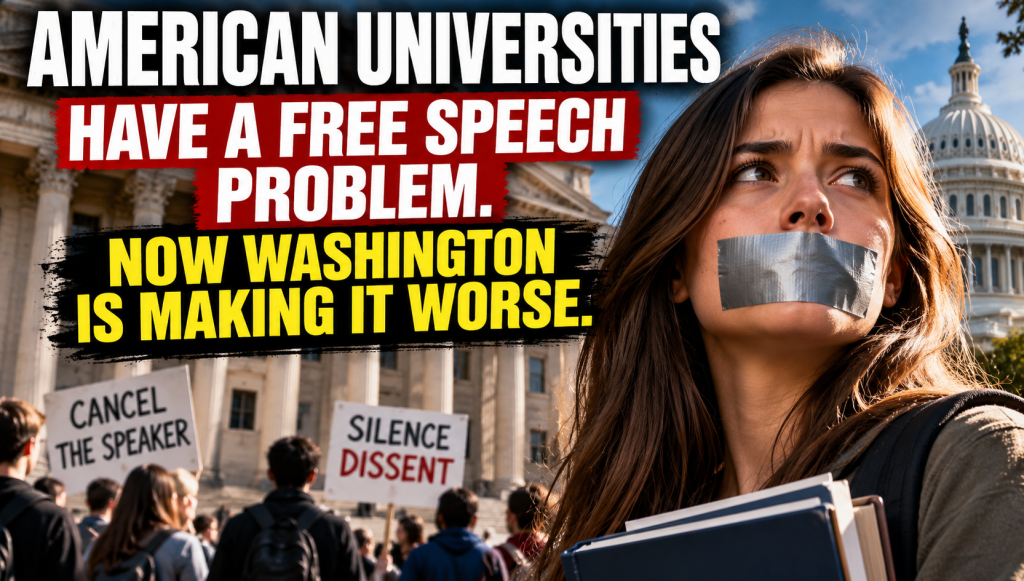
More than 200 attempts to silence campus speakers have been recorded in 2026, and a growing number are coming from the very politicians who once condemned censorship.
American universities have spent much of the past decade insisting that their free speech problem was exaggerated. Conservative students complained of ideological discrimination. Visiting speakers were shouted down, professors faced disciplinary investigations over controversial remarks, and administrators developed an extraordinary vocabulary for explaining why certain opinions were simply too dangerous to be heard. The response from university leadership was frequently the same: These were isolated incidents, not evidence of a broader institutional problem.
The latest figures from the Foundation for Individual Rights and Expression (FIRE) suggest otherwise. And they contain an uncomfortable revelation for both sides of the political aisle.
According to FIRE, more than 200 attempts to prevent invited speakers from appearing on college campuses have been recorded in 2026, surpassing the previous annual record with months still remaining in the year. In an October 29 Washington Post opinion piece, FIRE President Greg Lukianoff described a censorship problem that has not merely survived years of public criticism but has acquired a new and increasingly powerful set of participants: elected officials and government appointees.
For years, the most effective campaigns to suppress campus speech generally originated on the political left. Today, according to FIRE’s figures, attempts coming from the political right outnumber those from the left.
The irony is considerable. Conservatives who spent years demanding that universities respect the First Amendment are increasingly discovering the attractions of censorship when the offending speaker happens to be a political opponent.
A Record Year for Campus Censorship
FIRE’s research documents 96 attempts to suppress campus expression coming from the political right so far in 2026, compared with 74 from the left. The previous year produced an even wider disparity, with 116 attempts from the right and 64 from the left.
These figures measure the political direction of censorship attempts relative to the expression being targeted, rather than simply the party affiliations of those involved. They also represent attempts, not necessarily successful cancellations.
Nevertheless, the trend is striking.
For much of the preceding decade, conservatives had good reason to regard American higher education as an inhospitable environment for dissent. Faculty political affiliations leaned overwhelmingly Democratic, and university administrations frequently adopted the language and priorities of progressive campus activism.
Conservative speakers faced protests and disinvitation campaigns, while students expressing unpopular positions on abortion, immigration, race, and gender sometimes encountered administrative investigations or demands for punishment.
These controversies were not imaginary. Nor were they rendered harmless simply because university administrators preferred to describe them as efforts to maintain an inclusive learning environment.
But the principle at stake was never supposed to be that conservatives deserved protection from censorship while progressives did not. It was that universities should not punish protected expression merely because someone finds it objectionable.
That distinction appears to have become considerably less fashionable now that conservatives possess greater political leverage over higher education.
When Politicians Become the Censors
The most troubling development in FIRE’s findings is not simply the number of attempted cancellations. It is the growing involvement of government officials.
Between 1998 and 2022, politicians and government appointees were involved in no more than five recorded campus deplatforming attempts in any single year.
That figure rose to 19 in 2023 and reached 33 in 2025. The pace in 2026 has remained similarly elevated.
Even more revealing is the increasing success of these interventions.
During 2023 and 2024, campaigns involving politicians or government appointees succeeded in six of 30 recorded cases. During 2025 and 2026, they succeeded in 37 of 59 cases.
In other words, the success rate climbed from 20 percent to nearly 63 percent.
The distinction between an angry student protest and pressure from an elected official should be obvious. Students can demand that a speaker be disinvited. They can organize demonstrations, publish criticism, and express their disgust. Those activities are themselves generally protected forms of expression.
A government official, however, may possess authority over university budgets, investigations, and public funding. When that official demands that a speaker be silenced, the request can carry consequences extending far beyond public embarrassment.
The danger is not merely that politicians dislike certain opinions. Politicians have always disliked certain opinions. The danger arises when their official power becomes a means of discouraging universities from permitting lawful speech.
The Hasan Piker Controversy
One of the clearest examples involves left-wing political commentator Hasan Piker.
Piker has attracted substantial criticism for his statements about Israel, terrorism, and American foreign policy. His political views are frequently provocative, and many conservatives consider them deeply objectionable.
But whether those opinions are objectionable is not the relevant constitutional question.
In August, the University of Washington canceled a scheduled appearance by Piker. University officials attributed the decision to problems with the event’s planning process. Subsequent reporting revealed that at least two state lawmakers had contacted the university to express objections to his appearance.
Those facts do not, by themselves, establish that lawmakers caused the cancellation. They do, however, raise legitimate questions about whether political pressure influenced the university’s decision.
A separate controversy followed at the University of Texas at Austin, where Republican Governor Greg Abbott objected to another planned Piker appearance. That event proceeded, but the student organization hosting it faced more than $17,000 in security fees.
Security costs can be legitimate. Universities have obligations to protect speakers and audiences alike. But when the expense of hosting a controversial speaker becomes prohibitive, financial requirements can function as an effective barrier to expression, regardless of whether censorship was the stated intention.
The proper test of a commitment to free speech is not whether one agrees with Piker. It is whether one believes that a university should permit him to speak despite profound disagreement with his views.
The same standard must apply to conservative speakers, religious traditionalists, critics of progressive ideology, and anyone else whose opinions offend the prevailing campus consensus.
Otherwise, free speech becomes little more than a temporary privilege granted to whichever political faction happens to control the institution.
Universities Helped Create This Problem
It would be convenient to blame the current situation entirely on Washington. It would also overlook the role universities played in creating it.
For years, college administrators treated the emotional reactions of students and faculty as sufficient grounds for investigating or restricting controversial expression.
Disagreement was increasingly described as harm. Offense became evidence of an unsafe environment. University bureaucracies expanded their authority to determine which opinions were appropriate for academic discussion.
The consequences extended beyond canceled lectures.
Students learned that expressing an unpopular opinion could produce formal complaints, social isolation, or disciplinary scrutiny. Faculty members learned that controversial research or political commentary might endanger their professional standing.
In many institutions, the safest intellectual position was simply to remain silent.
This was a remarkable development for organizations whose stated purpose is the pursuit of knowledge.
A university is not supposed to guarantee that its students will never encounter an offensive argument. It is supposed to teach them how to evaluate arguments, distinguish evidence from assertion, and defend their conclusions against serious criticism.
Those skills cannot develop in an environment where administrators routinely intervene to protect students from intellectual discomfort.
The present political backlash was therefore not entirely unpredictable.
When universities repeatedly demonstrated that speech could be restricted in response to ideological pressure, they helped establish a precedent that other political factions would eventually exploit.
The people demanding censorship have changed. The administrative machinery remains largely intact.
The Free Speech Crisis Is Bigger Than One Party
FIRE’s 2027 College Free Speech Rankings offer additional evidence of the problem.
The organization surveyed nearly 63,000 students across 261 institutions. Of those schools, 121 received an F for their campus speech climate. Only 24 received a C or higher.
The University of Chicago ranked first, while New York University finished last.
The findings suggest a problem that cannot be adequately explained by the actions of a few unusually intolerant students or administrators.
It is also worth recognizing that not every effort to prevent a campus appearance succeeds.
Harvard University rejected demands to disinvite New York Times columnist Nicholas Kristof following controversy over his reporting about allegations involving Israeli soldiers and Palestinian detainees.
At Utah Valley University, administrators allowed a memorial event honoring Charlie Kirk to proceed despite opposition from a student organization.
And at the University of Chicago, administrators reversed an initial venue cancellation affecting an event featuring Tim Pool and Jack Posobiec.
These cases matter because they demonstrate that universities are capable of resisting pressure when their leadership chooses to do so.
The question is why such resistance is not more consistent.
A genuinely principled university should not need to determine whether a controversial speaker belongs to the political left or right before deciding whether that person deserves an audience.
Nor should it confuse the right to protest a speaker with the right to prevent everyone else from hearing that speaker.
There is an important legal distinction here. Public universities are generally bound by the First Amendment, while private universities are governed by their own commitments, contracts, and applicable laws. Universities may also impose legitimate, viewpoint-neutral rules governing events and conduct. Free speech does not protect threats, violence, or every form of disruption.
But those qualifications do not justify suppressing lawful expression simply because an administrator, donor, student activist, or politician finds it offensive.
Washington Cannot Fix Censorship by Practicing It
There is a legitimate debate to be had about ideological discrimination in higher education, the use of taxpayer money, and whether universities have honored their obligations to students.
Public officials have every right to investigate unlawful discrimination, criticize university leadership, and demand accountability for the expenditure of public funds.
They do not acquire the right to suppress constitutionally protected expression merely because they believe universities have previously mistreated their political allies.
Indeed, doing so risks confirming the very argument that campus censorship critics have made for years: that speech restrictions are less about protecting students than about preserving the power of those who administer them.
The appropriate response to decades of ideological conformity is not a new system of ideological conformity.
It is to dismantle the mechanisms that made such conformity possible.
Universities should establish clear protections for academic freedom, apply viewpoint-neutral rules to campus events, and refuse to punish students or faculty merely for expressing unpopular political opinions.
They should also make clear that invited speakers cannot be silenced simply because an organized group threatens disruption.
Above all, they should resist political demands to restrict lawful expression, regardless of whether those demands come from progressive activists, conservative legislators, wealthy donors, or federal officials.
The alternative is a university system in which intellectual freedom depends on the outcome of the most recent election.
That is a poor foundation for higher education and an even worse one for a constitutional republic.
The tragedy is that American universities have had years to address this problem. Instead, too many administrators treated censorship as a manageable instrument of institutional governance, useful so long as it was employed against the correct people.
Now that instrument is increasingly being wielded by political actors outside the university.
And the administrators who once defended their authority to police speech are discovering what happens when someone more powerful decides to exercise the same authority over them.
The lesson should not be difficult to understand.
A society that protects only agreeable speech has no meaningful commitment to free expression. It merely has a changing list of approved opinions.
American universities helped normalize that distinction. Washington now appears increasingly willing to exploit it.
Neither has done the country any favors.
Sources
- Greg Lukianoff, Universities Normalized Attacks on Free Speech. Now It’s All-Out War, The Washington Post, October 29, 2026.
- Sean Stevens, Campus Deplatformings Hit Record High, Foundation for Individual Rights and Expression, October 14, 2026.
- FIRE, 2027 College Free Speech Rankings, September 9, 2026.