



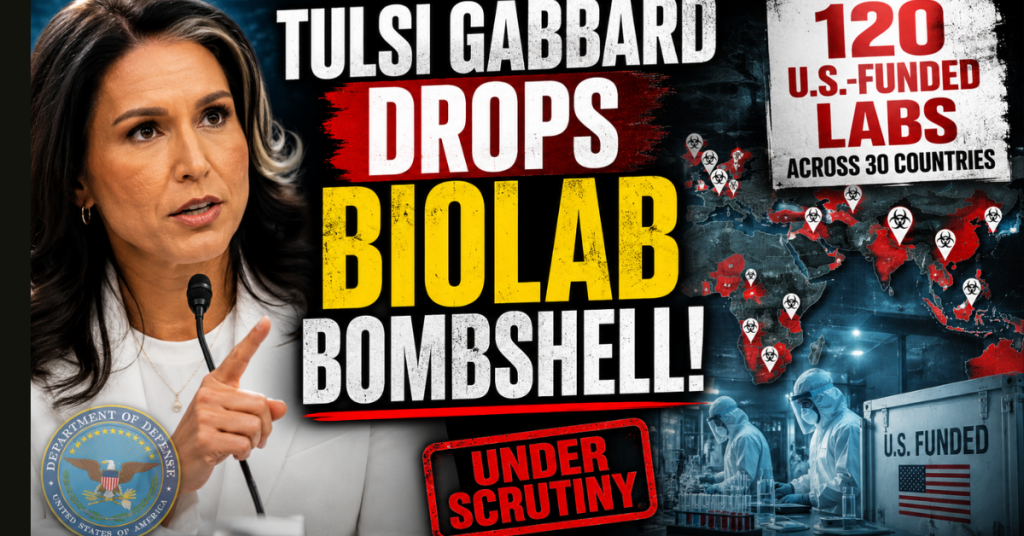
120 U.S.-Funded Labs Across 30 Countries Under Scrutiny
For years, Americans were told there was nothing to see.
Questions about overseas biolabs were dismissed as conspiracy theories. Concerns about gain-of-function research were brushed aside. Anyone who asked uncomfortable questions risked being labeled a crank, a propagandist, or worse.
Now the Director of National Intelligence is saying the federal government funded more than 120 biological laboratories in over 30 countries — and she’s releasing documents to prove it.
The announcement from DNI Tulsi Gabbard is reigniting one of the most controversial debates to emerge from the COVID era: How much dangerous biological research has the U.S. government been funding overseas, and why were Americans kept in the dark?
The Question Isn’t Whether the Labs Exist
One of the most significant aspects of Gabbard’s announcement is that it shifts the debate.
The question is no longer whether U.S.-funded biological laboratories exist overseas.
According to the newly released intelligence documents, they do. The ODNI says more than 120 facilities received U.S. funding and support, including laboratories in Ukraine and other foreign countries.
The real questions now are:
What pathogens were being studied?
What research was being conducted?
Who approved it?
And what oversight existed to ensure safety?
Those are questions many Americans have been asking since the COVID-19 pandemic exposed how catastrophic laboratory accidents or poorly supervised pathogen research could become.
Ukraine Back in the Spotlight
The most politically explosive portion of the release involves Ukraine.
According to the ODNI, intelligence assessments previously warned that at least one U.S.-funded laboratory in Ukraine housed dangerous pathogens and could be vulnerable to seizure, attack, or damage due to the ongoing conflict with Russia.
That does not mean the labs were biological weapons facilities.
In fact, many of the laboratories cited by U.S. officials have historically been described as public-health and biological-threat monitoring facilities funded through programs designed to secure dangerous pathogens after the collapse of the Soviet Union.
But Gabbard argues that the public was never given a complete picture of the scope of U.S. involvement.
Gain-of-Function Returns to Center Stage
The release also comes as the Trump administration continues its push against gain-of-function research, a controversial area of science involving experiments that can increase the transmissibility or characteristics of pathogens.
Supporters argue such research can help scientists understand and prepare for future outbreaks.
Critics argue the risks far outweigh the benefits.
Gabbard says the intelligence community will now conduct a broad review of overseas laboratories receiving American funding, including identifying what pathogens are present and what research is taking place.
The effort follows President Trump’s executive order aimed at ending federal support for dangerous gain-of-function research conducted abroad.
Trust Is the Real Issue
Regardless of where Americans stand on gain-of-function research, the deeper issue may be trust.
For years, public health officials insisted Americans should simply trust the experts.
Then came shifting COVID guidance.
Then came disputes over the pandemic’s origins.
Then came revelations that government-funded research programs were more extensive than many people realized.
Now comes confirmation that the federal government supported more than 120 biological laboratories overseas.
The existence of those labs may not prove wrongdoing.
But it does raise a fundamental question:
Why did it take years, intelligence reviews, and newly declassified documents for the American public to learn the full scope of what their government was funding?
That question may prove far more important than any individual laboratory.
And it is a question that is not going away anytime soon.
Subscribe to DailyClout so you never miss an update!