



Xi Warns Trump: Taiwan Could Trigger U.S.-China Conflict
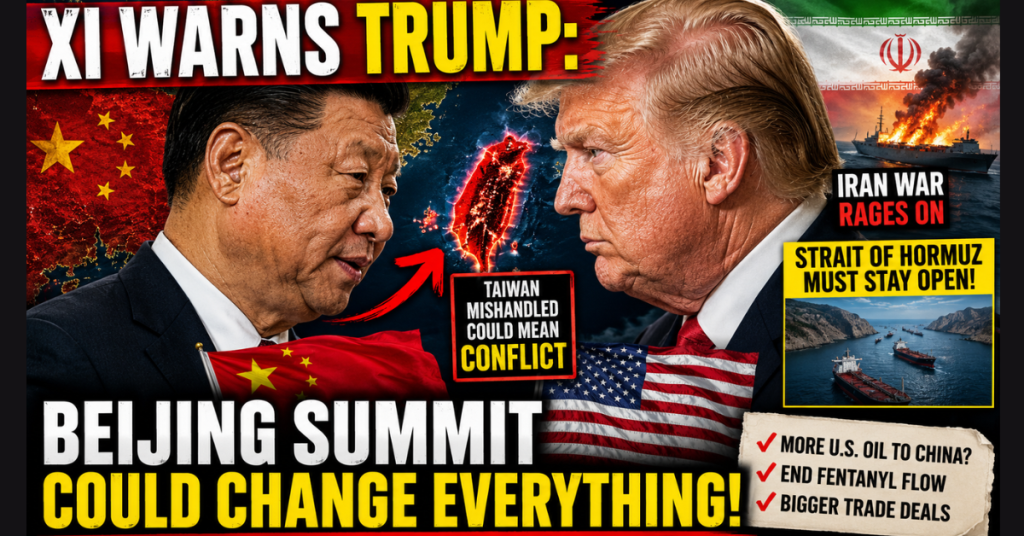
President Donald Trump and Chinese President Xi Jinping emerged from a high-stakes summit in Beijing on Thursday projecting optimism publicly — but behind closed doors, the message from Beijing was far more severe.
According to multiple reports, Xi warned Trump that mishandling Taiwan could push the United States and China toward “clashes and even conflicts,” underscoring just how dangerous the geopolitical situation has become between the world’s two largest powers.
The summit unfolded against the backdrop of an ongoing war with Iran, a global energy crisis centered around the Strait of Hormuz, and growing fears that the global balance of power is entering a far more unstable era.
Taiwan Dominates the Meeting
Taiwan reportedly became the central flashpoint during the closed-door discussions.
Xi warned Trump that Taiwan remains the most sensitive issue in U.S.-China relations and cautioned that continued American support for Taipei could send relations into what Chinese officials described as a “dangerous place.”
China has repeatedly condemned American arms sales to Taiwan and has dramatically increased military pressure around the island in recent years. Beijing views Taiwan as Chinese territory, while the United States continues maintaining unofficial support and military cooperation with Taipei.
The warning was not entirely unexpected. Chinese officials had signaled for weeks that Taiwan would sit at the top of Xi’s agenda during the summit.
Still, the direct language reportedly used by Xi highlights how seriously Beijing now views the issue.
Analysts increasingly fear Taiwan has become the most likely trigger point for a future military confrontation between the United States and China.
Iran War and Strait of Hormuz Crisis Reshape Diplomacy
At the same time, both leaders appeared eager to avoid a total collapse of global energy markets.
Trump and Xi reportedly agreed that the Strait of Hormuz must remain open and should not be militarized or subjected to shipping tolls.
The strait has become one of the most dangerous waterways on Earth since the U.S.-Iran conflict escalated earlier this year. Roughly 20% of the world’s oil supply passes through the narrow corridor.
China has enormous economic stakes in the crisis because it purchases the vast majority of Iran’s oil exports. U.S. officials have increasingly pressured Beijing to help push Iran toward reopening safe navigation routes.
Treasury Secretary Scott Bessent said China has a “strong interest” in reopening the strait, arguing Beijing may now use its influence with Tehran behind the scenes.
In a potentially major development, Xi reportedly expressed interest in increasing Chinese purchases of American oil in order to reduce China’s long-term dependence on Middle Eastern energy routes.
If realized, such a shift could dramatically reshape global energy markets and alter geopolitical alignments that have existed for decades.
Economic Cooperation Returns to the Forefront
Despite rising military tensions, both governments emphasized economic cooperation after the meeting.
The White House described the talks as productive and said both leaders discussed expanding American business access to Chinese markets while increasing Chinese investment into U.S. industries.
Discussions reportedly included:
- Chinese purchases of American agricultural products
- Expanded U.S. energy exports
- Reducing fentanyl precursor exports into the United States
- Trade barriers and tariff reductions
- Technology and semiconductor access
American CEOs including Elon Musk and Jensen Huang accompanied Trump’s delegation, highlighting the summit’s strong economic component.
During a state dinner, Xi described the U.S.-China relationship as “the most important bilateral relationship in the world” and said both countries should be “partners rather than rivals.”
A Fragile Calm Between Superpowers
For now, the summit appears to have lowered immediate tensions rather than resolved them.
Behind the diplomatic smiles sits a far more dangerous reality: Taiwan remains unresolved, the Iran war continues destabilizing global trade routes, and both Washington and Beijing are maneuvering to protect their economic futures while preparing for a more fractured world order.
Markets rallied modestly following the talks, largely because investors saw the summit itself as proof that communication channels between the two powers remain open.
But the underlying message from Beijing was unmistakable.
China may still want cooperation.
It is also preparing for confrontation if it believes Taiwan crosses a red line.