



CIA Whistleblower Alleges Fauci Influenced COVID Origins Narrative
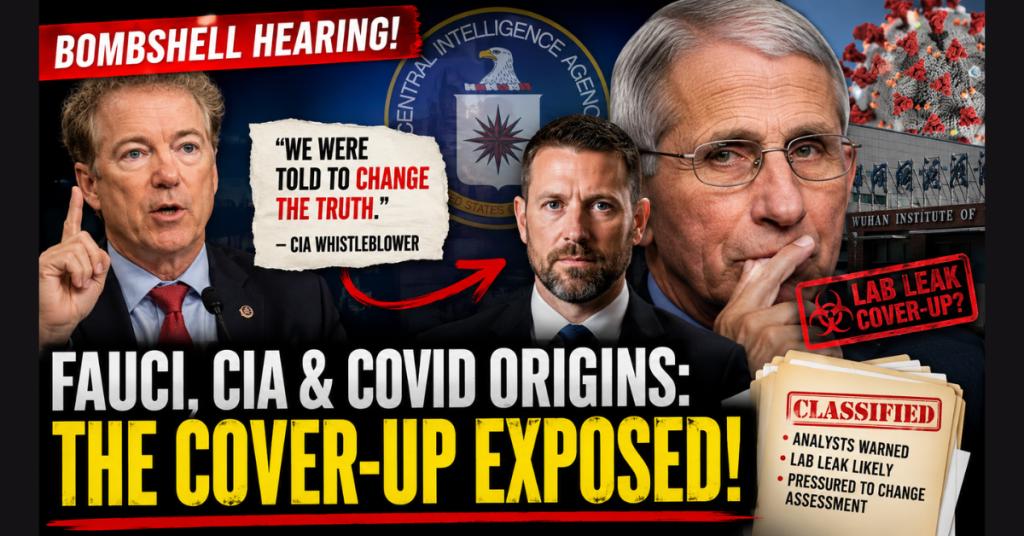
A stunning Senate hearing this week reignited one of the most explosive questions of the post-pandemic era: Did powerful figures inside the intelligence community help suppress evidence supporting a COVID-19 lab leak theory?
According to CIA whistleblower James Erdman, the answer is yes.
Erdman, a senior operations officer who previously served in the Army and foreign service before joining the CIA, testified before the Senate Homeland Security and Governmental Affairs Committee that intelligence analysts who believed COVID likely originated from a laboratory were overruled by agency leadership. He further alleged that Dr. Anthony Fauci played a significant role in steering the narrative toward natural origin explanations.
The hearing, led by Sen. Rand Paul and Sen. Ron Johnson, painted a picture of an intelligence apparatus more concerned with political fallout than scientific transparency.
CIA Analysts Reportedly Favored Lab Leak Theory
Erdman testified that analysts inside the intelligence community circulated papers early in the pandemic arguing that “all the conditions were present for a lab leak.” However, he claimed those conclusions were later softened or buried altogether.
According to the testimony, CIA management allegedly rewrote assessments “in the middle of the night” to convert stronger lab leak conclusions into weaker “non-call judgments.” Analysts who pushed back reportedly faced retaliation.
That claim adds fuel to long-running accusations that the American public was never given a fully honest accounting of what intelligence officials actually believed behind closed doors.
The CIA has strongly denied wrongdoing, blasting the hearing as “dishonest political theater” and accusing lawmakers of operating in bad faith.
Still, the hearing revealed growing frustration among lawmakers over what they describe as years of stonewalling from federal agencies.
Fauci’s Role Comes Under New Scrutiny
Perhaps the most politically explosive part of the hearing centered on Dr. Anthony Fauci.
Erdman alleged that Fauci’s influence over intelligence discussions was intentional and strategically inserted into the process through what he described as “injection points.”
Lawmakers highlighted Fauci’s ties to researchers connected to gain-of-function coronavirus experiments involving the Wuhan Institute of Virology. Particular attention was given to virologist Ralph Baric and EcoHealth Alliance president Peter Daszak, both of whom collaborated with Wuhan researchers on coronavirus projects that received U.S. funding.
The hearing also revisited the now-famous February 2020 discussions surrounding the paper “Proximal Origin,” which dismissed the lab leak theory early in the pandemic. Critics have long argued that several scientists involved initially believed the virus appeared engineered before later changing positions publicly.
Erdman testified that Fauci’s influence “significantly” affected the analytical process and that documentation showed the CIA leaning toward a lab leak assessment before abruptly reversing course days later.
Calls Grow for a New “Church Committee”
The revelations led several Republicans to call for a sweeping congressional investigation into intelligence community abuses similar to the historic Church Committee investigations of the 1970s.
Sen. Rand Paul argued that a small network of scientists, intelligence advisers, and federally funded researchers effectively reinforced one another’s conclusions while presenting them to the public as independent scientific consensus.
Meanwhile, Democrats were notably absent from the hearing, a point repeatedly emphasized by Republican lawmakers present.
Critics argue the absence reflects a broader unwillingness in Washington to revisit decisions made during the pandemic, especially as public trust in health institutions continues to erode.
Bigger Questions About Gain-of-Function Research
Beyond Fauci himself, Erdman warned of what he called a much larger structural problem: an interconnected network of public health agencies, intelligence officials, defense researchers, and academic institutions operating with little meaningful oversight.
He described the system as “deliberately opaque and excessively redundant,” arguing that decades of bureaucratic overlap blurred the lines between biodefense research and public health policy.
That warning comes as concerns continue growing over gain-of-function research — experiments that deliberately alter viruses to study how they may evolve or spread.
Supporters argue such research helps prepare for future pandemics.
Critics increasingly argue it may have helped create one.
What remains undeniable is that the COVID origins debate is far from over. And with new whistleblower testimony now on the congressional record, pressure is likely to intensify on intelligence agencies, public health officials, and the scientists who shaped the world’s understanding of the pandemic in its earliest days.