



Who’s Really Behind the Violence in Paris? Questions Grow Over Student Protests
Paris has a long history of student demonstrations escalating into nationwide political confrontations. From the upheaval of May 1968 to more recent protests over pension reform, French universities have frequently served as the starting point for movements that eventually draw thousands of participants from across the political spectrum.
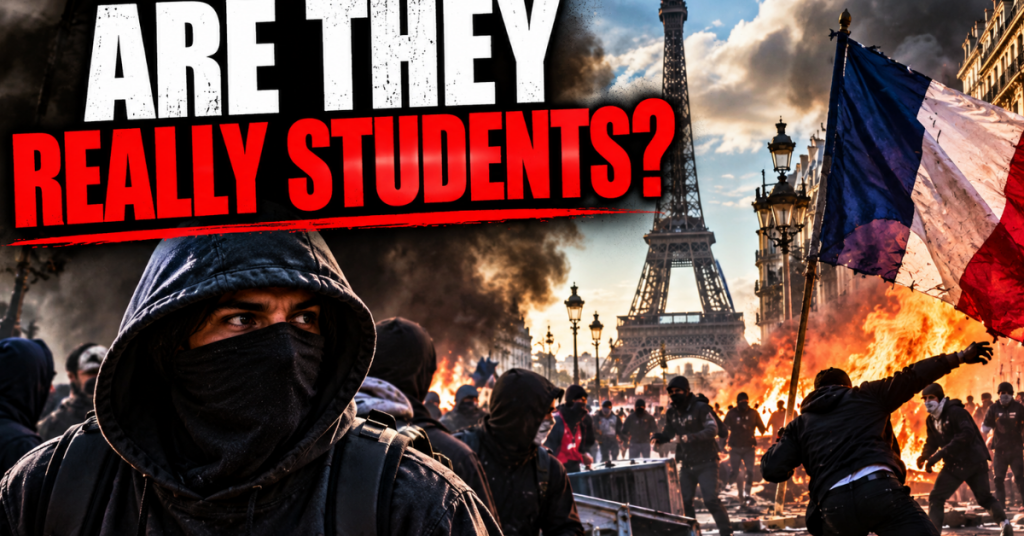
The latest reports of unrest in the French capital have renewed questions about the composition of these demonstrations, particularly whether those responsible for violence are students or outside activists who have joined the protests.
Some political commentators have alleged that individuals participating in the unrest are not university students at all, but migrants or organized agitators exploiting student demonstrations to advance their own political objectives. The allegations come amid growing public concern over immigration, national identity, and political violence in France.
Although there is insufficient evidence to establish that migrants are responsible for the unrest, the involvement of individuals unaffiliated with student organizations remains a legitimate subject of scrutiny.
French student demonstrations have historically attracted participants from labor unions, political organizations, and activist networks. During the May 1968 uprising, for example, student protests expanded into a nationwide general strike involving millions of workers. Similar alliances between students and organized political groups have emerged during subsequent disputes over labor laws, education policy, and pension reform.
The participation of nonstudents in such demonstrations is therefore not unusual. However, determining whether individuals involved in violent incidents belong to the organizations responsible for coordinating the protests is a separate matter.
Demonstrations involving thousands of participants can include peaceful protesters, organized political activists, and individuals who engage in vandalism or confrontations with police. Establishing responsibility for criminal activity requires distinguishing between these groups rather than treating everyone present as part of a single movement.
The debate has become particularly contentious because of France’s ongoing political divisions over immigration.
Critics of French immigration policy have argued that failures of integration and enforcement have contributed to public disorder. Others maintain that such accusations frequently overlook the involvement of French citizens in political violence and risk attributing criminal behavior to immigrant communities without sufficient evidence.
Citizenship, immigration status, and participation in political activism are distinct issues. France has a substantial population of citizens with North African and Middle Eastern ancestry, while foreign-born residents may also be legitimately enrolled in French educational institutions. Neither ethnicity nor appearance provides reliable evidence of an individual’s immigration status or connection to a university.
Consequently, determining whether outside groups are participating in the demonstrations requires examination of arrest records, verified footage, eyewitness accounts, and information released by French authorities.
Available reporting also raises questions about claims that the violence is predominantly attributable to adult migrants. According to a figure attributed to France’s Ministry of Justice, 86% of arrests associated with the student protest movement involved minors as of October 11. If confirmed, that figure would indicate that those arrested were overwhelmingly young, although it would not establish their enrollment status, nationality, or immigration background.
It would also complicate allegations that adult migrants constitute the principal source of unrest.
The broader question concerns the extent to which organized political groups may be participating in, influencing, or exploiting demonstrations originally presented as student-led movements.
For French authorities, identifying those responsible for violence is essential both to maintaining public order and to protecting the rights of peaceful demonstrators. Student organizations should not automatically be held responsible for crimes committed by unaffiliated individuals, but neither should the designation of an event as a student protest prevent scrutiny of outside participation.
The controversy reflects a larger political dispute over how France responds to civil unrest. As immigration and national identity remain central issues in French politics, the background and affiliations of those involved in violent demonstrations are likely to face increasing examination.