



VAED – MicroReport 20
Reporting Period and Background
Adverse events were reported to Pfizer during a 90-day period following the December 1, 2020, public rollout of its COVID-19 experimental “vaccine” product.
In the Pfizer 5.3.6 document, these AEs were categorized by System Organ Classes (SOC), in other words, by systems in the body.
Vaccine-Associated Enhanced Disease (VAED)
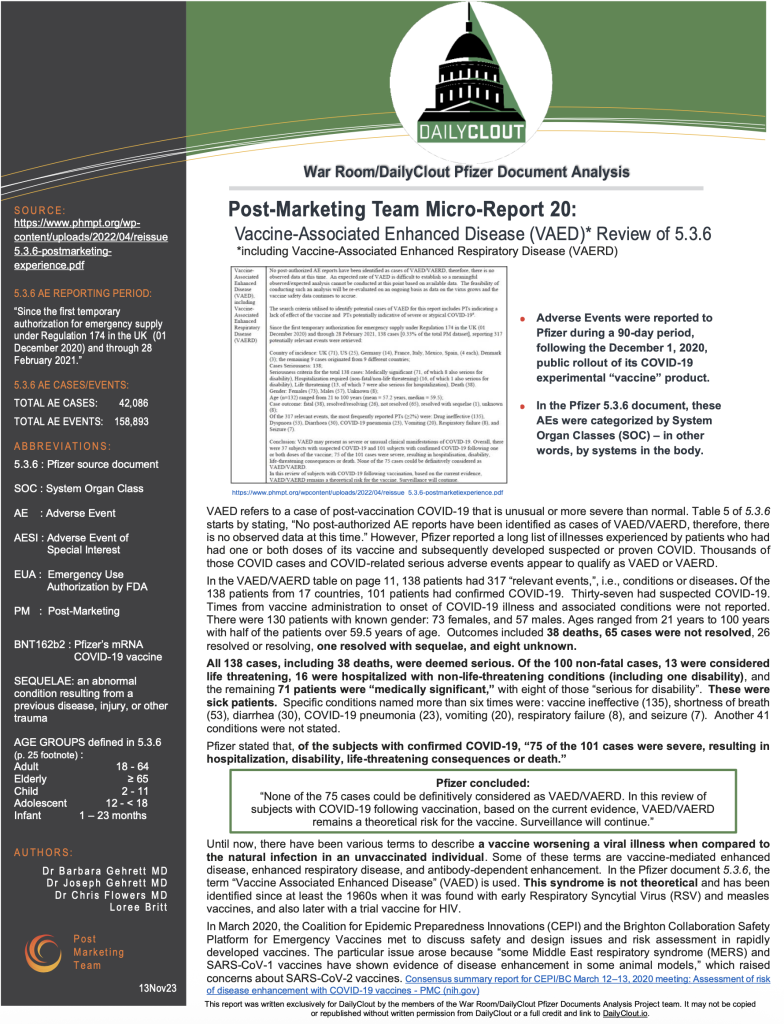
VAED refers to a case of post-vaccination COVID-19 that is unusual or more severe than normal. Table 5 of 5.3.6 starts by stating, “No post-authorized AE reports have been identified as cases of VAED/VAERD, therefore, there is no observed data at this time.”
However, Pfizer reported a long list of illnesses experienced by patients who had had one or both doses of its vaccine and subsequently developed suspected or proven COVID. Thousands of those COVID cases and COVID-related serious adverse events appear to qualify as VAED or VAERD.
In the VAED/VAERD table on page 11, 138 patients had 317 “relevant events,” i.e., conditions or diseases. Of the 138 patients from 17 countries, 101 patients had confirmed COVID-19. Thirty-seven had suspected COVID-19.
Times from vaccine administration to onset of COVID-19 illness and associated conditions were not reported. There were 130 patients with known gender: 73 females and 57 males. Ages ranged from 21 years to 100 years, with half of the patients over 59.5 years of age.
Outcomes included 38 deaths, 65 cases were not resolved, 26 resolved or resolving, one resolved with sequelae, and eight unknown.
All 138 cases, including 38 deaths, were deemed serious. Of the 100 non-fatal cases, 13 were considered life threatening, 16 were hospitalized with non-life-threatening conditions (including one disability), and the remaining 71 patients were “medically significant,” with eight of those “serious for disability.” These were sick patients.
Specific conditions named more than six times were: vaccine ineffective (135), shortness of breath (53), diarrhea (30), COVID-19 pneumonia (23), vomiting (20), respiratory failure (8), and seizure (7). Another 41 conditions were not stated.
Pfizer stated that, of the subjects with confirmed COVID-19, “75 of the 101 cases were severe, resulting in hospitalization, disability, life-threatening consequences or death.”
Pfizer’s Conclusion
“None of the 75 cases could be definitively considered as VAED/VAERD. In this review of subjects with COVID-19 following vaccination, based on the current evidence, VAED/VAERD remains a theoretical risk for the vaccine. Surveillance will continue.”
Background on Vaccine-Associated Enhanced Disease
Until now, there have been various terms to describe a vaccine worsening a viral illness when compared to the natural infection in an unvaccinated individual. Some of these terms are vaccine-mediated enhanced disease, enhanced respiratory disease, and antibody-dependent enhancement.
In the Pfizer document 5.3.6, the term “Vaccine Associated Enhanced Disease” (VAED) is used. This syndrome is not theoretical and has been identified since at least the 1960s when it was found with early Respiratory Syncytial Virus (RSV) and measles vaccines, and also later with a trial vaccine for HIV.
In March 2020, the Coalition for Epidemic Preparedness Innovations (CEPI) and the Brighton Collaboration Safety Platform for Emergency Vaccines met to discuss safety and design issues and risk assessment in rapidly developed vaccines. The particular issue arose because “some Middle East respiratory syndrome (MERS) and SARS-CoV-1 vaccines have shown evidence of disease enhancement in some animal models,” which raised concerns about SARS-CoV-2 vaccines.
Subsequently, a working group of the Brighton Collaboration reviewed the history of VAED and wrote a series of definitions. Their paper was released on February 23, 2021.
“Vaccine-associated enhanced diseases (VAED) are modified presentations of clinical infections affecting individuals exposed to a wild-type pathogen after having received a prior vaccination for the same pathogen.”
In other words, VAED refers to a case of COVID-19 after vaccination that is unusual or more severe than normal. VAERD was defined as “disease with predominant involvement of the lower respiratory tract.”
Of note, one of the authors, Fernando P. Polack, of the Brighton Collaboration report was the primary author of the Pfizer study on BNT162b2 which formed the basis of the emergency use authorization (EUA) by the FDA.
The report cites as examples atypical measles and enhanced RSV infection, where “severe disease has been documented resulting from infection in individuals primed with non-protective immune responses against the respective wild-type viruses.”
Furthermore, the authors state, “VAED always involves a memory response primed by vaccination and, in the experiences best characterized until now, targets the same organs as wild-type infections.” (Emphasis added.)
The authors go on to say, “As the clinical manifestations of VAED lies (sic) within the spectrum of natural disease – occurring more frequently and/or severely in vaccinated individuals – it is also difficult to separate vaccine failure (also called breakthrough disease) from VAED in vaccinated individuals. All cases of vaccine failure should be investigated for VAED.” (Bold added.)
Interestingly, cases of COVID-19 in vaccinated patients were quickly labeled “breakthrough” cases in 2021, without any indication that the Brighton recommendation to investigate for VAED was followed.
Additionally, they concluded, “The broad spectrum of natural disease manifestations in different populations and age groups makes it very difficult, if not impossible, to determine how severe COVID-19 infection would have been in the absence of vaccination in the individual case.”
Along with this, they state, “Identifying cases of VAED/VAERD might be impossible when assessing individual patients, however, in clinical studies, a control group is helpful to compare the frequency of cases and the severity of illness in vaccinees vs. controls, including the occurrence of specific events of concern such as hospitalization and mortality.”
Pfizer’s Phase 2/3 Vaccine Trial
Pfizer’s Phase 2/3 vaccine trial, C4591001, was a randomized controlled trial with a vaccinated group and a placebo (unvaccinated) group. This type of design is considered the gold standard for scientific investigation.
The trial was to have two years of follow-up of the vaccinated and placebo groups. However, in December 2020, when the FDA granted Emergency Use Authorization for BNT162b2, Pfizer asked for and received permission from the FDA to unblind the study and offer the vaccine to placebo individuals. Most of them accepted and were vaccinated by March 2021.
So a control group no longer exists. This is the only randomized placebo-controlled trial of the Pfizer vaccine. No subsequent trial meets this standard.
Questions About the COVID-19 Cases
Given the above statements, one would assume that Pfizer would have reported as potential VAED the 2,391 COVID-19 cases from Table 7 of 5.3.6.
Recently released DailyClout Report 90 records 2,585 serious adverse events in this group of COVID-19 cases. That sounds like VAED. There were 136 fatalities.
Other outcomes were “547 not resolved, 558 resolved/resolving, nine resolved with sequelae, and 2,110 unknown (63%).”
DailyClout Report 90 goes on to say, “The number of unknown outcomes is disproportionately large compared to the other SOCs in Table 7. If one postulates that all the fatalities and all the ‘not resolved,’ ‘resolved/resolving,’ and ‘resolved with sequelae’ adverse events were serious, that still leaves over 1,300 serious adverse events with unknown outcomes. Why were so many outcomes unknown? What happened to these patients?”
Again, these cases are very suggestive of VAED, particularly since most cases of COVID-19 are mild.
The Brighton Collaborative protocols are rigorous and demand testing that was unrealistic for the general population in early 2021. For the average person in the community to document seronegative status for COVID-19 infection prior to contracting COVID would be unrealistic outside of participating in a clinical study.
Even finding non-PCR COVID-19 tests in the early months of the pandemic was problematic. At this same time and under these constraints, the Brighton working group concluded:
Level 1 of Diagnostic Certainty (Definitive Case)
“The working group considers that a Definitive Case (LOC 1) of VAED cannot be ascertained with current knowledge of the mechanisms of pathogenesis of VAED.”
Examining Levels 2 and 3
Now go back to Pfizer’s conclusion, on page 11 of 5.3.6: “None of the 75 cases could be definitively considered as VAED/VAERD.”
Of course not. Brighton has conceded that a Level 1 diagnosis cannot be reached with current knowledge.
But what about Level 2 or Level 3? To examine VAED and VAERD seriously and responsibly in the BNT162b2-vaccinated population, Pfizer should have begun with Level 2 (probable) or Level 3 (possible) cases.
Level 2A and Level 3A require documentation, with a blood test, that an individual has not had prior COVID-19. That information was simply not readily available in early 2021.
Now Level 2B and Level 3B (see Green Box) start with COVID-19 infection in an individual with no prior history of infection. These two levels of certainty do not require a negative antibody test.
The next requirement is a positive COVID test. DailyClout Report 90 documents 415 cases with positive SARS-CoV-2 tests. It reports 51 cases of COVID-19 pneumonia.
For the cases to be reported as COVID-19 pneumonia, it is reasonable to assume that the 51 cases had a positive COVID-19 test. They certainly had severe disease, possibly enough to qualify as VAERD.
Level 2B: A Probable Case of VAED
A probable case of VAED is defined by the occurrence of disease in a vaccinated individual with no prior history of infection and unknown serostatus, with:
-
Laboratory-confirmed infection with the pathogen targeted by the vaccine.
-
Clinical findings of disease involving one or more organ systems (a case of VAERD if the lung is the primarily affected organ).
-
Severe disease as evaluated by a clinical severity index/score (systemic in VAED or specific to the lungs in VAERD).
-
Increased frequency of severe outcomes (including severe disease, hospitalization and mortality) when compared to a non-vaccinated population (control group or background rates).
-
Evidence of immunopathology in target organs involved by histopathology, if available. (Editorial note from the authors: Specific tests are enumerated, not documented in 5.3.6.)
-
No identified alternative etiology.
Level 3B: A Possible Case of VAED
A possible case of VAED is defined by the occurrence of disease in a vaccinated individual with no prior history of infection and unknown serostatus, with:
-
Laboratory-confirmed infection with the pathogen targeted by the vaccine.
-
Clinical findings of disease involving one or more organ systems (a case of VAERD if the lung is the primarily affected organ).
-
Severe disease as evaluated by a clinical severity index/score (systemic in VAED or specific to the lungs in VAERD).
-
Increased frequency of severe outcomes (including severe disease, hospitalization and mortality) when compared to a non-vaccinated population (control group or background rates).
-
No identified alternative etiology.
Post-Marketing Team’s Conclusion
In summary, in Table 5, Pfizer admits to 75 severe cases of COVID-19. These 75 cases fit the Level 3B criteria for possible VAED and should not have been dismissed because they did not fit the nonexistent Level 1 definition of VAED.
In addition, there are at least several hundred more cases in Table 7 under the COVID-19 AESIs, reviewed for severity of cases in DailyClout Report 90, which are suspicious of VAED.
The focus of this review, thus, returns to Pfizer’s initial statement: “No post-authorized AE reports have been identified as cases of VAED/VAERD, therefore, there is no observed data at this time.”
The discussion and the data presented above bring severe doubt about the veracity of those assertions. Certainly, Pfizer’s own data bring into doubt its ability to support its “safe and effective” mantra. Pfizer and the FDA have had a way forward to prove SAFETY but for over two years have failed to do so.
Reference Information
5.3.6 AE Reporting Period
“Since the first temporary authorization for emergency supply under Regulation 174 in the UK (01 December 2020) and through 28 February 2021.”
5.3.6 AE Cases/Events
| Category | Total |
|---|---|
| Total AE cases | 42,086 |
| Total AE events | 158,893 |
Abbreviations
-
5.3.6: Pfizer source document
-
SOC: System Organ Class
-
AE: Adverse Event
-
AESI: Adverse Event of Special Interest
-
EUA: Emergency Use Authorization by FDA
-
PM: Post-Marketing
-
BNT162b2: Pfizer’s mRNA COVID-19 vaccine
-
Sequelae: An abnormal condition resulting from a previous disease, injury, or other trauma
Age Groups Defined in 5.3.6 (p. 25 footnote)
| Age group | Age range |
|---|---|
| Adult | 18–64 |
| Elderly | 65 and older |
| Child | 2–11 |
| Adolescent | 12–17 |
| Infant | 1–23 months |