



Vaccine Effectiveness – MicroReport 18
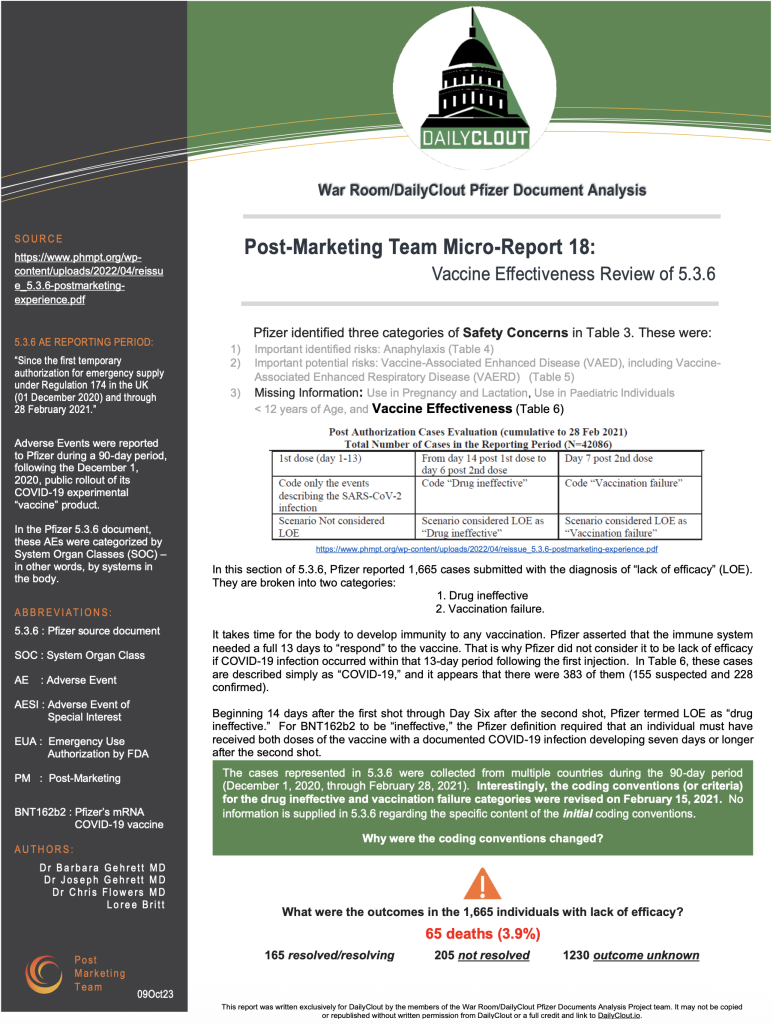
Safety Concerns Identified by Pfizer
Pfizer identified three categories of Safety Concerns in Table 3. These were:
-
Important identified risks: Anaphylaxis (Table 4).
-
Important potential risks: Vaccine-Associated Enhanced Disease (VAED), including Vaccine-Associated Enhanced Respiratory Disease (VAERD) (Table 5).
-
Missing Information: Use in Pregnancy and Lactation, Use in Paediatric Individuals under 12 years of age, and Vaccine Effectiveness (Table 6).
Post-Authorization Cases Evaluation
Cumulative to February 28, 2021
Total number of cases in the reporting period: 42,086.
| 1st dose (days 1–13) | From day 14 after 1st dose to day 6 after 2nd dose | Day 7 after 2nd dose |
|---|---|---|
| Code only the events describing the SARS-CoV-2 infection scenario. | Code “Drug ineffective.” | Code “Vaccination failure.” |
| Scenario not considered LOE. | Scenario considered LOE as “Drug ineffective.” | Scenario considered LOE as “Vaccination failure.” |
Source: Pfizer 5.3.6 Post-Marketing Experience Document
Lack of Efficacy Cases
In this section of 5.3.6, Pfizer reported 1,665 cases submitted with the diagnosis of “lack of efficacy” (LOE). They are broken into two categories:
-
Drug ineffective.
-
Vaccination failure.
It takes time for the body to develop immunity to any vaccination. Pfizer asserted that the immune system needed a full 13 days to “respond” to the vaccine. That is why Pfizer did not consider it to be lack of efficacy if COVID-19 infection occurred within that 13-day period following the first injection. In Table 6, these cases are described simply as “COVID-19,” and it appears that there were 383 of them (155 suspected and 228 confirmed).
Beginning 14 days after the first shot through Day Six after the second shot, Pfizer termed LOE as “drug ineffective.” For BNT162b2 to be “ineffective,” the Pfizer definition required that an individual must have received both doses of the vaccine with a documented COVID-19 infection developing seven days or longer after the second shot.
Changes to the Coding Conventions
The cases represented in 5.3.6 were collected from multiple countries during the 90-day period (December 1, 2020, through February 28, 2021). Interestingly, the coding conventions (or criteria) for the drug ineffective and vaccination failure categories were revised on February 15, 2021. No information is supplied in 5.3.6 regarding the specific content of the initial coding conventions.
Why were the coding conventions changed?
Outcomes of the 1,665 Individuals With Lack of Efficacy
| Reported outcome | Number |
|---|---|
| Deaths | 65 (3.9%) |
| Resolved/resolving | 165 |
| Not resolved | 205 |
| Outcome unknown | 1,230 |
Revised Vaccine Effectiveness Coding Conventions
After the unexplained change on February 15, 2021, what were the new Vaccine Effectiveness coding conventions?
For “drug ineffective,” the new definition included any of the following:
-
Infection was not confirmed by a lab test.
-
Unknowns present:
-
Whether vaccine doses followed the proper local regimen.
-
How many days had passed since the first dose.
-
Whether seven days had passed since the second dose.
-
-
COVID onset between 14 days after the first dose and through six days after the second dose.
For “vaccination failure,” the new definition required all three of the following:
-
Both doses received per local regimen.
-
At least seven days since the second dose.
-
Infection with a confirmed positive lab test for SARS-CoV-2.
Pfizer’s Classification of Drug Ineffective Cases
Based on the revised criteria, Pfizer classified 1,649 cases as “drug ineffective.” One thousand six hundred and twenty-five (98.5%) of these cases were labeled “serious,” but no reasoning for this label was given. The FDA has formally defined a “serious adverse event,” but that specific term was not used in Table 6; and the FDA Glossary of Terms does not include a definition for “clinical events” or “serious clinical events.” Did the patients have serious illness, or was inadequate performance of the inoculation considered serious?
Information is provided on how many doses of BNT162b2 had been given for only 927 cases. Table 6 states “lack of efficacy was reported after the first dose in 788 cases.” By the Pfizer definition of lack of efficacy, these 788 were definitely not drug failure. One hundred and thirty-nine cases occurred after the second dose of BNT162b2. An additional 722 of the 1,649 cases (44%) had “unknown timing” regarding whether the infection was after one or two doses of BNT162b2. This means some or all of the 861 cases (139 plus 722) could have been classified as drug failure if missing information had been available. Without obtaining more details on the remaining 861 cases, there is no way to know whether they were “drug ineffective” or “drug failure.” Only 788 of the 1,649 (47.8%) drug ineffective cases can be stated categorically not to have been drug failure.
Latency was reported in 654 cases and was missing in 995 cases (60%). Of those with latency reported after the second shot, 27 occurred between eight and 21 days. Had a COVID test been documented, some or all of those 27 might have been classified as vaccine failure. Another 409 cases did not include the number of vaccine doses but recorded the latency from the last dose. One hundred twenty-eight of these 409 had COVID-19 diagnosed eight to 44 days after the last dose. These 128 might also represent drug failure. Remember, 1,625 of the 1,649 “drug ineffective” cases were classified “serious.”
However, in Table 6, using the revised coding conventions, only 16 cases were specifically classified as “vaccination failure.” Six had “asymptomatic COVID-19” and 10 had “COVID-19.” This is a suspiciously low number for drug failure. Up to another 861 might have been true drug failure had missing data been collected.
Why Did Pfizer Revise the Coding Conventions Just 13 Days Before the 90-Day Reporting Period Ended?
An educated guess suggests the revised coding added a requirement for positive COVID-19 testing rather than only accepting clinical symptoms. This would be a necessary feature for a peer-reviewed study; but, in the midst of a pandemic when testing was not necessarily readily available or considered a high priority by a sick, homebound person, it may have been viewed as a convenient way to exclude troublesome cases. The inescapable conclusion is that the revision was not to make the data on drug failure look worse.
What does it mean in the coding conventions that the subject “has received the series of two doses per the dosing regimen in local labeling” (italics added)? Are there different regimens in different localities or different parts of the world?
To conclude with two other unresolved points: Why does Pfizer avoid the standard FDA classifications of adverse events? What does it mean that there were 1,625 serious “cases”?
The evasive phrasing throughout renders this table even more obscure than those previously analyzed.
Reference Information
5.3.6 AE Reporting Period
“Since the first temporary authorization for emergency supply under Regulation 174 in the UK (01 December 2020) and through 28 February 2021.”
Adverse Events were reported to Pfizer during a 90-day period, following the December 1, 2020, public rollout of its COVID-19 experimental “vaccine” product.
In the Pfizer 5.3.6 document, these AEs were categorized by System Organ Classes (SOC), in other words, by systems in the body.
Abbreviations
-
5.3.6: Pfizer source document
-
SOC: System Organ Class
-
AE: Adverse Event
-
AESI: Adverse Event of Special Interest
-
EUA: Emergency Use Authorization by FDA
-
PM: Post-Marketing
-
BNT162b2: Pfizer’s mRNA COVID-19 vaccine
-
Sequelae: An abnormal condition resulting from a previous disease, injury, or other trauma
Age Groups Defined in 5.3.6 (p. 25 footnote)
| Age group | Age range |
|---|---|
| Adult | 18–64 |
| Elderly | 65 and older |
| Child | 2–11 |
| Adolescent | 12–17 |
| Infant | 1–23 months |