



U.S.-Iran Missile Exchange Renews Fears of a Wider Middle East War
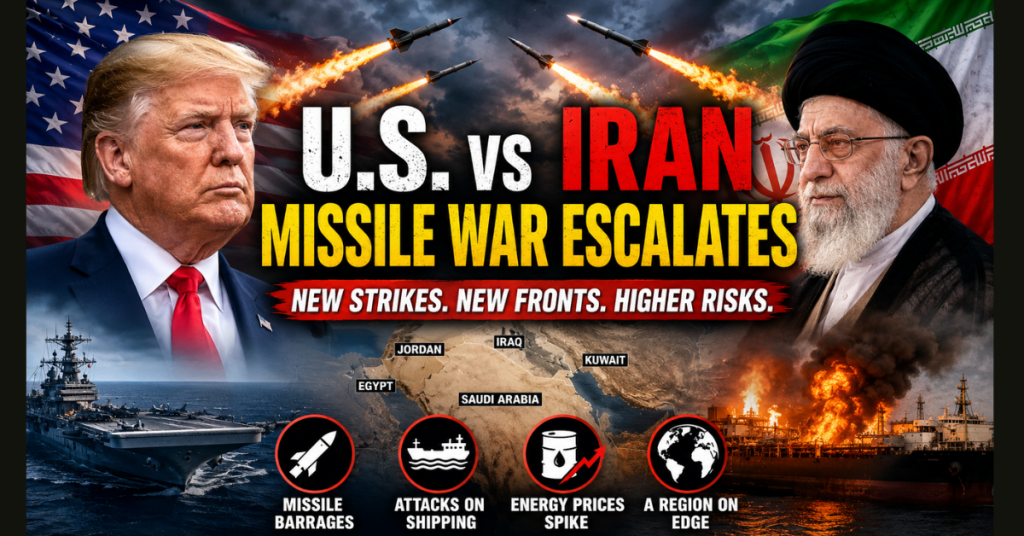
A brief lull in fighting has come to an abrupt end as the United States and Iran exchanged fresh waves of missile strikes, raising fears that a conflict once centered on the Persian Gulf is expanding across the broader Middle East.
The latest escalation follows several days of reduced hostilities that had fueled hopes for renewed diplomacy. Instead, both sides have resumed military operations, while neighboring countries are increasingly finding themselves caught in the crossfire.
New Fronts Continue to Open
The renewed exchange has spread well beyond the original battlefield.
Jordan reported intercepting multiple Iranian missiles for the second consecutive day as projectiles crossed its airspace. Kuwait confirmed that an Iranian strike damaged a building and killed one worker. Egypt is now investigating drone attacks that ignited fires aboard two natural gas vessels at the port of Damietta, marking one of the most significant security incidents the country has faced since the conflict began.
Saudi Arabia has also taken a more active military role after accusing Iran-backed militias of targeting its oil infrastructure. The kingdom reportedly coordinated strikes alongside U.S. forces against Iranian-backed groups operating inside Iraq, while continuing to push publicly for renewed negotiations.
U.S. Responds With Major Airstrikes
According to U.S. Central Command, American forces launched what officials described as a “heavy wave” of strikes targeting facilities linked to Iran’s Islamic Revolutionary Guard Corps.
Military officials said the attacks struck command centers, missile launch sites, drone facilities, coastal defense systems, and surveillance infrastructure. The strikes were described as retaliation for an earlier Iranian missile attack targeting a U.S. military base in Jordan.
Iranian state media reported casualties following the strikes, including deaths on Qeshm Island near the strategically vital Strait of Hormuz.
Energy Markets Feel the Pressure
The conflict is once again shaking global energy markets.
The Strait of Hormuz remains one of the world’s most important shipping lanes, carrying roughly one-fifth of global oil and liquefied natural gas shipments during normal conditions. Continued attacks and security threats have sharply reduced commercial traffic through the waterway, increasing shipping costs and contributing to higher fuel prices worldwide.
Additional pressure has come from attacks near the Red Sea and threats involving the Bab el-Mandeb Strait, another crucial maritime chokepoint for international trade. Analysts warn that disruptions at both locations could further strain already volatile energy markets.
Diplomatic Hopes Fade
Despite mediation efforts by regional governments, prospects for a near-term ceasefire appear increasingly uncertain.
Officials in Pakistan, which has participated in mediation efforts, acknowledged that negotiations continue but warned that the regional security situation remains fragile. Discussions have reportedly focused on stabilizing shipping through the Strait of Hormuz, though no breakthrough has been announced.
Meanwhile, the expanding list of countries affected by missile launches, drone attacks, and maritime disruptions has heightened concerns that the conflict could draw additional regional powers into direct military involvement.
Growing Political Pressure at Home
The prolonged conflict is also creating political challenges in the United States.
After months of military operations, public support appears to be softening. An AP-NORC survey found President Donald Trump’s approval rating on his handling of Iran has slipped slightly compared with last month, reflecting growing public concern over the duration and cost of the conflict.
Military analysts have also raised questions about the long-term sustainability of the campaign, noting that continued missile defense operations and precision strikes consume large quantities of high-end munitions needed for other potential global contingencies.
As diplomacy struggles to regain momentum and missile exchanges resume, hopes for a quick resolution appear to be fading. With attacks now touching multiple countries and critical global shipping routes, the conflict increasingly carries consequences well beyond the battlefield itself.