



The Hidden Witness Behind Trump’s Impeachment
A newly resurfaced thread in the long-running saga surrounding the first impeachment of Donald Trump is raising fresh questions about transparency, bias, and the inner workings of the intelligence community during one of the most politically charged moments in modern U.S. history.
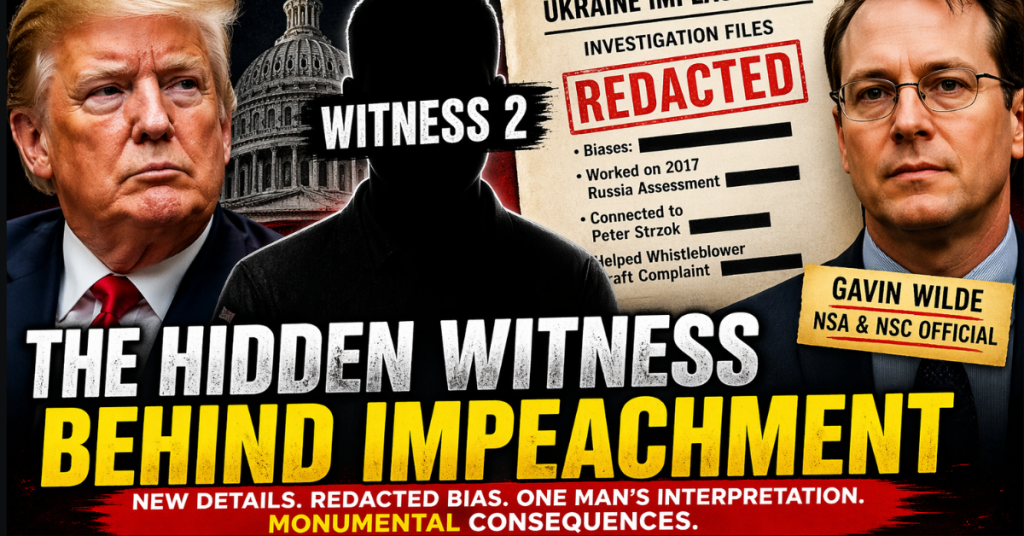
At the center of it all is a previously unnamed figure now identified as Gavin Wilde, a former National Security Agency and National Security Council official, who appears to have played a far more influential role in the Ukraine whistleblower complaint than was publicly known at the time.
A Key Figure Behind the Scenes
According to newly highlighted reporting, Wilde is believed to be “Witness 2,” a figure cited extensively in inspector general materials tied to the 2019 impeachment inquiry. His input was not peripheral. It was foundational.
Internal testimony indicates that Witness 2 served as a primary source for key portions of the whistleblower complaint that ultimately led to Trump’s impeachment in the House of Representatives.
That complaint centered on Trump’s July 25, 2019 phone call with Volodymyr Zelensky, which critics argued involved improper pressure related to investigations into the Biden family. Trump denied wrongdoing and was later acquitted by the Senate.
Interpretation vs. Evidence
One of the most striking revelations is how Witness 2 formed his conclusions.
Rather than pointing to explicit language in the call, Wilde reportedly admitted that his interpretation relied on “reading between the lines.” He acknowledged there was no direct mention of the 2020 election in the transcript, yet inferred political intent based on context.
This distinction is critical. Lawmakers at the time pressed whether such interpretations constituted factual evidence or subjective analysis. The answer, even in official testimony, leaned toward the latter.
Intelligence Ties and Withheld Context
Equally significant are Wilde’s professional connections and prior roles, some of which were reportedly withheld or redacted from congressional investigators during the impeachment process.
Wilde had:
- Worked on the 2017 Intelligence Community Assessment on Russian election interference
- Maintained connections to Peter Strzok, a central figure in the controversial Crossfire Hurricane investigation
- Participated in broader intelligence efforts focused on Russia and election security
These affiliations could have provided important context for evaluating potential bias. Yet, according to the material, those details were obscured during key phases of congressional review.
The Role of the Inspector General
The intelligence community inspector general at the time, Michael Atkinson, acknowledged that Witness 2’s information played a decisive role in advancing the complaint.
In fact, testimony suggests that without Witness 2’s input, the complaint may not have met the threshold required to move forward through official channels.
That raises a broader institutional question: how much weight should be given to secondhand interpretation in matters with constitutional consequences?
A Broader Pattern of Narrative Formation
Wilde’s post-government career adds another layer to the story. Since leaving public service, he has publicly criticized Trump and warned about what he describes as “MAGA conspiracy theories,” while continuing to write and speak on Russian influence and information warfare.
This has fueled debate among critics who argue that political predispositions may have shaped not only public commentary but earlier intelligence judgments as well.
At the same time, defenders of the intelligence community maintain that analysts often must interpret incomplete information and assess intent based on patterns, not just explicit statements.
What This Means Now
The renewed attention on Wilde and his role does not rewrite the outcome of the impeachment. Trump was impeached in the House and acquitted in the Senate, and that chapter is closed in procedural terms.
But it does reopen a deeper question that has lingered since 2019:
How much of what drove one of the most consequential political events in recent history was grounded in verifiable fact, and how much rested on interpretation shaped by institutional and personal bias?
As more documents continue to surface and previously redacted details come into view, the line between intelligence analysis and political narrative is once again under scrutiny.