



Pediatrics – MicroReport 6
Main Finding
Infants and children under 12 were injected with the Pfizer “vaccine” seven months before the product was approved for children.
The 5.3.6 document was compiled by Pfizer for the purpose of reporting adverse events to the FDA. The reporting period was during the first 90 days, starting December 1, 2020, after the COVID-19 “vaccine” rollout to the public. This experimental product was not approved for use in the under-12 age group at that time.
Who was responsible for administering this unapproved product to children? Did these children receive a full or a partial adult dose? Who decided how much to inject? Were the AEs in these children monitored long term? Were the results or final outcomes of this inappropriate administration utilized when the approval for this age group was considered? These questions are not answered in the 5.3.6 document.
Pfizer’s Safety Concerns
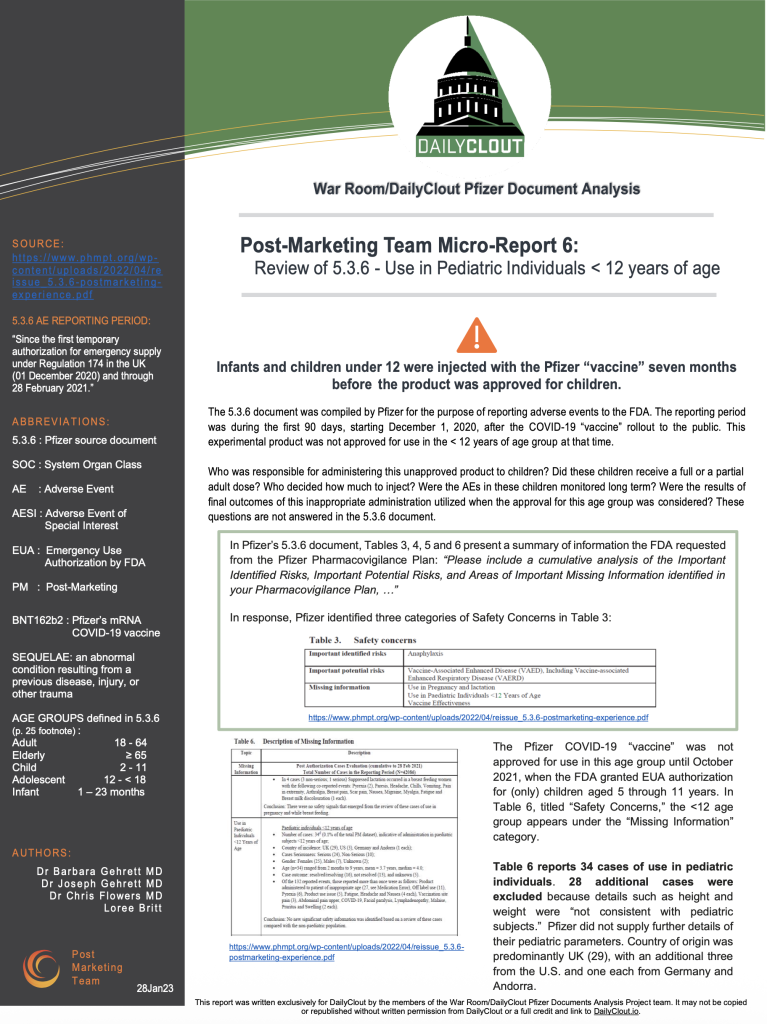
In Pfizer’s 5.3.6 document, Tables 3, 4, 5 and 6 present a summary of information the FDA requested from the Pfizer Pharmacovigilance Plan:
“Please include a cumulative analysis of the Important Identified Risks, Important Potential Risks, and Areas of Important Missing Information identified in your Pharmacovigilance Plan, …”
In response, Pfizer identified three categories of Safety Concerns in Table 3:
| Category | Safety concern |
|---|---|
| Important identified risks | Anaphylaxis |
| Important potential risks | Vaccine-Associated Enhanced Disease (VAED), including Vaccine-associated Enhanced Respiratory Disease (VAERD) |
| Missing information | Use in Pregnancy and Lactation; Use in Paediatric Individuals Under 12 Years of Age; Vaccine Effectiveness |
Source: Pfizer 5.3.6, Table 3: Safety Concerns
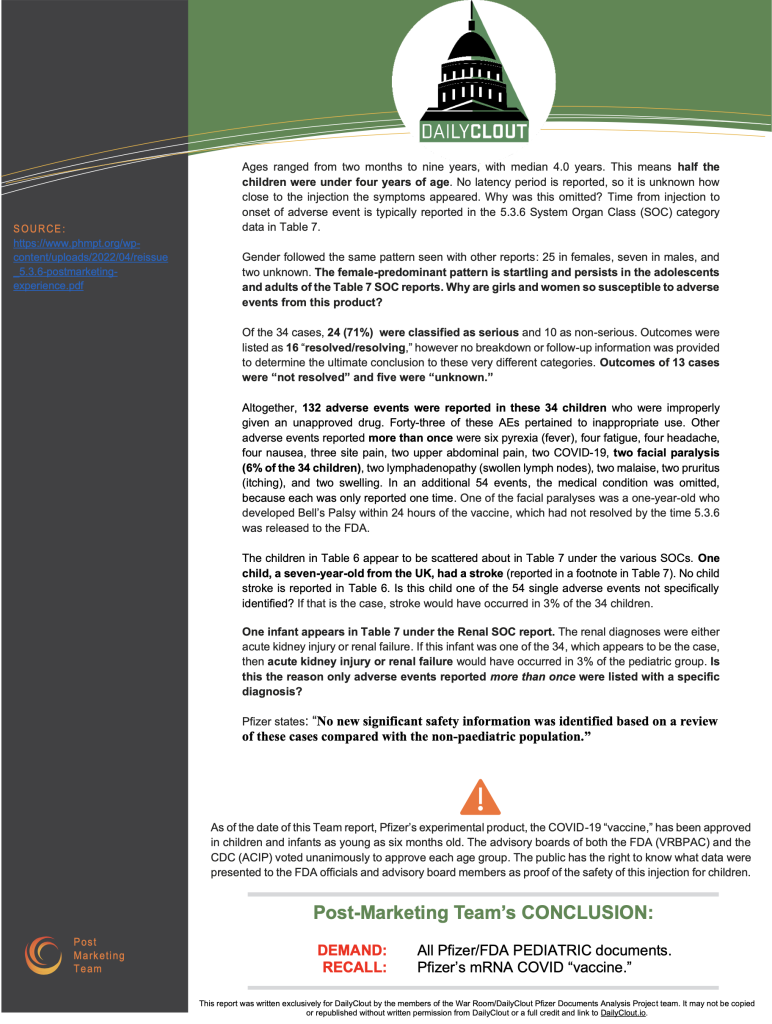
The Pfizer COVID-19 “vaccine” was not approved for use in this age group until October 2021, when the FDA granted EUA authorization for (only) children aged 5 through 11 years. In Table 6, titled “Safety Concerns,” the under-12 age group appears under the “Missing Information” category.
Reported Pediatric Cases
Table 6 reports 34 cases of use in pediatric individuals. 28 additional cases were excluded because details such as height and weight were “not consistent with pediatric subjects.” Pfizer did not supply further details of their pediatric parameters. Country of origin was predominantly UK (29), with an additional three from the U.S. and one each from Germany and Andorra.
Ages ranged from two months to nine years, with median 4.0 years. This means half the children were under four years of age. No latency period is reported, so it is unknown how close to the injection the symptoms appeared. Why was this omitted? Time from injection to onset of adverse event is typically reported in the 5.3.6 System Organ Class (SOC) category data in Table 7.
Gender followed the same pattern seen with other reports: 25 in females, seven in males, and two unknown. The female-predominant pattern is starting and persists in the adolescents and adults of the Table 7 SOC reports. Why are girls and women so susceptible to adverse events from this product?
Of the 34 cases, 24 (71%) were classified as serious and 10 as non-serious. Outcomes were listed as 16 “resolved/resolving,” however no breakdown or follow-up information was provided to determine the ultimate conclusion to these very different categories. Outcomes of 13 cases were “not resolved” and five were “unknown.”
Adverse Events Reported
Altogether, 132 adverse events were reported in these 34 children who were improperly given an unapproved drug.
Forty-three of these AEs pertained to inappropriate use. Other adverse events reported more than once were six pyrexia (fever), four fatigue, four headache, four nausea, three site pain, two upper abdominal pain, two COVID-19, two facial paralysis (6% of the 34 children), two lymphadenopathy (swollen lymph nodes), two malaise, two pruritus (itching), and two swelling.
In an additional 54 events, the medical condition was omitted, because each was only reported one time. One of the facial paralyses was a one-year-old who developed Bell’s Palsy within 24 hours of the vaccine, which had not resolved by the time 5.3.6 was released to the FDA.
Stroke and Renal Adverse Events
The children in Table 6 appear to be scattered about in Table 7 under the various SOCs. One child, a seven-year-old from the UK, had a stroke (reported in a footnote in Table 7). No child stroke is reported in Table 6. Is this child one of the 54 single adverse events not specifically identified? If that is the case, stroke would have occurred in 3% of the 34 children.
One infant appears in Table 7 under the Renal SOC report. The renal diagnoses were either acute kidney injury or renal failure. If this infant was one of the 34, which appears to be the case, then acute kidney injury or renal failure would have occurred in 3% of the pediatric group. Is this the reason only adverse events reported more than once were listed with a specific diagnosis?
Pfizer states:
“No new significant safety information was identified based on a review of these cases compared with the non-paediatric population.”
Post-Marketing Team’s Assessment
As of the date of this Team report, Pfizer’s experimental product, the COVID-19 “vaccine,” has been approved in children and infants as young as six months old. The advisory boards of both the FDA (VRBPAC) and the CDC (ACIP) voted unanimously to approve each age group. The public has the right to know what data were presented to the FDA officials and advisory board members as proof of the safety of this injection for children.
Post-Marketing Team’s Conclusion
DEMAND: All Pfizer/FDA PEDIATRIC documents.
RECALL: Pfizer’s mRNA COVID “vaccine.”
Reference Information
5.3.6 AE Reporting Period
“Since the first temporary authorization for emergency supply under Regulation 174 in the UK (01 December 2020) and through 28 February 2021.”
Abbreviations
-
5.3.6: Pfizer source document
-
SOC: System Organ Class
-
AE: Adverse Event
-
AESI: Adverse Event of Special Interest
-
EUA: Emergency Use Authorization by FDA
-
PM: Post-Marketing
-
BNT162b2: Pfizer’s mRNA COVID-19 vaccine
-
Sequelae: An abnormal condition resulting from a previous disease, injury, or other trauma
Age Groups Defined in 5.3.6 (p. 25 footnote)
| Age group | Age range |
|---|---|
| Adult | 18–64 |
| Elderly | 65 and older |
| Child | 2–11 |
| Adolescent | 12–17 |
| Infant | 1–23 months |