



Empire of Necessity: When Non-Intervention Fails
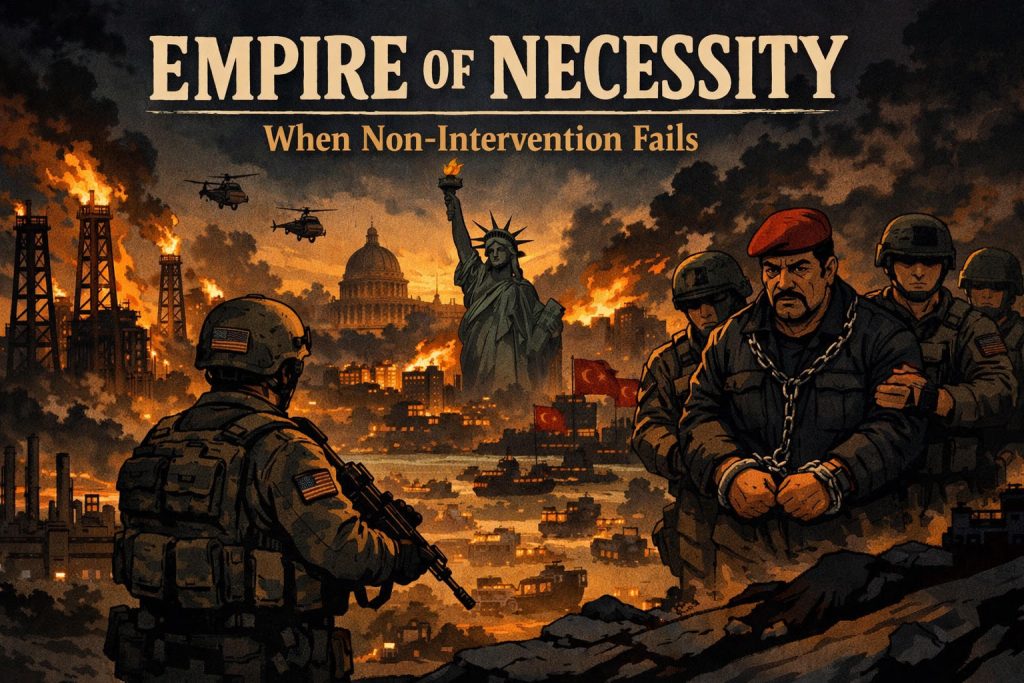
There is a taboo in polite American conversation: America as empire.
Going to college during the War on Terror, partly out of contrarian instinct and partly to get a rise out of others, I began deploying my best neo-con arguments to anyone who would listen to my pro-Iraq War arguments. I learned that there are always silver linings, even in the most mistake-infested bouts of adventurism. We would hold up the Kurdish region, north of the corrupt swamp of Iranian-influenced Baghdad and east of the rapidly radicalizing Sunni region, as proof of American brilliance. There is always a romantic tale that can be woven like a garment, covering the true agenda of resource acquisition. For the sake of respectful and honest dialogue, let’s shed the fairy tales.
As the years went by and regions dominoed into horror shows, there came a time when no argument could justify the post-Cold War version of nation-building. Along with words like colonialist, dominion, and occupation, imperialism carries no shortage of ghosts. History is replete with brutality committed by great powers and the domestic strains accrued while trying to subjugate populations too unwilling and too far away. However, for the sake of survival, it is worth asking whether advances in technology, intelligence, and strategic execution have finally made achievable what once collapsed under its own weight.
In the first week of the new year, 2026, the world witnessed an objectively extraordinary and deeply controversial operation. U.S. forces captured Venezuelan President Nicolás Maduro and swiftly transported him to New York to face federal charges. The image of a once-brazen strongman, chained and paraded through a hallway in a ridiculous hat, was not meant for Venezuelans alone. It served as a message to every leader who had grown comfortable during decades of consequence-free impunity.
President Donald Trump, who has never governed with short-term vision or rhetorical restraint, made the message explicit. The United States, he said, would run Venezuela for an indefinite period, ensuring that American oil companies entered the long-mismanaged energy sector to revive production.
And yet, while many Americans today oscillate between panic-laced tautologies and an apologetic, legally flimsy approach to defend the action, we must confront an uncomfortable truth. What we are witnessing is not an aberration but the opening chapter of an American imperial era. What few seem willing to consider is that this era, if it continues, may be born not of vanity, but of necessity.
President Donald Trump, who has never governed with short-term vision or rhetorical restraint, made the message explicit. The United States, he said, would run Venezuela for an indefinite period, ensuring that American oil companies entered the long-mismanaged energy sector to revive production.
Whether one views this as law enforcement or a blatant overreach of presidential authority, the episode forces a question well outside the bounds of acceptable discourse. What if actions like this are no longer optional, but necessary for the survival and continued success of the United States?
One of our country’s most important freedoms is that of free speech.
Agree with this essay? Disagree? Join the debate by writing to DailyClout HERE.