



Zohran Mamdani’s Victory and the Jewish Divide in New York City
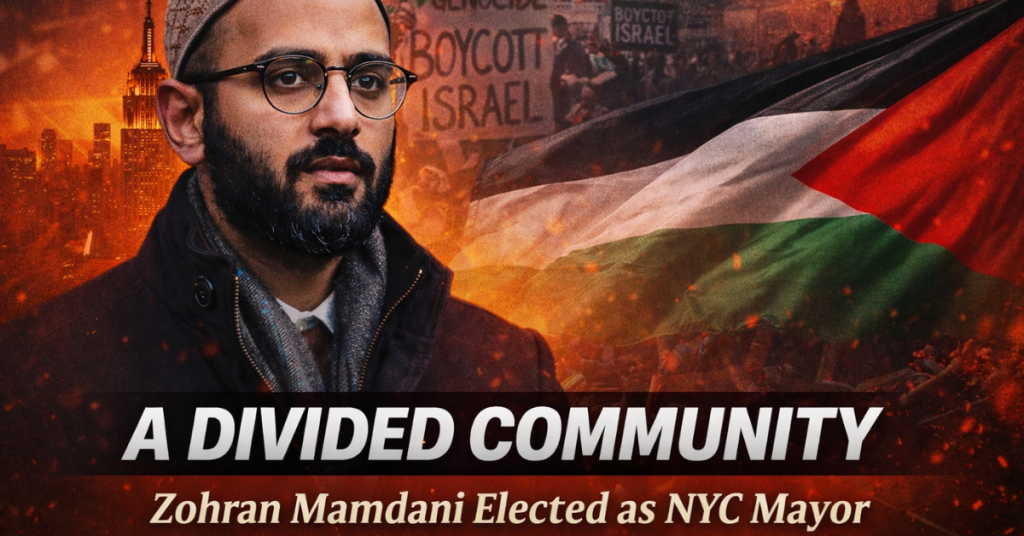
On January 1, Zohran Mamdani was sworn in as mayor of New York City, a city that is home to the largest Jewish population outside the State of Israel. His election marked a historic political shift—not merely because of his affiliation with the Democratic Socialists of America, but because of what his victory revealed about deepening fractures within New York’s Jewish community itself.
Mamdani’s rise has been interpreted by many observers as a referendum on Israel, Zionism, and the boundaries between political critique and communal security in a post–October 7 landscape. For some Jewish New Yorkers, his election represents a warning sign. For others, it signals a generational realignment already underway.
A Political Profile That Alarmed Many
Mamdani is a longtime critic of Israeli government policy and an open supporter of the Boycott, Divestment and Sanctions movement (BDS). He also founded his college chapter of Students for Justice in Palestine, an organization that has been repeatedly scrutinized by civil rights groups for rhetoric and activism that critics argue crosses from anti-Zionism into antisemitism.
Although Mamdani has stated that he personally avoids incendiary slogans such as “globalize the intifada,” he has also declined to explicitly condemn them, framing such language as protected political expression. To many Jewish voters—particularly those with familial, religious, or cultural ties to Israel—this ambiguity was unacceptable in the aftermath of Hamas’s October 7, 2023 attack and the subsequent Gaza war.
In that context, Mamdani’s victory felt less like a routine political upset and more like an existential shock.
The October 7 Aftermath and Jewish Insecurity
The mayoral election took place against a backdrop of sharply rising antisemitic incidents nationwide, particularly in major urban centers. According to data from Jewish advocacy organizations and law enforcement reports, New York City experienced a significant spike in antisemitic harassment, vandalism, and threats following October 7—often tied to protests, campus activism, and online rhetoric.
For many Jewish residents, especially in Orthodox and traditionally pro-Israel communities, Mamdani’s political alliances and ideological history raised fears that City Hall would be less responsive—or less sympathetic—to concerns about Jewish safety and communal legitimacy.
Yet these fears were not universally shared.
The Jewish Vote Was Not Monolithic
Exit polling and post-election analysis revealed a more complex reality: roughly one-third of Jewish voters in New York supported Mamdani. Among younger Jewish voters, that share was almost certainly higher.
This support did not necessarily reflect widespread hostility toward Israel. Instead, it appeared to stem from a combination of factors:
-
Generational shifts in how Jewish identity is expressed
-
A growing tendency among younger Jews to separate Zionism from Jewishness
-
Prioritization of domestic issues such as housing, policing, and economic inequality
-
Distrust of traditional Jewish institutions perceived as politically rigid
During the campaign, Mamdani’s team highlighted endorsements from sympathetic rabbis and circulated campaign materials branded as “New York Jews for Zohran,” complete with coordinated visuals and messaging. While these supporters did not represent a majority, they were numerous, organized, and vocal—far beyond what could be dismissed as a fringe movement.
A Generational and Ideological Divide
Sociologists and Jewish communal leaders have increasingly noted a widening gap between older Jewish voters—who tend to view Israel as inseparable from Jewish survival—and younger Jews, many of whom frame their Jewish identity primarily through social justice, universalism, or progressive politics.
For these voters, Mamdani’s stance on Israel was not disqualifying. Some viewed criticism of Israel as consistent with Jewish ethical traditions; others saw Israel as one issue among many, not the defining test of political allegiance.
This divide has placed Jewish institutions in an uncomfortable position: caught between a base that feels existentially threatened and a younger cohort that resists being told which political views are “acceptable” expressions of Jewish identity.
What Mamdani’s Election Ultimately Signifies
Mamdani’s mayoralty does not signal a unified Jewish rejection of Zionism, nor does it prove that antisemitism has been normalized among Jewish voters. What it does reveal is a profound fragmentation—of priorities, identities, and political frameworks—within one of New York’s most influential communities.
For supporters, Mamdani represents a broader coalition politics that includes Jews without centering Israel as the litmus test of belonging. For critics, his election underscores how anti-Israel activism has been laundered into mainstream politics, even in cities with large Jewish populations.
Both interpretations coexist, uneasily.
As Mamdani begins governing, his administration will be tested not only on policy outcomes, but on whether it can navigate this fault line without deepening mistrust. In a city defined by pluralism and political intensity, his victory may ultimately be remembered less for what it says about Israel—and more for what it exposed about American Jewish politics in an era of profound change.