



Trump Says ‘Huge Win’ for Americans as Greenland Deal Framework Emerges
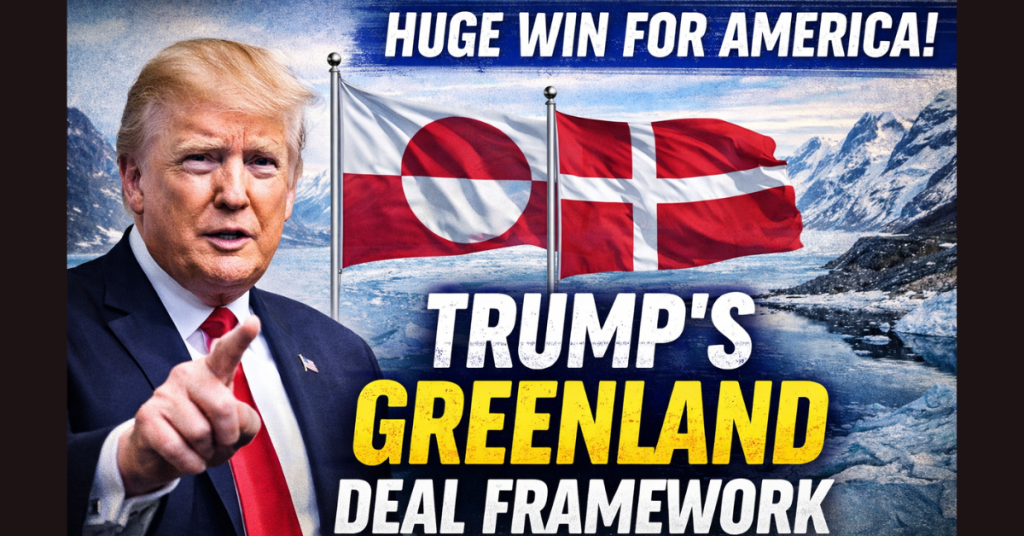
President Donald Trump and his allies are framing a newly announced framework for a Greenland-related deal as a major success for U.S. interests, following tense diplomatic discussions at the World Economic Forum in Davos, Switzerland. The development, which came after discussions with NATO Secretary General Mark Rutte, has been described by a former State Department official as a “huge win” for Americans — even as critics emphasize ongoing controversies and geopolitical sensitivities.
From Confrontation to a “Framework” Agreement
In recent days, Trump’s push for a stronger U.S. stance on Greenland — including earlier threats of tariffs and talk of acquiring sovereignty — provoked sharp reactions from European allies and North Atlantic partners. However, after meeting with Rutte on the sidelines of the forum, Trump announced on social media that the two sides had agreed on a framework for a future deal involving the island and the broader Arctic region.
This framework, Trump said, represents progress toward American strategic goals in the Arctic, and he touted it as providing “everything we wanted” from the negotiations, framing the outcome as beneficial not only for the United States but also for NATO and wider regional stability.
A former State Department official appearing on Fox News @ Night echoed that positive assessment, describing the framework agreement as a significant victory for U.S. strategic interests. The logic behind this claim centers on ensuring enhanced U.S. access and influence in a region becoming increasingly contested by global powers such as Russia and China.
What the “Framework” Actually Means
According to NATO’s secretary general, discussions with Trump focused on collective security measures across the Arctic rather than U.S. acquisition of Greenland itself. Rutte stressed that ideas of forced control or Danish sovereignty being overridden were not part of the talks, suggesting the framework centers instead on cooperative defense and shared strategic priorities in the far north.
The shift also saw Trump abandon previously threatened tariffs on several European nations — a key point of contention in recent diplomacy — which were tied to his demands in the Greenland dispute. By framing this as a diplomatic breakthrough, the administration is portraying the move as a win for American global leadership and reduced economic conflict.
Strategic Stakes in the Arctic
Greenland’s location makes it a critical piece of the Arctic landscape: it borders key polar routes and sits between potential adversaries’ military reach and North America’s northern flank. Earlier in the week, Trump explicitly rejected the use of military force to obtain the territory but continued to underline the island’s strategic significance for national defense. That shift — away from forceful rhetoric — has eased some transatlantic concerns and helped underpin claims of diplomatic progress.
Analysts note that while the precise details of the framework remain vague, the emphasis appears to be on ensuring U.S. access for defense and potentially resource development, along with reinforcing NATO’s Arctic posture.
Responding to Critics and Allies
Despite administration claims of success, reactions have not been uniformly positive. European leaders and Greenlandic representatives have repeatedly underscored Denmark’s sovereignty and Greenland’s self-determination in any negotiations, emphasizing that decisions about the island’s future must involve its people. This insistence reflects broader unease among allied governments about U.S. pressure tactics earlier in the dispute.
Polling data also suggest limited American public enthusiasm for outright acquisition of Greenland, with most Americans historically opposing annexation efforts — highlighting how sensitive the issue is, even domestically.
What Comes Next?
At this stage, the “framework” represents a statement of intent rather than a detailed treaty. The White House’s framing of the outcome as a “huge win” is rooted in its assessment that the United States secured key strategic guarantees without triggering tariffs or aggressive confrontations with NATO allies. Whether that positioning will hold as negotiations continue with Denmark, Greenlandic authorities, and other NATO partners remains to be seen.
What is clear is that the Greenland question — once a fringe idea — has become a flashpoint in U.S.–European relations, Arctic security policy, and the broader debate over how America projects power and influence in the 21st century.