



Trump Acts to Confront Christian Persecution in Nigeria
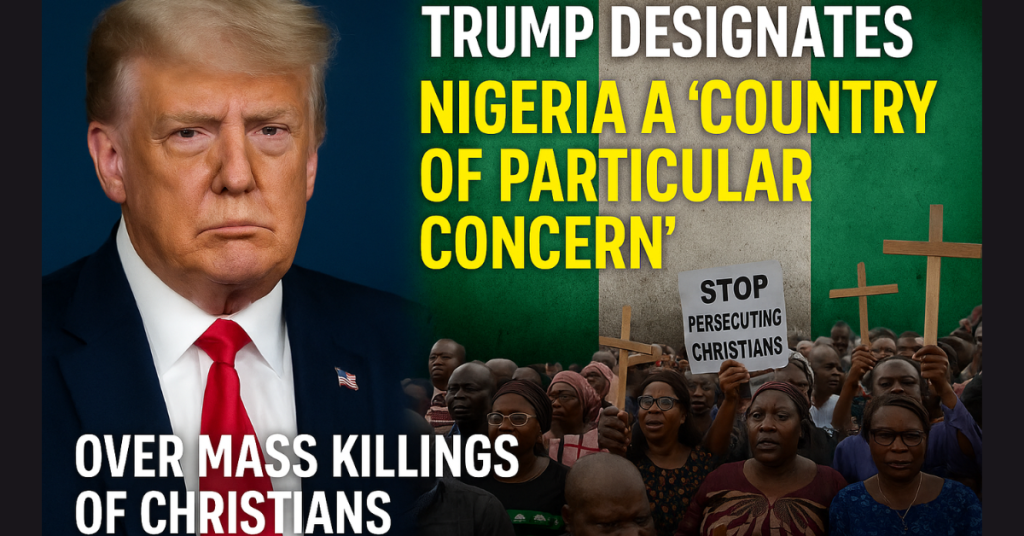
In the northern and central states of Nigeria, Islamist groups like Boko Haram, Islamic State West Africa Province (ISWAP), and Fulani militant herders have targeted Christian villages with increasing frequency. Homes are burned, churches destroyed, and thousands forced to flee.
Open Doors, an international watchdog group, reports that nearly 70% of all Christians killed for their faith worldwide last year were in Nigeria. Survivors often recount gunmen shouting “Allahu Akbar” as they torch homes and churches—acts described by U.S. Senator Ted Cruz as part of a “crisis of religious genocide.”
Cruz said in March that since 2009, over 50,000 Christians have been massacred in Nigeria and 20,000 churches and Christian schools destroyed. Despite these figures, the Nigerian government continues to deny that Christians are being specifically targeted.
Trump’s Directive and International Response
President Trump has instructed Reps. Riley Moore (R-WV) and Tom Cole (R-OK), along with members of the House Appropriations Committee, to investigate the crisis and report back with policy recommendations.
“This isn’t about politics—it’s about human life,” said Mark Walker, Trump’s ambassador-designate for International Religious Freedom and a former pastor. “From ISWAP to Fulani militias, this persecution has gone on for years. The Nigerian government must be far more proactive.”
Walker emphasized that he plans to work closely with Sen. Marco Rubio to ensure the U.S. government continues to prioritize religious liberty in its foreign policy. “All of us should raise our voices,” Walker added. “These are boys and girls, mothers and fathers—people being slaughtered for their faith.”
The White House has confirmed it is monitoring the surge of anti-Christian violence across sub-Saharan Africa, where jihadist movements have exploited instability and porous borders to expand. Both Pope Leo XIV and the U.S. State Department have issued statements condemning the killings.
Nigerian Government Pushes Back
Despite global outcry, Nigerian officials insist the situation is being exaggerated. Information Minister Mohammed Idris called reports of mass persecution “very misleading,” and presidential spokesperson Bayo Onanuga claimed that “Christians are not targeted” and that “religious harmony” exists across the country.
Yet eyewitness accounts and satellite imagery from human rights organizations tell a different story—showing burned-out church compounds, mass graves, and entire Christian villages wiped out in the Middle Belt region.
A priest from Plateau State told reporters, “When the world stays silent, the killers return. Every time officials deny what’s happening, another church burns.”
The Road Ahead
The designation of Nigeria as a “country of particular concern” carries potential diplomatic and financial consequences. It allows the U.S. to impose sanctions or restrict aid if the Nigerian government fails to act against perpetrators of religious violence.
For President Trump and his supporters, the move underscores his broader pledge to defend persecuted Christians globally. “This is about protecting faith and freedom,” Trump wrote. “America stands with the faithful in Nigeria and around the world.”
As villages rebuild and families mourn, faith leaders in Nigeria say they hope this new U.S. action will mark the beginning of accountability—and an end to years of silence.