



Netanyahu Rushes to Washington to Shape Trump’s Iran Nuclear Talks
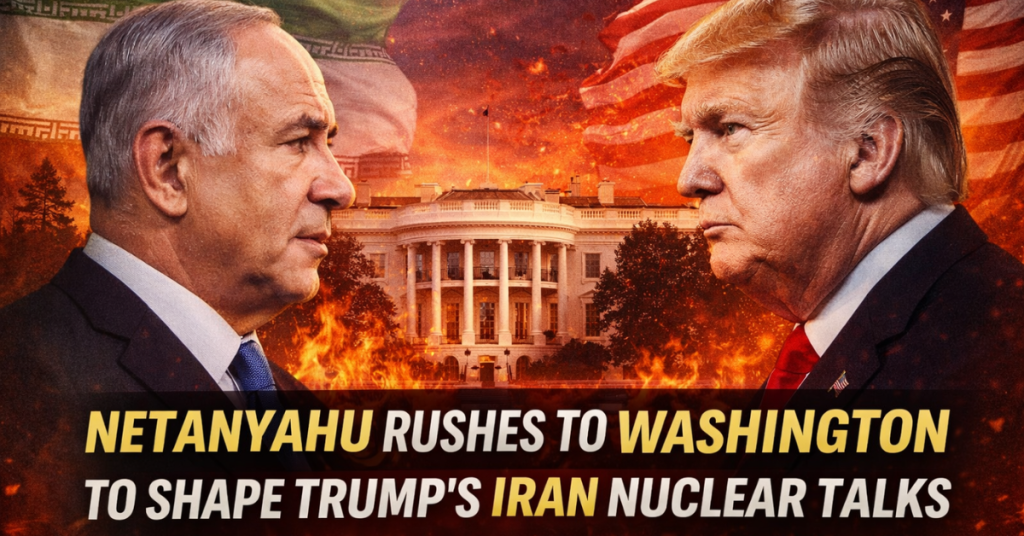
Israeli Prime Minister Benjamin Netanyahu arrived in Washington, D.C., this week for a crucial round of diplomacy with senior U.S. officials as the United States and Iran edge back into nuclear negotiations. Before his scheduled meeting with U.S. President Donald Trump on Wednesday, Netanyahu met with the United States’ top Iran negotiators — Steve Witkoff, the U.S. special envoy to the Middle East, and Jared Kushner — at Blair House to discuss the first round of talks held last Friday and broader regional security concerns.
The gathering at the White House guest residence centered on updates from indirect negotiations in Muscat, Oman, where American and Iranian officials held initial discussions on February 6. Tehran, however, has thus far limited its engagement to nuclear issues and shown no willingness to compromise on its ballistic missile program or its support for proxy groups across the Middle East — key points of Israeli concern.
Netanyahu made clear before departure that he intends to present to Trump a set of principles for the U.S. delegation’s approach to Iran, arguing that limits should encompass not just uranium enrichment but also missiles and regional militancy. He told reporters that these principles are critical not only for Israel’s security but for “everyone who wants peace and security in the Middle East.”
This visit marks one of Netanyahu’s most strategically timed trips to the U.S. in years. Though originally scheduled for later in February, he requested to move his Washington visit forward amid what Israeli officials described as unease over the direction of the negotiations — particularly fears that the U.S. might agree to a narrowly focused deal with Iran that does not curb Tehran’s broader military capabilities.
In Washington, the diplomatic calculus is further complicated by public statements from U.S. leaders. President Trump has signaled cautious optimism about reaching some sort of agreement with Iran, describing earlier talks as “very good” while maintaining that Tehran must make meaningful concessions. But Trump has also reiterated that any deal must prevent Iran from obtaining nuclear weapons or missile systems — positions that resonate with Israeli priorities but stop short of detailing how such limits would be enforced.
U.S. military readiness has also factored into the backdrop of these negotiations. Washington has already boosted its presence in the Middle East with aircraft carriers and other assets, a signal that diplomatic efforts are being backed by credible military pressure should talks fail. Iranian officials, for their part, have warned of retaliatory action against U.S. bases if provoked, underscoring how volatile the situation remains.
Netanyahu’s broader agenda in Washington includes discussions about Gaza and the stability of the region following the war the two countries fought last year. Israeli officials fear that an agreement between Tehran and Washington that focuses solely on nuclear limits could inadvertently legitimize parts of Iran’s regional power projection.
Iran’s own posture in the negotiations continues to be firm. Tehran insists on its sovereign right to peaceful nuclear enrichment and has rebuffed demands to make parallel concessions on missiles or proxy forces. Iranian Foreign Minister Abbas Araghchi has voiced skepticism about the depth of U.S. intentions, while Tehran officials have publicly urged Washington not to allow external actors, including Israel, to influence the talks.
The meeting between Netanyahu and Trump is expected to focus on aligning American and Israeli strategies ahead of the next round of U.S.–Iran discussions. Both leaders recognize that the talks, if they succeed, could shape the Middle Eastern security landscape for years to come — with Israel pushing for a broad framework that addresses not only nuclear constraints but also Tehran’s broader military ambitions.