



Middle East Erupts After U.S.–Israel Strike on Iran
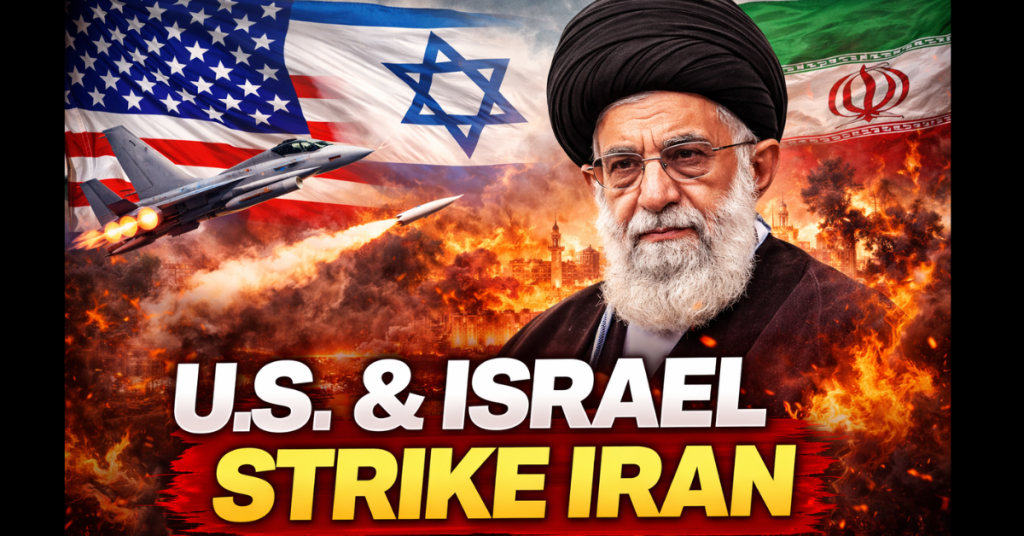
The Middle East entered one of its most dangerous moments in decades Saturday after the United States and Israel launched coordinated airstrikes against Iranian targets, prompting an immediate retaliatory response from Tehran that sent shockwaves across the region and raised fears of a wider war.
President Donald Trump confirmed the joint operation in a video address directed not only at Americans but at the Iranian public itself, framing the strikes as both a defensive military action and a potential turning point inside Iran.
“The hour of your freedom is at hand,” Trump said in an eight-minute message posted online, urging Iranians to challenge their government as explosions were reported across Tehran.
From Failed Diplomacy to Military Action
The strikes followed the collapse of weeks of negotiations over Iran’s nuclear program. U.S. officials had pushed for a complete halt to uranium enrichment, while Iranian negotiators reportedly offered limited concessions but refused restrictions on ballistic missile development — a sticking point Washington and Jerusalem described as unacceptable.
Hours before the attack, Trump signaled frustration with diplomacy, saying negotiations had reached an impasse.
“Sometimes you have to use force,” he told reporters, adding he preferred a peaceful resolution but believed threats from Tehran were becoming imminent.
Israeli Defense Minister Israel Katz described the operation as a “preemptive strike” designed to remove emerging dangers tied to Iran’s nuclear and military capabilities. Israeli officials said intelligence assessments suggested accelerated Iranian activity that could shorten the timeline toward weapons capability.
Smoke rising from multiple sites in Tehran — including areas near government and security facilities — was confirmed by international media outlets and satellite imagery reviewed by defense analysts.
Iran’s Retaliation Expands the Conflict
Iran responded within hours.
Missiles and drone strikes were launched across the Middle East, according to regional governments and military officials. Explosions were reported near U.S. military installations in Bahrain, Qatar, Kuwait, Jordan, and the United Arab Emirates — countries not directly involved in the initial attack but home to American forces.
Israeli authorities ordered civilians into shelters and suspended schools, public gatherings, and most workplace activity amid warnings of additional incoming strikes.
Iranian military statements framed the retaliation as a direct response to “aggression against Iranian sovereignty,” signaling Tehran’s strategy of widening pressure across U.S. and allied positions rather than limiting retaliation to Israel alone.
Defense analysts noted the response closely mirrors Iran’s long-standing doctrine of asymmetric escalation — targeting regional infrastructure and allied bases to raise the cost of confrontation without triggering immediate full-scale invasion.
A Message Aimed at Iran’s Population
Unlike previous military confrontations, Trump’s remarks placed unusual emphasis on internal political change inside Iran.
“Our joint action will create the conditions for the brave Iranian people to take their destiny into their own hands,” Israeli Prime Minister Benjamin Netanyahu said in a parallel statement, echoing Trump’s appeal.
The messaging suggests Washington and Jerusalem may be attempting to combine military pressure with psychological and political signaling aimed at weakening the Iranian regime domestically.
Iran has faced years of economic strain, protests, and internal dissent driven by sanctions, inflation, and political repression. However, experts warn external attacks can sometimes strengthen hardline factions rather than destabilize them.
Regional Stakes and Global Risk
The escalation immediately raised concerns among U.S. allies and global markets, particularly because several targeted areas host critical energy infrastructure and shipping routes tied to global oil supply.
The Persian Gulf remains one of the world’s most strategically sensitive regions, and any sustained conflict risks disrupting maritime trade through the Strait of Hormuz, a chokepoint responsible for roughly one-fifth of global oil shipments.
Secretary of State Marco Rubio reinforced the administration’s hardline stance earlier Friday by designating Iran a state sponsor of wrongful detention, citing decades of hostage diplomacy involving American and foreign nationals.
“For decades, Iran has cruelly detained innocent people as political leverage,” Rubio said, signaling additional sanctions could follow the military confrontation.
The Shadow of History
The strikes revive memories of previous flashpoints between Washington, Israel, and Tehran — including the 2020 killing of Iranian General Qassem Soleimani and repeated covert operations targeting Iran’s nuclear infrastructure.
Yet analysts say this moment differs in scale.
For the first time in years, open military coordination between the United States and Israel has been paired with direct retaliatory attacks spanning multiple countries simultaneously, transforming what began as a targeted strike into a regional security crisis.
What Happens Next
Military officials across the region remain on high alert as both sides assess damage and prepare for potential escalation.
The central question now is whether Iran limits its retaliation to symbolic demonstrations of strength or expands attacks against American assets — a move that could draw the United States deeper into sustained conflict.
For now, the Middle East stands at a volatile crossroads: a failed diplomatic effort has given way to open confrontation, and the outcome may depend less on battlefield victories than on whether either side chooses escalation or restraint in the days ahead.