



Mamdani’s First Moves Trigger Senate Investigation
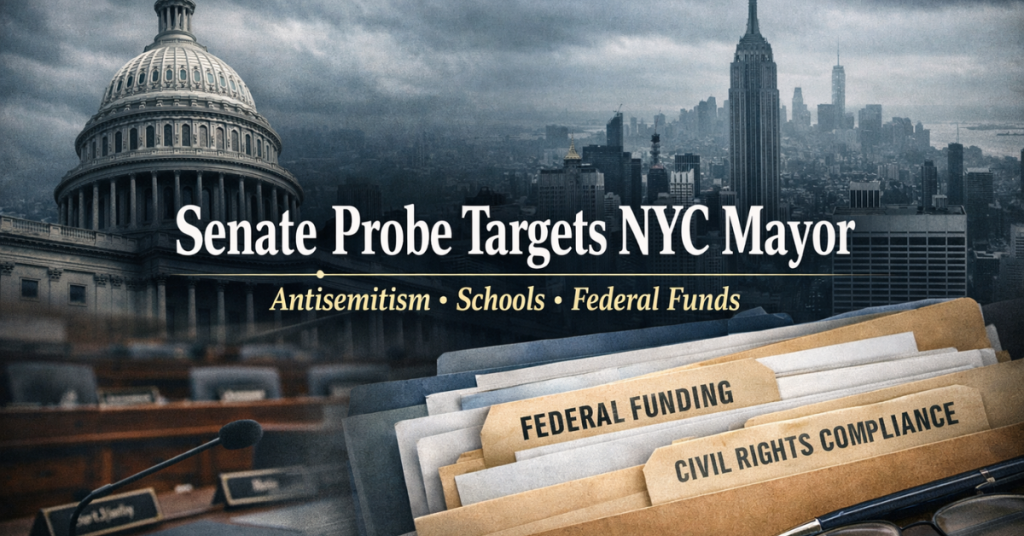
Republican Sen. Bill Cassidy of Louisiana has launched a formal congressional inquiry into New York City Mayor Zohran Mamdani, citing concerns that the mayor’s early executive decisions may weaken protections for Jewish students and residents while potentially jeopardizing billions in federal education funding.
Cassidy, who chairs the Senate Health, Education, Labor, and Pensions (HELP) Committee, sent a letter to Mamdani this week expressing alarm over the mayor’s decision not to renew two executive orders issued by his predecessor, Eric Adams, both of which were aimed at combating antisemitism within city government and public schools.
Executive Orders Rolled Back
One of the rescinded orders expanded New York City’s working definition of antisemitism to align with standards adopted by the International Holocaust Remembrance Alliance (IHRA), a framework widely used by governments and educational institutions to identify antisemitic conduct. The second order restricted city officials from participating in the Boycott, Divestment, and Sanctions (BDS) movement targeting Israel.
Mamdani allowed both orders to lapse shortly after taking office, arguing during the campaign that such measures risked chilling political speech and conflating criticism of Israel with antisemitism. Critics, however, argue the rollback sends a troubling signal at a time when antisemitic incidents are rising nationally and in New York City in particular.
Federal Funding in Focus
In his letter, Cassidy underscored that New York City’s Department of Education relies heavily on federal support. As of mid-2025, the city’s education budget included approximately $2.2 billion in federal funds, much of it tied to civil-rights compliance requirements.
Cassidy warned that continued eligibility for those funds depends on adherence to federal laws designed to protect students from discrimination and harassment.
“It is deeply troubling that one of your first official acts as mayor was to revoke two executive orders designed to protect students and combat antisemitism,” Cassidy wrote, adding that Jewish students are reporting increased fear and insecurity on campuses nationwide.
Jewish Community Concerns
New York City is home to the largest Jewish population outside Israel, with roughly 1.77 million Jewish residents—nearly one in ten New Yorkers statewide. Community leaders have repeatedly warned that rhetoric surrounding the Israel–Hamas conflict has spilled into domestic harassment, vandalism, and threats directed at Jewish institutions.
Cassidy emphasized that leadership during periods of social tension requires clear condemnation of antisemitism, regardless of political ideology.
“Whatever somebody’s ideological background, if they’re in a position of responsibility, they must protect their citizens,” Cassidy wrote in a public statement. “We must respond to real dangers directed at Jewish students.”
Broader Political Backlash
Mamdani, a democratic socialist, has faced sustained criticism for his past anti-Israel rhetoric and for declining to explicitly condemn phrases such as “globalize the intifada,” which many Jewish organizations interpret as an endorsement of violence against Jews worldwide. While Mamdani has defended his record as focused on human rights and free expression, opponents argue his refusal to draw clearer lines risks normalizing extremist language.
The mayor’s office did not respond to requests for comment on Cassidy’s inquiry as of publication.
What Comes Next
Cassidy’s probe does not automatically trigger funding penalties, but it places New York City under heightened congressional scrutiny. The HELP Committee has broad authority to examine how federally funded education systems enforce civil-rights protections, and its findings could inform future legislative or administrative action.
As antisemitism continues to surge across the U.S., the confrontation between a Republican-led Senate committee and New York City’s new left-wing mayor underscores a growing national debate: where the line lies between political activism, protected speech, and the government’s obligation to protect vulnerable communities.