



Hyundai’s Atlas Signals the Robot Takeover of the Factory Floor
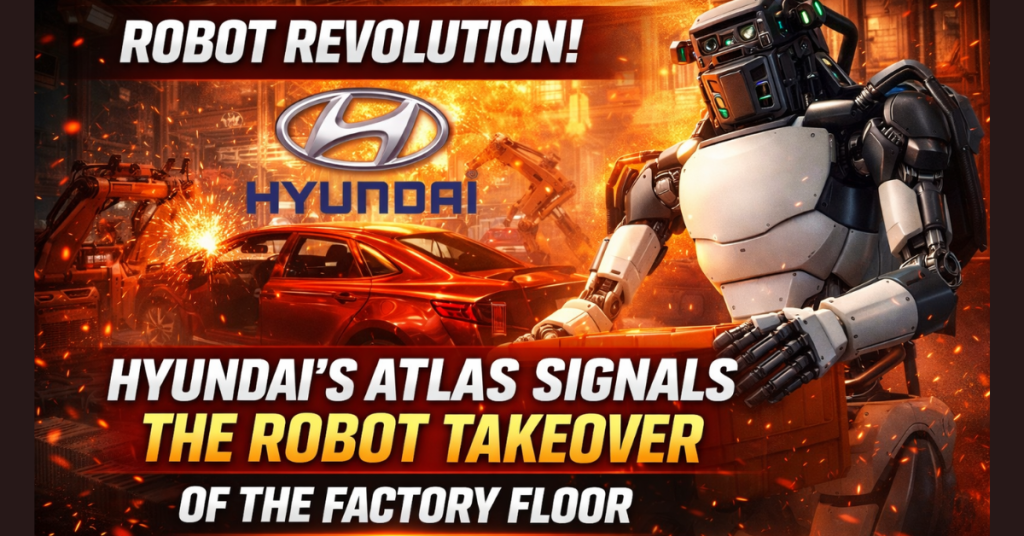
In a striking signal of how advanced robotics is transitioning from the research lab to industrial workhorses, Hyundai Motor Group — through its majority ownership of Boston Dynamics — unveiled a production-ready version of the Atlas humanoid robot at CES 2026, announcing plans for widespread deployment in its manufacturing operations by 2028. Reuters+1
The new Atlas represents a major departure from its earlier, highly athletic prototypes to a machine designed for real-world factory tasks — from parts sequencing to more intricate assembly roles slated for rollout after 2030. Hyundai’s announcement underscores a broader strategic bet that AI-driven humanoid robotics will be a cornerstone of future industrial productivity. Reuters+1
A Factory Robot, Not a Fancy Prototype
At the Las Vegas technology showcase, Hyundai and Boston Dynamics presented Atlas walking and gesturing in a live demonstration that hinted at its physical agility and balance. But the key takeaway was not showmanship — it was readiness for real labor environments. A production-oriented version of Atlas is already in fabrication, and the company expects the robot to begin service in Georgia-based manufacturing facilities as early as 2028. AP News
Unlike earlier models that were primarily research platforms, this iteration of Atlas boasts practical industrial specifications:
-
Human-scale manipulation and strength — able to lift significant loads and perform tasks that previously required human dexterity. Boston Dynamics
-
Autonomous capabilities — Atlas can navigate complex factory settings, manage its own battery life, and interact with production systems. Boston Dynamics
-
Built for production scale — Hyundai is building manufacturing capacity to produce up to 30,000 humanoid robots annually by 2028. Axios
Physical AI Meets Industrial Demand
Hyundai’s move places it at the center of what some analysts describe as the emergence of “physical AI” — the fusion of advanced artificial intelligence with embodied robots capable of operating in human environments. Instead of being confined to simulation labs or novelty showcases, robots like Atlas are now being positioned as productivity multipliers on the factory floor, with Hyundai betting they could become central to next-generation manufacturing. Hyundai News
The company’s robotics strategy extends beyond its own factories. At CES, Hyundai stressed that Atlas will be supported by partnerships with major AI and computing players such as Google DeepMind and NVIDIA, strengthening the cognitive capabilities that distinguish next-gen robots from traditional automation. Hyundai News
Competition and the Trillion-Dollar Robot Opportunity
Hyundai’s announcement also reflects a broader shift in the automotive and tech sectors — robots are no longer curiosities, but core technological platforms. Competitors like Tesla’s Optimus humanoid project and other advanced robotics programs signal that carmakers increasingly see humanoids not just as internal tools but as potentially mass-market products. Axios
Industry observers estimate that humanoid robotics could grow into a multi-billion- or even trillion-dollar segment of the physical AI market as robots expand from repetitive, high-strain factory work to logistics, inspection, and even collaborative roles alongside human teams. The size of that opportunity helps explain Hyundai’s aggressive investment plan — including tens of billions of dollars in U.S. facilities and technology partnerships aimed at driving scale and practical adoption. Axios
Why It Matters
Hyundai’s Atlas rollout strategy is significant for several reasons:
-
Industrial transformation: Robots that can operate with human-level dexterity and reasoning could redefine manufacturing productivity and workplace safety. Reuters
-
Economic implications: Mass production of humanoid robots could drive new industries, jobs in robot training and maintenance, and spur competitiveness in global supply chains. Axios
-
Societal impact: As robots absorb repetitive or hazardous tasks, questions about workforce displacement, skills retraining, and the future of human-machine collaboration will accelerate. Autoweek
In shifting Atlas from demo stages to real factory applications, Hyundai is betting that the age of practical humanoid robotics has arrived — and that those capable of integrating AI with physical autonomy will lead the next wave of industrial and economic innovation. Reuters