



Hepatic – MicroReport 4
ABBREVIATIONS:
5.3.6: Pfizer source document
SOC: System Organ Class
AE: Adverse Event
AESI: Adverse Event of Special Interest
EUA: Emergency Use Authorization by FDA
PM: Post-Marketing
BNT162b2: Pfizer’s mRNA COVID-19 vaccine
SEQUELAE: an abnormal condition resulting from a previous disease, injury, or other trauma
AGE GROUPS defined in 5.3.6 (p. 25 footnote):
Adult: 18–64
Elderly: ≥65
Child: 2–11
Adolescent: 12–<18
Infant: 1–23 months
Pfizer Document 5.3.6
BNT162b2
5.3.6 Cumulative Analysis of Post-authorization Adverse Event Reports
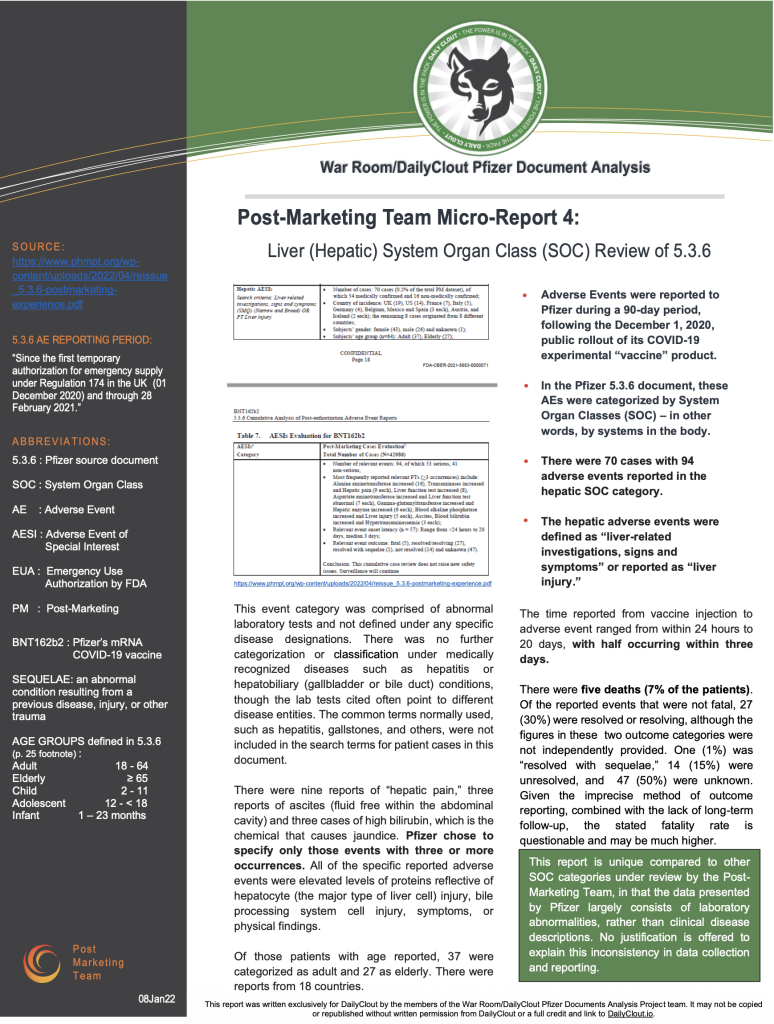
Hepatic AESIs
Search criteria:
Liver related investigations, signs and symptoms (SMQ) (Narrow and Broad) OR PT Liver injury
Pfizer Post-Marketing Cases Evaluation
- Number of cases: 70 cases (0.2% of the total PM dataset), of which 54 medically confirmed and 16 non-medically confirmed.
- Country of incidence: UK (19), US (14), France (7), Italy (5), Germany (4), Belgium, Mexico and Spain (3 each), Austria and Iceland (2 each); the remaining 8 cases originated from 8 different countries.
- Subjects’ gender: female (43), male (26) and unknown (1).
- Subjects’ age group: Adult (37), Elderly (27).
Table 7. AESIs Evaluation for BNT162b2
Post-Marketing Cases Evaluation
Total Number of Cases (N=42086)
- Number of relevant events: 94, of which 53 serious, 41 non-serious.
- Most frequently reported relevant PTs (>3 occurrences) included: Alanine aminotransferase increased (16), Transaminases increased and Hepatic pain (9 each), Liver function test increased (8), Aspartate aminotransferase increased and Liver function test abnormal (7 each), Gamma-glutamyltransferase increased and Hepatic enzyme increased (6 each), Blood alkaline phosphatase increased and Liver injury (5 each), Ascites, Blood bilirubin increased and Hypertransaminasemia (3 each).
- Relevant event onset latency (n=57): Range from <24 hours to 20 days, median 3 days.
- Relevant event outcome: fatal (5), resolved/resolving (27), resolved with sequelae (1), not resolved (14) and unknown (47).
Pfizer Conclusion:
“This cumulative case review does not raise new safety issues. Surveillance will continue.”
Micro-Report Summary
- Adverse Events were reported to Pfizer during a 90-day period, following the December 1, 2020, public rollout of its COVID-19 experimental “vaccine” product.
- In the Pfizer 5.3.6 document, these AEs were categorized by System Organ Classes (SOC) – in other words, by systems in the body.
- There were 70 cases with 94 adverse events reported in the hepatic SOC category.
- The hepatic adverse events were defined as “liver-related investigations, signs and symptoms” or reported as “liver injury.”
Explanation of the Hepatic Event Category
This event category was comprised of abnormal laboratory tests and not defined under any specific disease designations. There was no further categorization or classification under medically recognized diseases such as hepatitis or hepatobiliary (gallbladder or bile duct) conditions, though the lab tests cited often point to different disease entities.
The common terms normally used, such as hepatitis, gallstones, and others, were not included in the search terms for patient cases in this document.
There were nine reports of “hepatic pain,” three reports of ascites (fluid free within the abdominal cavity) and three cases of high bilirubin, which is the chemical that causes jaundice.
Pfizer chose to specify only those events with three or more occurrences.
All of the specific reported adverse events were elevated levels of proteins reflective of hepatocyte (the major type of liver cell) injury, bile processing system cell injury, symptoms, or physical findings.
Of those patients with age reported, 37 were categorized as adult and 27 as elderly. There were reports from 18 countries.
Timing of the Reported Events
The time reported from vaccine injection to adverse event ranged from within 24 hours to 20 days, with half occurring within three days.
Outcomes Highlighted by the Micro-Report
There were five deaths (7% of the patients).
Of the reported events that were not fatal, 27 (30%) were resolved or resolving, although the figures in these two outcome categories were not independently provided.
One (1%) was “resolved with sequelae,” 14 (15%) were unresolved, and 47 (50%) were unknown.
Given the imprecise method of outcome reporting, combined with the lack of long-term follow-up, the stated fatality rate is questionable and may be much higher.
Post-Marketing Team Observation
This report is unique compared to other SOC categories under review by the Post-Marketing Team, in that the data presented by Pfizer largely consists of laboratory abnormalities, rather than clinical disease descriptions. No justification is offered to explain this inconsistency in data collection and reporting.