



Gallup: Support for Childhood Shots Falls Sharply Since 2001
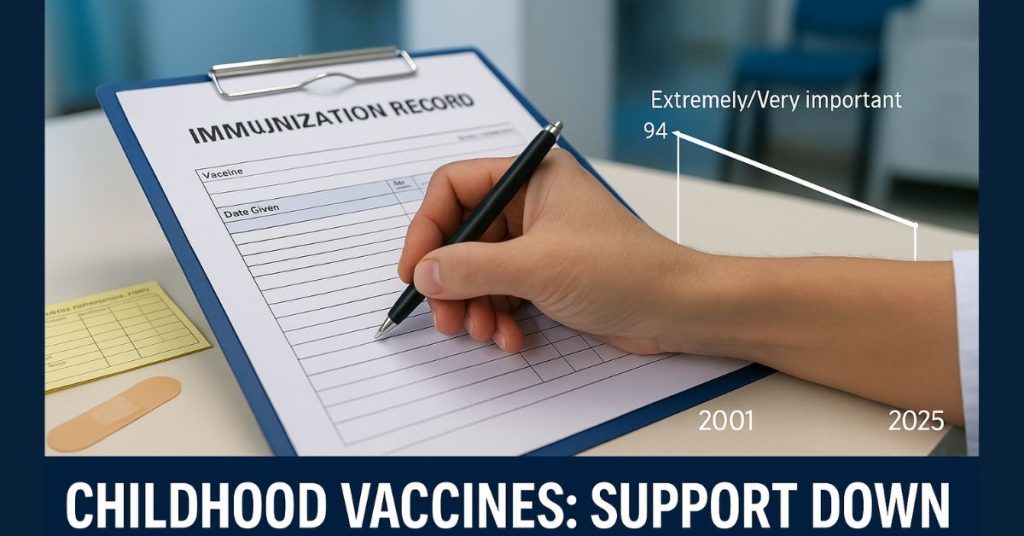
In Gallup’s July 1–21 survey (n=1,010; ±4 pts), just 40% of U.S. adults say it’s “extremely important” for parents to vaccinate their children—down from 58% in 2019 and 64% in 2001. The “extremely/very important” share has fallen from 94% in 2001 to 69% today. Republicans account for most of the shift: only 26% now call it “extremely important,” roughly half the 2019 level, while Democrats have changed little over two decades.
Partisan gap widens
A slim Republican majority (52%) still says vaccines are extremely or very important, but 93% of Democrats say the same. Eleven percent of Republicans now say childhood vaccination isn’t important at all. Among parents of minors, 29% call vaccination extremely important and 29% very important—down from 54% and 23% in 2019, respectively. The takeaway: the views that once looked bipartisan now break sharply along party lines.
Mandates: bare majority in favor
Mirroring the shift in attitudes, only 51% of Americans now say government should require childhood vaccinations for diseases like measles—down from 62% in 2019 and 81% in a 1991 benchmark. Again, Republicans drive the change: 36% favor requirements (down from 53% in 2019), and 60% oppose them. Democrats remain roughly steady at 69% in favor. Other recent surveys sometimes show higher support for school requirements, but Gallup’s long trendline captures how far views have moved since the early 1990s.
H2: Inside the Gallup childhood vaccine poll numbers
Despite the downturn in perceived importance, knowledge about vaccine advantages remains high: 88% say they’ve heard a great deal or fair amount (about flat since 2019). Paradoxically, fewer report hearing about disadvantages than five years ago (63%, down from 79%). Yet skepticism has grown: 20% now say vaccines are more dangerous than the diseases they prevent (up from 11% in 2019 and 6% in 2001). That view is held by 31% of Republicans versus 5% of Democrats.
On the enduring autism claim, 13% say “certain vaccines can cause autism,” up from 6% in 2015 and 10% in 2019; 36% say vaccines do not cause autism, and about half are unsure. Parents with minor children are slightly more likely than adults overall to say vaccines cause autism (18%).
What’s driving the shift
Three forces stand out:
-
Pandemic spillover: Positions hardened during COVID-19 and spilled into long-standing childhood schedules.
-
Trust sorting: Media, party cues, and messaging ecosystems now reinforce different priors about risk and authority.
-
Policy backlash: Mandate debates reframed vaccination from a community norm into a question of personal autonomy—especially on the right.
What to watch next
Public-health planners are dealing with two realities at once: high, stable awareness of benefits, and a smaller, more skeptical slice that sees greater risk and resists mandates. Expect efforts to shore up measles/MMR uptake in states where exemptions are broad, plus renewed emphasis on pediatric access and clear consent communication aimed at parents who are unsure—not hostile.
Bottom line
The Gallup childhood vaccine poll shows a durable, two-decade slide in perceived importance, concentrated among Republicans and reflected in softer support for mandates. Awareness remains wide, but skepticism has edged up. Reversing the trend will likely hinge less on blasting more facts than on rebuilding trust with parents who feel overruled by policy—and persuading them that routine shots protect their kids and their communities.
DailyClout.IO will continue to follow this story.
Sources and further reading:
https://news.gallup.com/poll/648308/far-fewer-regard-childhood-vaccinations-important.aspx
https://debeaumont.org/news/2025/poll-79-of-americans-support-routine-childhood-vaccine-requirements/
https://apnews.com/article/521201a8e4100f3cc1a8f1f5a7423b77
https://www.kff.org/medicaid/kindergarten-routine-vaccination-rates-continue-to-decline/