



DOJ Weighs Trans Gun Ban After Minneapolis Shooting
In the days after the Aug. 27, 2025 shooting at Annunciation Catholic School in Minneapolis—an attack that killed two children and wounded more than a dozen others—senior Justice Department officials met to examine whether the government could bar transgender people from purchasing or possessing firearms. People familiar with the meetings described them as exploratory. The White House acknowledged the conversations but said the idea is not currently on the Oval Office docket. The department, for its part, said it’s evaluating options to address violence linked to certain mental-health and substance-use factors and has not advanced a specific proposal.
The suspected shooter, identified by police as 23-year-old Robin Westman, died at the scene from a self-inflicted gunshot wound. Local officials have continued to refine the injury counts as victims received treatment and were identified.
The legal hook—and its limits
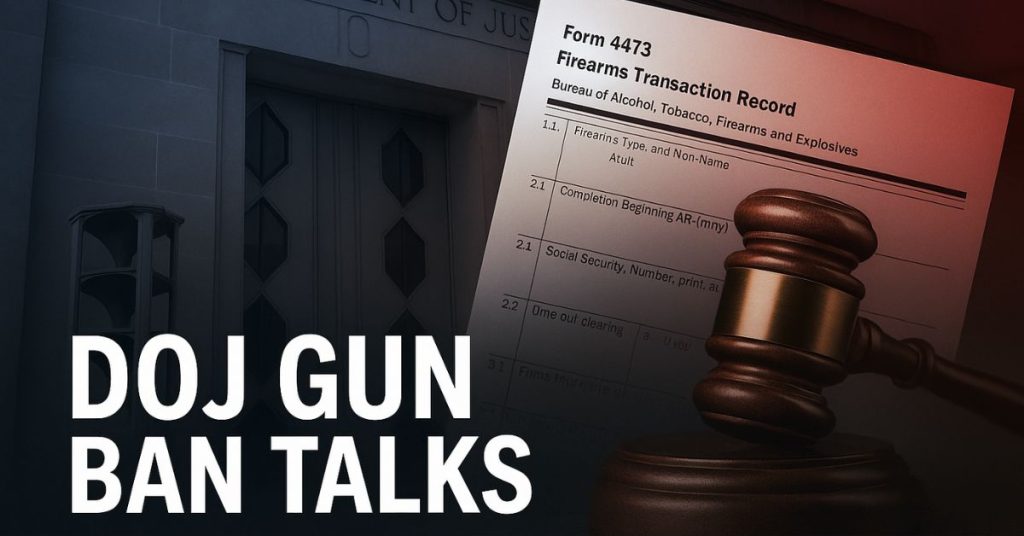
Participants in the discussions reviewed whether classifying gender dysphoria as a disqualifying mental-health condition could fit within existing federal firearms rules. Under current regulations, prohibited-person categories include individuals “adjudicated as a mental defective” or involuntarily committed—standards that rely on formal findings by a court or other lawful authority. The federal Form 4473 that retail buyers complete at the point of sale mirrors those categories.
Creating a new status-based bar that sweeps in all transgender people—many of whom have never been adjudicated or treated—would set up immediate legal challenges. It would test agency authority under administrative law and run head-on into Supreme Court Second Amendment precedents that require modern gun restrictions to comport with the nation’s historical tradition of firearm regulation. Even some gun-rights lawyers who typically favor strict enforcement of existing prohibitions have called a categorical, identity-based ban a nonstarter.
The data backdrop: rarity and risk
Policy built in the heat of a headline often falters under data. Mass shootings involving transgender suspects are extremely rare in large national datasets. By contrast, peer-reviewed research finds transgender people are far more likely to be victims of violent crime than cisgender people. Advocates argue that a blanket prohibition would punish a vulnerable minority for crimes overwhelmingly committed by others, while doing little to alter the overall risk profile.
That tension helps explain the White House’s caution and the Justice Department’s emphasis on evaluating options tied to adjudications, treatment histories, or substance-use flags—areas where federal and state law already provide clearer footing.
Where DOJ transgender gun restrictions could stumble
Statutory authority. Congress writes the gun laws; the Bureau of Alcohol, Tobacco, Firearms and Explosives (ATF) implements them. A sweeping new category defined by gender identity would invite challenges that ATF exceeded its mandate and skipped the historical-tradition test now required in Second Amendment litigation.
Medical consensus. Being transgender is not itself a mental illness. Gender dysphoria is a diagnosis some people experience, including some who are not transgender, and many transgender people do not meet criteria for it. A rule premised on identity rather than adjudicated impairment would be hard to defend with clinical evidence.
Enforcement mechanics. Short of court findings, the government would need a way to identify would-be purchasers by status—raising privacy, due-process, and discrimination concerns. The existing background-check form asks about adjudications and commitments; it does not ask about gender identity.
Precedent creep. Civil-rights groups warn that reclassifying a non-disqualifying status as a firearms disability would set a template to restrict other groups that aren’t currently barred, widening government discretion over who may exercise a constitutional right.
Politics: why this surfaced now
The talks began amid a wave of commentary that tried to pin the Minneapolis attack on the suspect’s gender identity. Even as some prominent conservatives amplified that narrative, others—including the president—downplayed any categorical link, noting that most mass shooters are not transgender. The result is a familiar policy arc: a trial balloon in response to a horrific crime, followed by legal reality checks and intraparty debate over strategy and optics.
What could happen next
No rule, for now. Absent a notice of proposed rulemaking from DOJ or ATF, there is no formal process underway. If one appears, it will trigger public comment and, almost certainly, rapid lawsuits.
State responses. Expect blue-state attorneys general to prepare challenges to any federal effort; some red states may float copycat bills to force a court test.
Narrower tools. If the department decides a status-based approach won’t survive, it could refocus on adjudication-driven mechanisms already on the books—such as better reporting to the background-check system, targeted threat-assessment, or tighter enforcement where courts have found individuals dangerous or incompetent.
Bottom line
The government is talking about a ban; it is not close to implementing one. The legal, medical, and practical hurdles to DOJ transgender gun restrictions are steep, and the data case for a categorical rule is weak. If the department moves at all, the most legally durable path runs through the standards that already exist—adjudications and commitments—not through identity. For now, this remains a trial balloon and a likely courtroom fight if it ever takes flight.
DailyClout.IO will continue to follow this story.
Sources and further reading:
https://www.washingtonpost.com/national-security/2025/09/04/guns-transgender-justice-trump-bondi-shootings/
https://www.minneapolismn.gov/news/2025/august/active-situation-august-27/
https://abcnews.go.com/US/minnesota-school-shooting-suspect-robin-westman/story?id=125029777
https://williamsinstitute.law.ucla.edu/press/ncvs-trans-press-release/