



Supreme Court Poised to Uphold State Bans in Women’s Sports
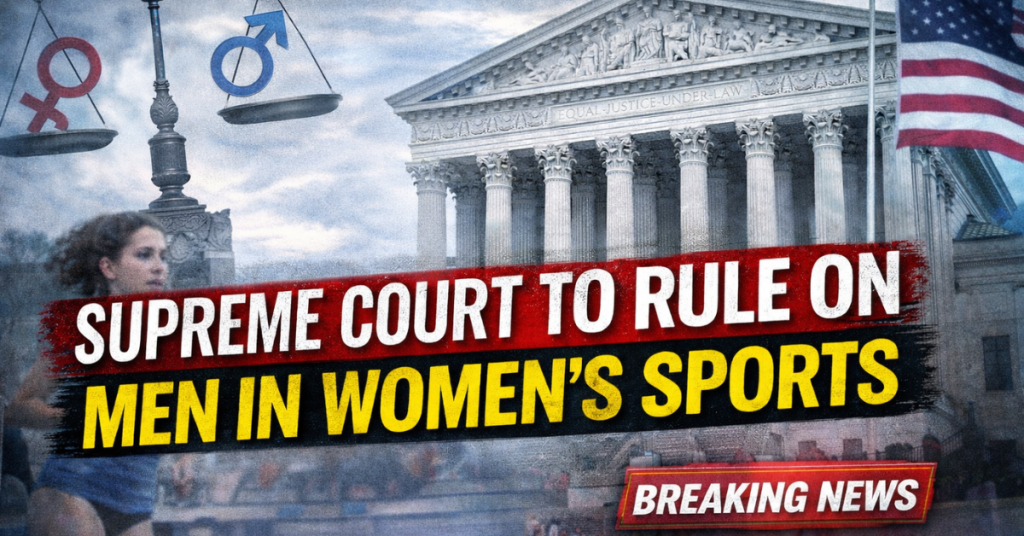
The debate over sex-segregated sports has reached a decisive stage in the American legal system, and all signs suggest that the Supreme Court of the United States may soon affirm the authority of states to restrict women’s sports to biological females.
At the center of the issue are laws passed by Republican-led states that prohibit male athletes from competing in women’s athletic categories. These measures, enacted across more than twenty states, argue that sex-based divisions are necessary to preserve fairness, safety, and equal opportunity for female athletes.
The Legal Question Before the Court
The core constitutional question is whether states violate federal civil-rights law, particularly Title IX, by enforcing sex-based athletic categories. Supporters of the bans argue the opposite: that Title IX itself was designed to protect women, and that allowing biological males to compete in women’s sports undermines the very purpose of the statute.
Recent emergency orders and procedural decisions from the Court suggest skepticism toward lower-court rulings that blocked these state laws. In multiple cases, the Court has allowed bans to remain in effect while litigation proceeds, a strong indicator of how the justices may ultimately rule.
Why the Court’s Direction Matters
The Supreme Court has increasingly emphasized textual interpretation of law. Title IX, passed in 1972, explicitly refers to “sex,” not gender identity. Several justices have indicated that redefining sex categories is a matter for legislatures, not courts or federal agencies.
This approach aligns with the Court’s broader pattern of reining in administrative overreach, particularly when executive agencies attempt to impose social policy without congressional authorization.
The Scientific and Competitive Reality
Supporters of the bans point to well-documented biological differences in muscle mass, bone density, and aerobic capacity that persist even after hormone suppression. Numerous studies show male puberty confers lasting athletic advantages, especially in speed and strength-based sports.
Female athletes and advocacy groups have testified that mixed-sex competition has resulted in lost scholarships, displaced podium finishes, and increased injury risk. These concerns have resonated with lawmakers and judges alike.
The Political and Cultural Context
While LGBTQ advocacy organizations frame the bans as discriminatory, public polling consistently shows that a majority of Americans oppose allowing biological males to compete in women’s sports, including a substantial portion of independents and Democrats.
Republican governors and legislators argue they are responding to constituents, not ideology. Their position is simple: women’s sports exist because sex differences matter.
What a Supreme Court Ruling Would Do
If the Court ultimately upholds these state laws, it would:
-
Affirm that states have the authority to define sex-based athletic categories
-
Limit the ability of federal agencies to rewrite civil-rights law through regulation
-
Set a nationwide legal precedent protecting women’s sports
-
Signal that cultural debates cannot override statutory language
Such a ruling would represent a major setback for national LGBTQ lobbying efforts that have relied on courts rather than legislatures to achieve policy goals.
A Defining Moment for Title IX
For decades, Title IX expanded opportunities for women by recognizing biological reality. The current cases force the Court to decide whether that framework will remain intact or be fundamentally transformed.
Based on the Court’s recent posture, many legal analysts believe the justices are prepared to restore clarity to the law and leave broader cultural questions to the democratic process.