



Respiratory – MicroReport 16
Main Finding
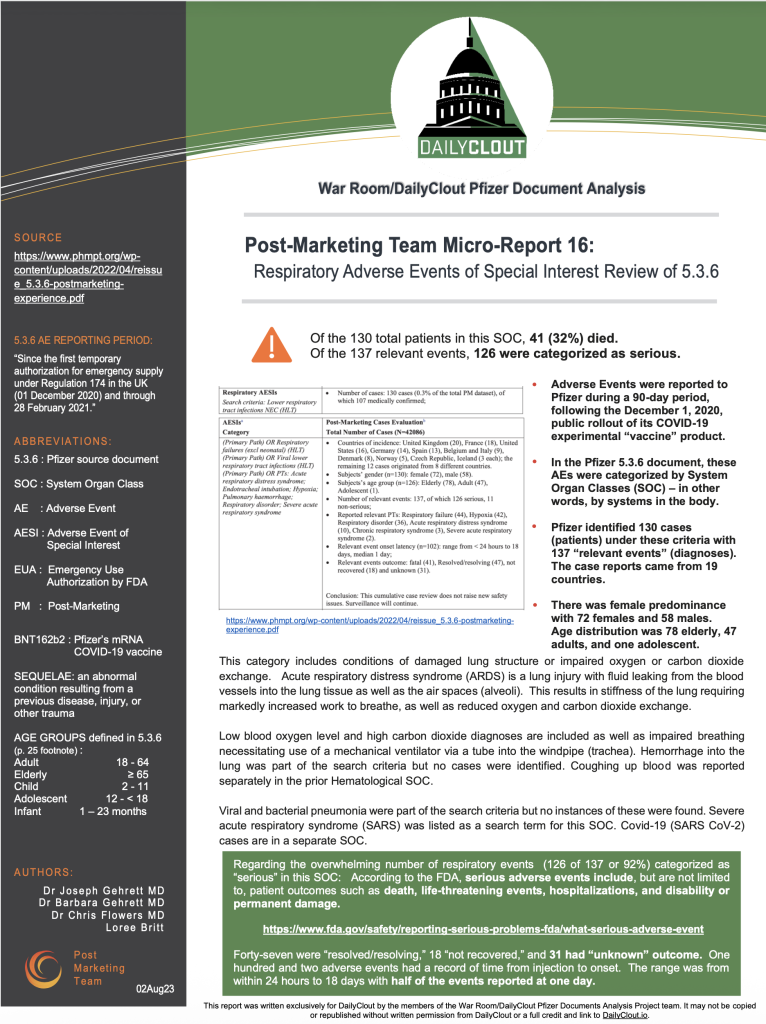
Of the 130 total patients in this SOC, 41 (32%) died. Of the 137 relevant events, 126 were categorized as serious.
Main Findings
-
Adverse Events were reported to Pfizer during a 90-day period, following the December 1, 2020, public rollout of its COVID-19 experimental “vaccine” product.
-
In the Pfizer 5.3.6 document, these AEs were categorized by System Organ Classes (SOC), in other words, by systems in the body.
-
Pfizer identified 130 cases (patients) under these criteria with 137 “relevant events” (diagnoses). The case reports came from 19 countries.
-
There was female predominance with 72 females and 58 males. Age distribution was 78 elderly, 47 adults, and one adolescent.
Respiratory Adverse Events of Special Interest
This category includes conditions of damaged lung structure or impaired oxygen or carbon dioxide exchange. Acute respiratory distress syndrome (ARDS) is a lung injury with fluid leaking from the blood vessels into the lung tissue as well as the air spaces (alveoli). This results in stiffness of the lung requiring markedly increased work to breathe, as well as reduced oxygen and carbon dioxide exchange.
Low blood oxygen level and high carbon dioxide diagnoses are included as well as impaired breathing necessitating use of a mechanical ventilator via a tube into the windpipe (trachea). Hemorrhage into the lung was part of the search criteria but no cases were identified. Coughing up blood was reported separately in the prior Hematological SOC.
Viral and bacterial pneumonia were part of the search criteria but no instances of these were found. Severe acute respiratory syndrome (SARS) was listed as a search term for this SOC. Covid-19 (SARS CoV-2) cases are in a separate SOC.
Severity and Reported Outcomes
Regarding the overwhelming number of respiratory events (126 of 137 or 92%) categorized as “serious” in this SOC: According to the FDA, serious adverse events include, but are not limited to, patient outcomes such as death, life-threatening events, hospitalizations, and disability or permanent damage.
Source: FDA: What Is a Serious Adverse Event?
Forty-seven were “resolved/resolving,” 18 “not recovered,” and 31 had an “unknown” outcome. One hundred and two adverse events had a record of time from injection to onset. The range was from within 24 hours to 18 days with half of the events reported at one day.
Specific Respiratory Adverse Events
In the 5.3.6 document, Pfizer reported 42 adverse events as low arterial oxygen levels. An additional 44 had “Respiratory failure,” which would include all cases requiring a ventilator, but other medical diagnoses are not specified. Ten adverse events were diagnosed with ARDS. Thirty-six adverse events were a non-specific “Respiratory disorder,” and three were “Chronic respiratory syndrome.” Two patients were defined as “Severe acute respiratory syndrome” (SARS).
Post-Marketing Team’s Assessment
This SOC is interesting in that there was a high percentage of the adverse events that were serious (92%), and 44 adverse events (32%) were “respiratory failure.” Pfizer was vague in defining what happened. How many were put on a ventilator in an ICU? How many of those with ARDS placed on a ventilator developed severe, long-term lung impairment or even chronic ventilator or oxygen dependency? The outcome category of “resolved with sequelae” is missing from this SOC, while it is present in the majority of the other Table 7 SOCs. Instead, Pfizer reports a large percentage of “not recovered” and “unknown” outcomes in this SOC with a high percentage of deaths and serious adverse events.
The early vaccine program prioritized the elderly and those with chronic diseases. Pfizer has this SOC and others with serious adverse events and a high mortality rate. Where are the studies to show there is a net benefit to vaccination with BNT162b2 in cohorts with varied chronic diseases?
Why Were Two Patients Reported as Having SARS?
This disease has not been seen around the world since 2004, according to the CDC website:
“Since 2004, there have not been any known cases of SARS reported anywhere in the world. The content in this website was developed for the 2003 SARS epidemic. But some guidelines are still being used. Any new SARS updates will be posted on this website.”
Source: CDC: Severe Acute Respiratory Syndrome (SARS) (accessed August 2, 2023).
This is a problem. There is no explanation for the SARS diagnosis, though the SARS virus was a different coronavirus, SARS-CoV-1.
Pfizer’s Conclusion
“This cumulative case review does not raise new safety issues. Surveillance will continue.”
Post-Marketing Team’s Conclusion
RECALL this unsafe “vaccine.”
Reference Information
5.3.6 AE Reporting Period
“Since the first temporary authorization for emergency supply under Regulation 174 in the UK (01 December 2020) and through 28 February 2021.”
5.3.6 AE Cases/Events
| Category | Total |
|---|---|
| Total AE cases | 42,086 |
| Total AE events | 158,893 |
Abbreviations
-
5.3.6: Pfizer source document
-
SOC: System Organ Class
-
AE: Adverse Event
-
AESI: Adverse Event of Special Interest
-
EUA: Emergency Use Authorization by FDA
-
PM: Post-Marketing
-
BNT162b2: Pfizer’s mRNA COVID-19 vaccine
-
Sequelae: An abnormal condition resulting from a previous disease, injury, or other trauma
Age Groups Defined in 5.3.6 (p. 25 footnote)
| Age group | Age range |
|---|---|
| Adult | 18–64 |
| Elderly | 65 and older |
| Child | 2–11 |
| Adolescent | 12–17 |
| Infant | 1–23 months |