



Vasculitis – MicroReport 12
Main Findings
-
Adverse Events were reported to Pfizer during a 90-day period, following the December 1, 2020, public rollout of its COVID-19 experimental “vaccine” product.
-
In the Pfizer 5.3.6 document, these AEs were categorized by System Organ Classes (SOC), in other words, by systems in the body.
-
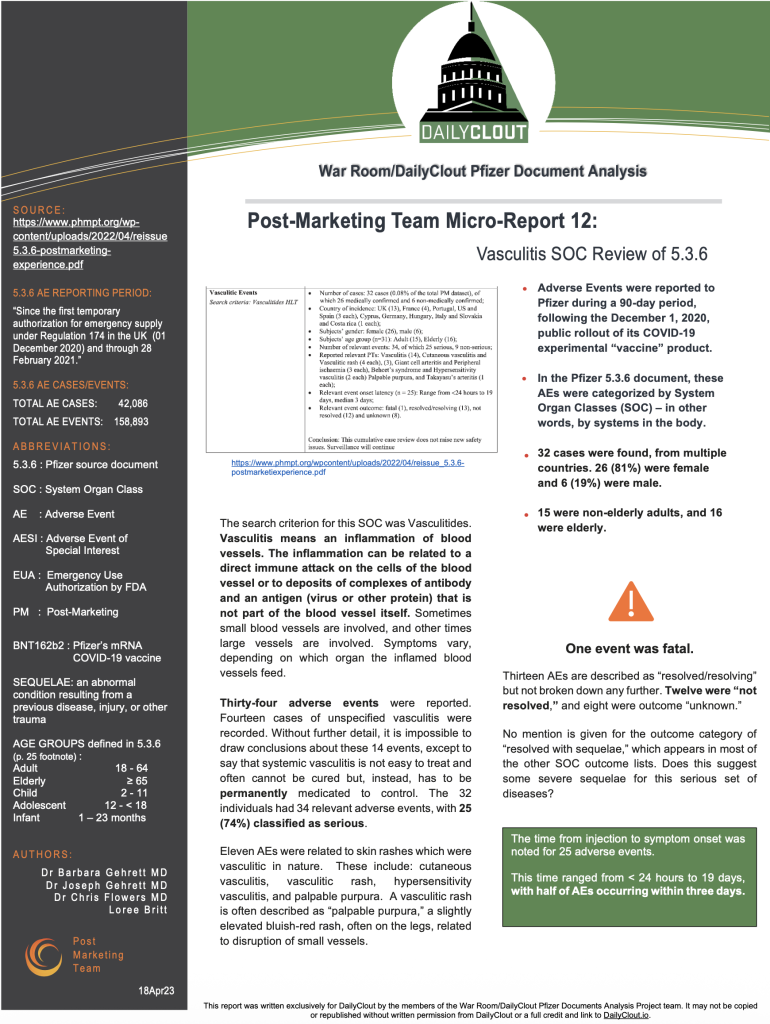
32 cases were found, from multiple countries. 26 (81%) were female and 6 (19%) were male.
-
15 were non-elderly adults, and 16 were elderly.
Vasculitis and Reported Adverse Events
The search criterion for this SOC was Vasculitides. Vasculitis means an inflammation of blood vessels. The inflammation can be related to a direct immune attack on the cells of the blood vessel or to deposits of complexes of antibody and an antigen (virus or other protein) that is not part of the blood vessel itself. Sometimes small blood vessels are involved, and other times large vessels are involved. Symptoms vary, depending on which organ the inflamed blood vessels feed.
Thirty-four adverse events were reported. Fourteen cases of unspecified vasculitis were recorded. Without further detail, it is impossible to draw conclusions about these 14 events, except to say that systemic vasculitis is not easy to treat and often cannot be cured but, instead, has to be permanently medicated to control. The 32 individuals had 34 relevant adverse events, with 25 (74%) classified as serious.
Eleven AEs were related to skin rashes which were vasculitic in nature. These include: cutaneous vasculitis, vasculitic rash, hypersensitivity vasculitis, and palpable purpura. A vasculitic rash is often described as “palpable purpura,” a slightly elevated bluish-red rash, often on the legs, related to disruption of small vessels.
Reported Outcomes
One event was fatal.
Thirteen AEs are described as “resolved/resolving” but not broken down any further. Twelve were “not resolved,” and eight were outcome “unknown.”
No mention is given for the outcome category of “resolved with sequelae,” which appears in most of the other SOC outcome lists. Does this suggest some severe sequelae for this serious set of diseases?
Time From Injection to Symptom Onset
The time from injection to symptom onset was noted for 25 adverse events.
This time ranged from less than 24 hours to 19 days, with half of AEs occurring within three days.
Specific Vasculitis Conditions
Pfizer received reports of three cases of Giant cell arteritis, a serious syndrome that causes headache and visual symptoms. It can lead to blindness in the affected eye if it is not recognized and treated quickly. Giant cell arteritis is often associated with polymyalgia rheumatica, a debilitating condition that causes weakness, aching, and stiffness in the shoulders and hips. Polymyalgia rheumatica is much more common than Giant cell arteritis, but no cases of polymyalgia rheumatica were recorded in the musculoskeletal SOC. However, that SOC had 3,525 instances of arthralgia (joint aching), and Table 2 of 5.3.6 recorded 4,915 instances of myalgia (muscle aching), which might easily have included developing polymyalgia rheumatica.
Three cases of peripheral ischemia were reported. This indicates that blood vessels feeding an arm, leg or digit were inflamed enough to cause impairment of blood flow. This threatens the loss of the affected area, with gangrene and perhaps even amputation as a result.
Two instances of Behçet’s syndrome were reported. Behçet’s syndrome is an unusual form of vasculitis that has mouth, skin, and genital sores, often with eye inflammation (uveitis) and blood clots. These patients may have neurologic symptoms as well.
Finally, one case of Takayasu’s arteritis is included. This is a very serious and very rare condition. The NIH website Genetic and Rare Diseases states that a population estimate of Takayasu’s arteritis in the U.S. is fewer than 5,000 cases in the entire country. The blood vessels inflamed are usually the aorta and its main branches. Takayasu’s is most common among women under 40. It is also a condition that may develop slowly and manifest itself well after the start of the inflammation of the blood vessels. The fact that one case of Takayasu’s arteritis was described in the first 90 days of general use of the Pfizer product is very concerning.
Source: Takayasu Arteritis: Genetic and Rare Diseases Information Center (NIH). Accessed April 1, 2023.
Pfizer’s Conclusion
“This cumulative case review does not raise new safety issues. Surveillance will continue.”
Note: As of the date of this team report, no additional safety data have been publicly released.
Post-Marketing Team’s Conclusion
RECALL this unsafe “vaccine.”
Reference Information
5.3.6 AE Reporting Period
“Since the first temporary authorization for emergency supply under Regulation 174 in the UK (01 December 2020) and through 28 February 2021.”
5.3.6 AE Cases/Events
| Category | Total |
|---|---|
| Total AE cases | 42,086 |
| Total AE events | 158,893 |
Abbreviations
-
5.3.6: Pfizer source document
-
SOC: System Organ Class
-
AE: Adverse Event
-
AESI: Adverse Event of Special Interest
-
EUA: Emergency Use Authorization by FDA
-
PM: Post-Marketing
-
BNT162b2: Pfizer’s mRNA COVID-19 vaccine
-
Sequelae: An abnormal condition resulting from a previous disease, injury, or other trauma
Age Groups Defined in 5.3.6 (p. 25 footnote)
| Age group | Age range |
|---|---|
| Adult | 18–64 |
| Elderly | 65 and older |
| Child | 2–11 |
| Adolescent | 12–17 |
| Infant | 1–23 months |