



Cardiovascular – MicroReport 5
ABBREVIATIONS:
5.3.6: Pfizer source document
SOC: System Organ Class
AE: Adverse Event
AESI: Adverse Event of Special Interest
EUA: Emergency Use Authorization by FDA
PM: Post-Marketing
BNT162b2: Pfizer’s mRNA COVID-19 vaccine
SEQUELAE: an abnormal condition resulting from a previous disease, injury, or other trauma
AGE GROUPS defined in 5.3.6 (p. 25 footnote):
Adult: 18–64
Elderly: ≥65
Child: 2–11
Adolescent: 12–<18
Infant: 1–23 months
Pfizer Document 5.3.6
BNT162b2
5.3.6 Cumulative Analysis of Post-authorization Adverse Event Reports
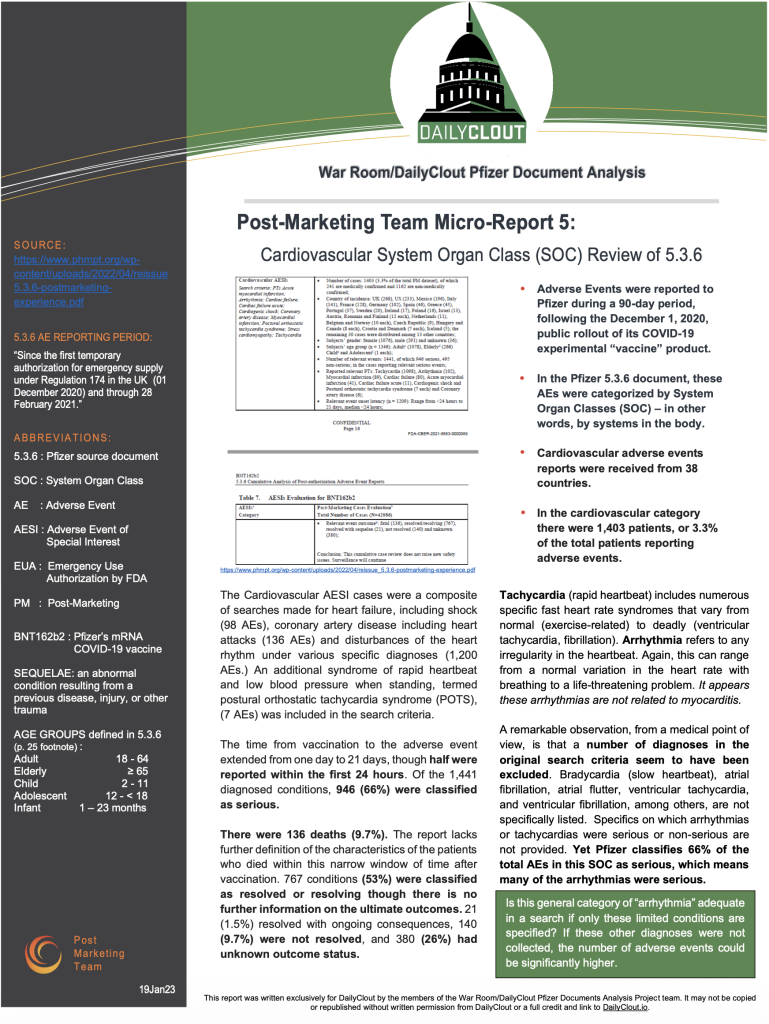
Cardiovascular AESIs
Search criteria:
PT: Acute myocardial infarction; Arrhythmia; Cardiac failure; Cardiac failure acute; Cardiogenic shock; Coronary artery disease; Myocardial infarction; Postural orthostatic tachycardia syndrome; Stress cardiomyopathy; Tachycardia
Pfizer Post-Marketing Cases Evaluation
- Number of cases: 1,403 (3.3% of the total PM dataset), of which 241 are medically confirmed and 1,162 are non-medically confirmed.
- Country of incidence: UK (528), US (231), Mexico (196), Italy (141), France (125), Germany (102), Spain (45), Greece (45), Portugal (37), Sweden (20), Ireland (17), Poland (16), Israel (13), Austria, Romania and Finland (12 each), Netherlands (11), Belgium and Norway (10 each), Czech Republic (9), Hungary and Canada (8 each), Croatia and Denmark (7 each), Iceland (5); the remaining 30 cases were distributed among 18 other countries.
- Subjects’ gender: female (1076), male (291) and unknown (36).
- Subjects’ age group: Adult (796), Elderly (278), Child and Adolescent (1 each).
- Number of relevant events: 1,441, of which 946 serious, 495 non-serious.
- Reported relevant PTs: Tachycardia (1097), Arrhythmia (102), Myocardial infarction (89), Cardiac failure (80), Acute myocardial infarction (41), Cardiac failure acute (11), Cardiogenic shock and Postural orthostatic tachycardia syndrome (7 each) and Coronary artery disease (6).
- Relevant event onset latency (n=1209): Range from <24 hours to 21 days, median <24 hours.
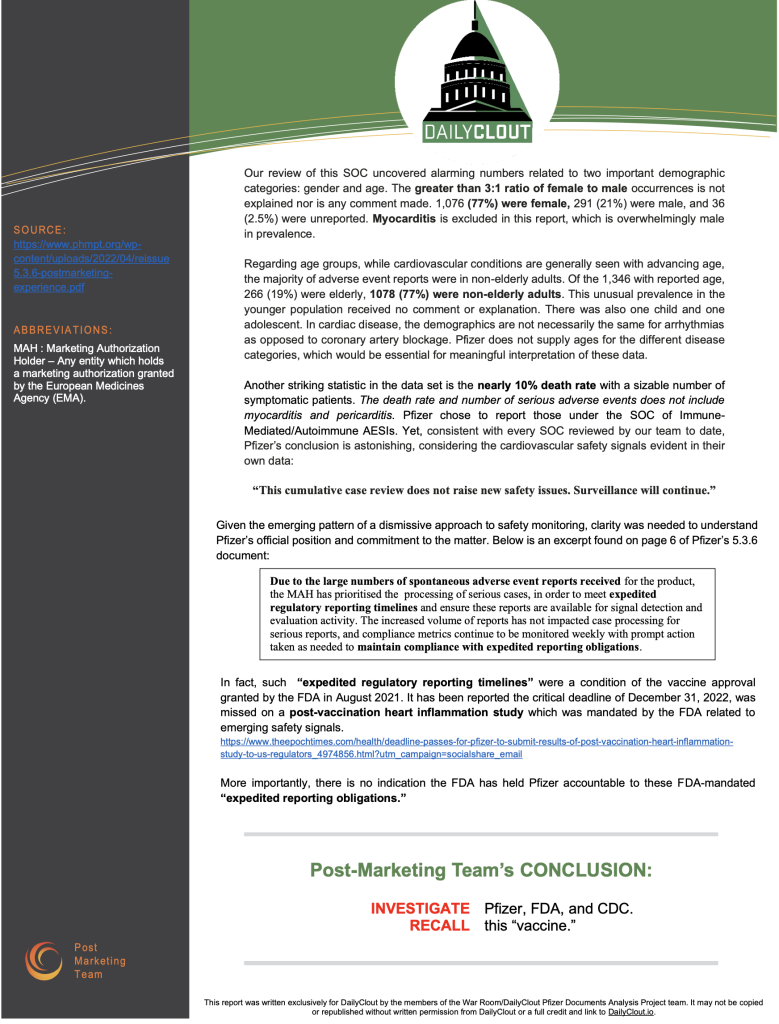
Table 7. AESIs Evaluation for BNT162b2
Relevant Event Outcome
- Fatal (136)
- Resolved/resolving (767)
- Resolved with sequelae (21)
- Not resolved (140)
- Unknown (380)
Pfizer Conclusion:
“This cumulative case review does not raise new safety issues. Surveillance will continue.”
Micro-Report Summary
- Adverse Events were reported to Pfizer during a 90-day period, following the December 1, 2020, public rollout of its COVID-19 experimental “vaccine” product.
- In the Pfizer 5.3.6 document, these AEs were categorized by System Organ Classes (SOC) – in other words, by systems in the body.
- Cardiovascular adverse events reports were received from 38 countries.
- In the cardiovascular category there were 1,403 patients, or 3.3% of the total patients reporting adverse events.
Explanation of the Cardiovascular Category
The Cardiovascular AESI cases were a composite of searches made for heart failure, including shock (98 AEs), coronary artery disease including heart attacks (136 AEs) and disturbances of the heart rhythm under various specific diagnoses (1,200 AEs). An additional syndrome of rapid heartbeat and low blood pressure when standing, termed postural orthostatic tachycardia syndrome (POTS), (7 AEs) was included in the search criteria.
The time from vaccination to the adverse event extended from one day to 21 days, though half were reported within the first 24 hours. Of the 1,441 diagnosed conditions, 946 (66%) were classified as serious.
There were 136 deaths (9.7%). The report lacks further definition of the characteristics of the patients who died within this narrow window of time after vaccination. 767 conditions (53%) were classified as resolved or resolving though there is no further information on the ultimate outcomes. 21 (1.5%) resolved with ongoing consequences, 140 (9.7%) were not resolved, and 380 (26%) had unknown outcome status.
Tachycardia and Arrhythmia
Tachycardia (rapid heartbeat) includes numerous specific fast heart rate syndromes that vary from normal (exercise-related) to deadly (ventricular tachycardia, fibrillation).
Arrhythmia refers to any irregularity in the heartbeat. Again, this can range from a normal variation in the heart rate with breathing to a life-threatening problem.
It appears these arrhythmias are not related to myocarditis.
A remarkable observation, from a medical point of view, is that a number of diagnoses in the original search criteria seem to have been excluded.
Bradycardia (slow heartbeat), atrial fibrillation, atrial flutter, ventricular tachycardia, and ventricular fibrillation, among others, are not specifically listed.
Specifics on which arrhythmias or tachycardias were serious or non-serious are not provided.
Yet Pfizer classifies 66% of the total AEs in this SOC as serious, which means many of the arrhythmias were serious.
Post-Marketing Team Observation
Is this general category of “arrhythmia” adequate in a search if only these limited conditions are specified? If these other diagnoses were not collected, the number of adverse events could be significantly higher.
PAGE 2
Gender Distribution
Our review of this SOC uncovered alarming numbers related to two important demographic categories: gender and age.
The greater than 3:1 ratio of female to male occurrences is not explained nor is any comment made. 1,076 (77%) were female, 291 (21%) were male, and 36 (2.5%) were unreported.
Myocarditis is excluded in this report, which is overwhelmingly male in prevalence.
Age Distribution
Regarding age groups, while cardiovascular conditions are generally seen with advancing age, the majority of adverse event reports were in non-elderly adults.
Of the 1,346 with reported age, 266 (19%) were elderly, 1078 (77%) were non-elderly adults. This unusual prevalence in the younger population received no comment or explanation. There was also one child and one adolescent.
In cardiac disease, the demographics are not necessarily the same for arrhythmias as opposed to coronary artery blockage. Pfizer does not supply ages for the different disease categories, which would be essential for meaningful interpretation of these data.
Deaths and Serious Adverse Events
Another striking statistic in the data set is the nearly 10% death rate with a sizable number of symptomatic patients.
The death rate and number of serious adverse events does not include myocarditis and pericarditis.
Pfizer chose to report those under the SOC of Immune-Mediated/Autoimmune AESIs.
Yet, consistent with every SOC reviewed by our team to date, Pfizer’s conclusion is astonishing, considering the cardiovascular safety signals evident in their own data:
“This cumulative case review does not raise new safety issues. Surveillance will continue.”
Pfizer’s Statement on Processing Serious Cases
Given the emerging pattern of a dismissive approach to safety monitoring, clarity was needed to understand Pfizer’s official position and commitment to the matter.
Below is an excerpt found on page 6 of Pfizer’s 5.3.6 document:
“Due to the large numbers of spontaneous adverse event reports received for the product, the MAH has prioritised the processing of serious cases, in order to meet expedited regulatory reporting timelines and ensure these reports are available for signal detection and evaluation activity. The increased volume of reports has not impacted case processing for serious reports, and compliance metrics continue to be monitored weekly with prompt action taken as needed to maintain compliance with expedited reporting obligations.”
ABBREVIATION:
MAH: Marketing Authorization Holder – Any entity which holds a marketing authorization granted by the European Medicines Agency (EMA).
Post-Vaccination Heart Inflammation Study
In fact, such “expedited regulatory reporting timelines” were a condition of the vaccine approval granted by the FDA in August 2021.
It has been reported the critical deadline of December 31, 2022, was missed on a post-vaccination heart inflammation study which was mandated by the FDA related to emerging safety signals.
Source cited in the report:
https://www.theepochtimes.com/health/deadline-passes-for-pfizer-to-submit-results-of-post-vaccination-heart-inflammation-study-to-us-regulators_4974856.html?utm_campaign=socialshare_email
More importantly, there is no indication the FDA has held Pfizer accountable to these FDA-mandated “expedited reporting obligations.”