



Stroke – MicroReport 2
ABBREVIATIONS:
5.3.6: Pfizer source document
SOC: System Organ Class
AE: Adverse Event
AESI: Adverse Event of Special Interest
EUA: Emergency Use Authorization by FDA
PM: Post-Marketing
BNT162b2: Pfizer’s mRNA COVID-19 vaccine
SEQUELAE: an abnormal condition resulting from a previous disease, injury, or other trauma
AGE GROUPS defined in 5.3.6 (p. 25 footnote):
Adult: 18–64
Elderly: ≥65
Child: 2–11
Adolescent: 12–<18
Infant: 1–23 months
Pfizer Document 5.3.6
BNT162b2
5.3.6 Cumulative Analysis of Post-authorization Adverse Event Reports
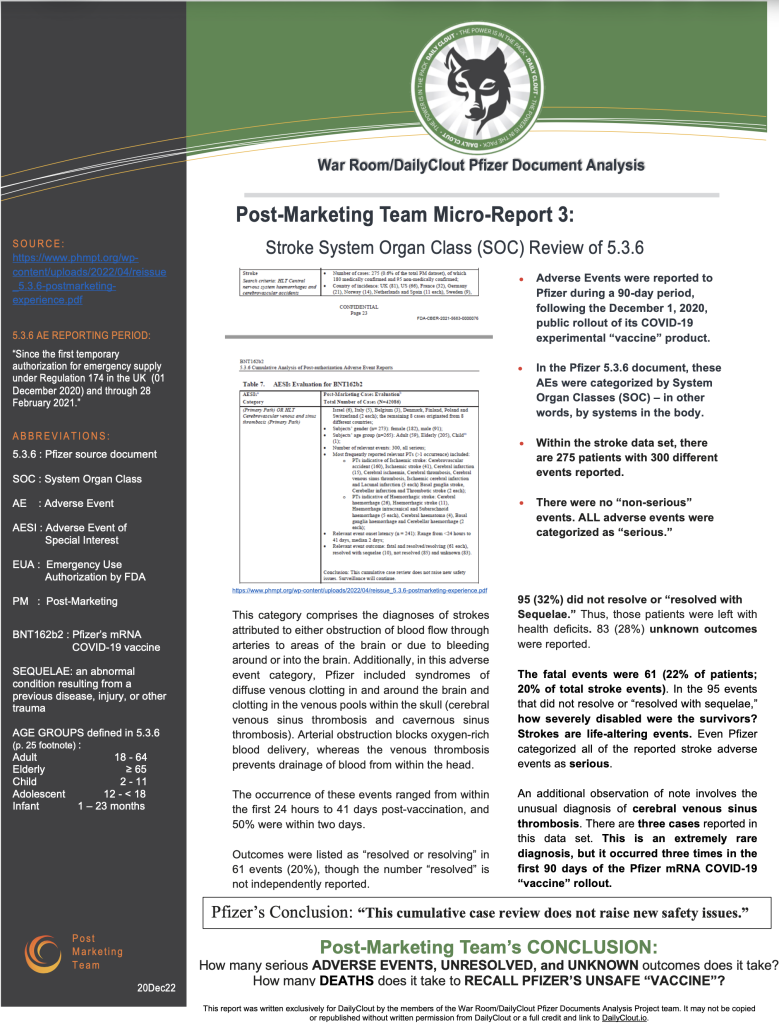
Stroke
Search criteria:
HLT Central nervous system hemorrhages and cerebrovascular accidents
Pfizer Post-Marketing Cases Evaluation
- Number of cases: 275 (0.6% of the total PM dataset), of which 180 medically confirmed and 95 non-medically confirmed.
- Country of incidence: UK (81), US (66), France (23), Germany (21), Norway (14), Netherlands and Spain (11 each), Sweden (9), Israel (8), Italy (5), Belgium (3), Denmark, Finland, Poland and Switzerland (2 each); the remaining 8 cases originated from 8 different countries.
- Subjects’ gender (n=273): female (182), male (91).
- Subjects’ age group (n=265): Adult (95), Elderly (205), Child (1).
- Number of relevant events: 300, all serious.
- Most frequently reported relevant PTs (>1 occurrence) included:
- Cerebrovascular accident (160)
- Ischaemic stroke (41)
- Cerebral infarction (15)
- Cerebral ischaemia
- Cerebral thrombosis
- Cerebral venous sinus thrombosis
- Ischaemic cerebral infarction
- Lacunar infarction
- Subarachnoid haemorrhage
- Cerebral haemorrhage
- Basal ganglia haemorrhage
- Cerebellar haemorrhage
- Haemorrhagic stroke
- Hemiplegia
- Hemiparesis
- Relevant event onset latency (n=241): Range from <24 hours to 41 days, median 2 days.
- Relevant event outcome: fatal and resolved/resolving (61 each), resolved with sequelae (10), not resolved (85) and unknown (83).
Pfizer Conclusion:
“This cumulative case review does not raise new safety issues. Surveillance will continue.”
Additional Pfizer Table Shown in the Graphic
The graphic also reproduces Table 7: AESIs Evaluation for BNT162b2 from Pfizer’s 5.3.6 document.
AESI Category
(Primary Path) OR HLT Cerebrovascular venous and sinus thrombosis (Primary Path)
Post-Marketing Cases Evaluation
Total Number of Cases (N=42086)
- Israel (6), Italy (5), Belgium (3), Denmark, Finland, Poland and Switzerland (2 each); the remaining 8 cases originated from 8 different countries.
- Subjects’ gender (n=273): female (182), male (91).
- Subjects’ age group (n=265): Adult (95), Elderly (205), Child (1).
- Number of relevant events: 300, all serious.
- Most frequently reported relevant PTs (>1 occurrence) included:
- 160 cerebrovascular accident
- 41 ischaemic stroke
- 15 cerebral infarction
- cerebral ischaemia
- cerebral thrombosis
- cerebral venous sinus thrombosis
- ischaemic cerebral infarction
- lacunar infarction
- subarachnoid haemorrhage
- cerebral haemorrhage
- basal ganglia haemorrhage
- cerebral haematoma
- haemorrhagic stroke
- cerebellar haemorrhage
- haemorrhagic stroke
- Relevant event onset latency (n=241): Range from <24 hours to 41 days, median 2 days.
- Relevant event outcome: fatal and resolved/resolving (61 each), resolved with sequelae (10), not resolved (85) and unknown (83).
Pfizer Conclusion:
“This cumulative case review does not raise new safety issues. Surveillance will continue.”
Micro-Report Summary
- Adverse Events were reported to Pfizer during a 90-day period, following the December 1, 2020, public rollout of its COVID-19 experimental “vaccine” product.
- In the Pfizer 5.3.6 document, these AEs were categorized by System Organ Classes (SOC) – in other words, by systems in the body.
- Within the stroke data set, there are 275 patients with 300 different events reported.
- There were no “non-serious” events. ALL adverse events were categorized as “serious.”
Explanation of the Stroke Category
This category comprises the diagnoses of strokes attributed to either obstruction of blood flow through arteries to areas of the brain or due to bleeding around or into the brain.
Additionally, in this adverse event category, Pfizer included syndromes of diffuse venous clotting in and around the brain and clotting in the venous pools within the skull (cerebral venous sinus thrombosis and cavernous sinus thrombosis).
Arterial obstruction blocks oxygen-rich blood delivery, whereas the venous thrombosis prevents drainage of blood from within the head.
Timing of the Reported Events
The occurrence of these events ranged from within the first 24 hours to 41 days post-vaccination, and 50% were within two days.
Outcomes were listed as “resolved or resolving” in 61 events (20%), though the number “resolved” is not independently reported.
Outcomes Highlighted by the Micro-Report
95 (32%) did not resolve or “resolved with Sequelae.” Thus, those patients were left with health deficits.
83 (28%) unknown outcomes were reported.
Fatal Events
The fatal events were 61 (22% of patients; 20% of total stroke events).
In the 95 events that did not resolve or “resolved with sequelae,” how severely disabled were the survivors?
Strokes are life-altering events.
Even Pfizer categorized all of the reported stroke adverse events as serious.
Cerebral Venous Sinus Thrombosis
An additional observation of note involves the unusual diagnosis of cerebral venous sinus thrombosis.
There are three cases reported in this data set.
This is an extremely rare diagnosis, but it occurred three times in the first 90 days of the Pfizer mRNA COVID-19 “vaccine” rollout.
Pfizer’s Conclusion:
“This cumulative case review does not raise new safety issues.”
Post-Marketing Team’s CONCLUSION:
How many serious ADVERSE EVENTS, UNRESOLVED, and UNKNOWN outcomes does it take?
How many DEATHS does it take to RECALL PFIZER’S UNSAFE “VACCINE”?
AUTHORS:
Dr Barbara Gehrett MD
Dr Joseph Gehrett MD
Dr Chris Flowers MD
Loree Britt
Post Marketing Team
20Dec22
Publication Notice
This report was written exclusively for DailyClout by the members of the War Room/DailyClout Pfizer Documents Analysis Project team. It may not be copied or republished without written permission from DailyClout or a full credit and link to DailyClout.io.
One caution on the embedded table: it is extremely small in the supplied image, so I would not treat every diagnosis/count I transcribed from that tiny table as letter-perfect without comparing it against the original Pfizer PDF. The large-format text, figures such as 275 cases, 300 events, 61 fatal events, 85 not resolved, 83 unknown, 10 resolved with sequelae, and the surrounding Micro-Report prose are clearly legible in the image.