



Hunter Laptop Letter Back Under Federal Scrutiny
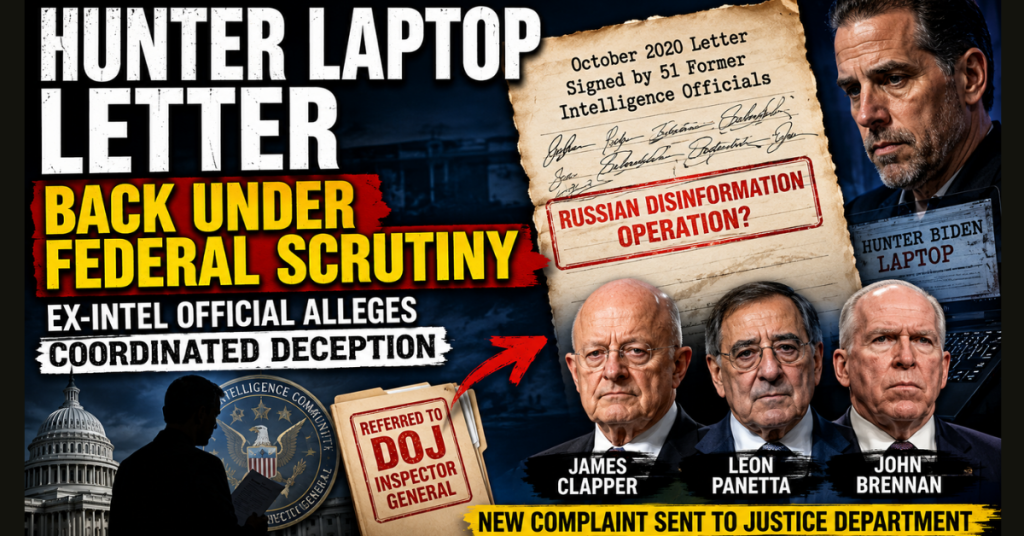
A new whistleblower complaint has reignited scrutiny of one of the most controversial intelligence-related episodes of the 2020 presidential election: the letter signed by 51 former intelligence officials that suggested reports about Hunter Biden’s laptop bore the “hallmarks” of a Russian disinformation operation.
According to newly revealed documents, a former senior intelligence official has asked federal watchdogs to examine whether the creation and promotion of the letter itself resembled a coordinated intelligence deception operation. The complaint has now been referred for further review by federal authorities.
Former Intelligence Official Raises Concerns
The complaint was filed by Thomas Kuhns, a former Senior Intelligence Officer who served as an adviser to the Deputy Director of National Intelligence during the Obama administration. Kuhns told the Intelligence Community Inspector General that his concerns stemmed from decades spent working to uphold intelligence community standards and analytical integrity.
According to his memo, Kuhns conducted a detailed review of the October 2020 letter signed by 51 former intelligence officials. He argued that the planning, drafting, and dissemination of the document displayed characteristics commonly associated with intelligence tradecraft and influence operations.
The complaint reportedly focused on factors such as coordination among former intelligence officials, selective presentation of information, omissions of known facts, and reliance on the authority of former government positions to influence public perception.
The Letter That Shaped the 2020 Election Narrative
The original letter was released just weeks before the 2020 presidential election after the New York Post published reports based on material recovered from Hunter Biden’s abandoned laptop.
The signatories stated they did not possess evidence proving Russian involvement. However, they argued that the circumstances surrounding the laptop story had characteristics resembling previous Russian information operations.
The letter quickly became a major talking point during the final weeks of the election. Then-candidate Joe Biden cited it during a presidential debate to dismiss allegations surrounding his son’s foreign business dealings. Social media platforms also limited distribution of some reporting related to the laptop story during that period.
Years later, multiple news organizations, including the New York Times and Washington Post, authenticated significant portions of the laptop’s contents.
Questions About How the Letter Was Created
One of the central issues raised in the complaint concerns whether the letter’s authors sought verification from the FBI before publicly suggesting Russian involvement.
According to Kuhns’ analysis, the FBI had possessed the laptop since 2019, yet none of the former intelligence officials appeared to seek confirmation from the bureau before releasing the public statement. He argued that several signatories maintained extensive professional relationships within the intelligence and law enforcement communities and could have pursued additional verification.
The complaint suggests this omission raises questions about whether the authors were more focused on shaping public perception than determining the underlying facts.
Congressional Testimony Added Fuel to the Debate
The controversy intensified after congressional investigators released transcripts from interviews with former CIA Acting Director Michael Morell and other participants involved in drafting the letter.
According to those transcripts, Morell acknowledged that one of his motivations was to help Joe Biden defeat Donald Trump in the 2020 election. He also reportedly testified that he had no direct evidence linking the laptop materials to a Russian operation.
Additional testimony indicated that former Biden campaign adviser Antony Blinken contacted Morell shortly before the effort to organize the letter began, a fact that has fueled ongoing questions about the campaign’s involvement in encouraging the statement.
Republican lawmakers have pointed to these admissions as evidence that political considerations may have influenced the letter’s creation.
Complaint Referred for Further Review
According to documents cited in the report, the Intelligence Community Inspector General has referred Kuhns’ complaint to the Inspector General of the Department of Justice. Officials emphasized that such referrals do not necessarily indicate wrongdoing or guarantee that a formal investigation will occur.
The Inspector General’s office stated that it routinely shares information with appropriate oversight and law enforcement entities when matters may involve multiple agencies or jurisdictions.
At this stage, no findings have been made and no charges have been filed against any of the letter’s signatories.
Why the Story Still Matters
The debate surrounding the Hunter Biden laptop letter extends beyond questions about Hunter Biden himself.
Critics argue the episode represents a case where former intelligence officials used their credentials to shape public opinion during a presidential election despite lacking direct evidence for their claims. Defenders maintain the officials were expressing a professional assessment based on historical patterns of foreign influence operations.
With federal watchdogs now reviewing new allegations about how the letter was created and promoted, the controversy that dominated the closing weeks of the 2020 campaign appears far from settled.