



Trump-Xi Summit: Inside the Surveillance State
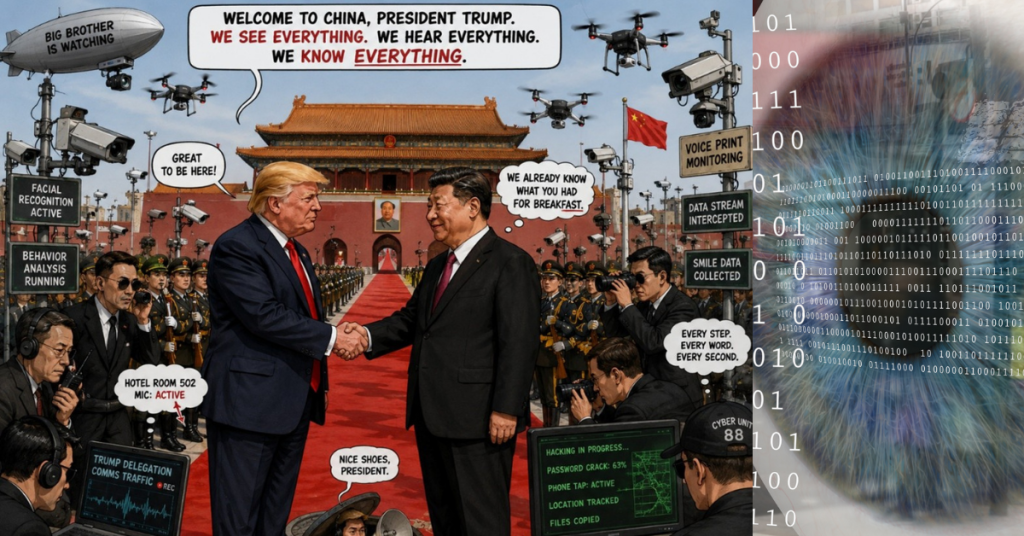
As President Donald Trump and Chinese President Xi Jinping meet on Chinese soil, one fascinating behind-the-scenes reality often goes unnoticed: the extraordinary cybersecurity and counter-surveillance precautions required for the U.S. delegation to operate inside what many experts consider the world’s most advanced surveillance state.
China’s surveillance infrastructure is vast and deeply integrated into daily life. Cameras blanket city streets, hotels, airports, transportation hubs, government buildings, and commercial districts — often enhanced with facial recognition, behavioral tracking, and digital monitoring systems. For a visiting American president, secure communications become a mission of their own.
Top of Form
Bottom of Form
Digital Lockdowns and Burner Devices
U.S. delegations typically leave personal phones, tablets, and primary work devices behind before entering China. Instead, officials use temporary “clean” devices or burner phones containing minimal information and no sensitive personal data. These devices are often wiped or destroyed after the trip. This includes the media outlets.
Air-Gapped Communications
Cloud syncing, Bluetooth, and many internet-connected functions are heavily restricted. Sensitive equipment may be stored inside specialized Faraday bags that block wireless signals entirely, preventing remote interception or unauthorized access.
Analogue Environments
In high-risk environments, the old-fashioned method still works best: face-to-face communication. Sensitive discussions are often conducted in person rather than digitally. Physical paper documents and hand-delivered briefings reduce the risk of cyber interception.
Secure Physical Spaces
The White House Military Office and U.S. technical security teams establish tightly controlled meeting environments. Hotel rooms and meeting spaces may undergo electronic sweeps for hidden microphones, cameras, or signal interception devices before officials enter.
Device Forensics After the Trip
Once the delegation returns home, all temporary electronics are subjected to deep forensic analysis by cybersecurity experts. Devices are scanned for malware, spyware, keyloggers, cloned SIM activity, and evidence of tampering.
Other Interesting Tidbits
- U.S. intelligence and cybersecurity teams often assume that hotel Wi-Fi networks, room phones, smart TVs, and even charging ports could be compromised.
- Many officials avoid plugging devices directly into unknown USB ports due to the risk of “juice jacking” or hidden malware delivery.
- Some security experts advise travelers to assume every hotel room conversation in China could potentially be monitored.
- China’s “Golden Shield Project,” often associated with the “Great Firewall,” integrates surveillance, censorship, and digital tracking systems on a national scale.
- Facial recognition systems in some Chinese cities can reportedly identify individuals within seconds across massive camera networks.
Ironically, while many Americans worry that Chinese-made electronics, cameras, apps, and devices could potentially collect data inside the United States, China openly and actively operates one of the most extensive domestic surveillance systems on Earth within its own borders.
The result is a remarkable geopolitical image: while the world watches two superpowers shake hands on the red carpet, an invisible technological chess match unfolds behind the scenes — one focused not on diplomacy, but on information security, espionage prevention, and digital survival.
Certainly, one of the most frustrating things for President Trump in China, is that he was not able to push out any Truth Social posts! It’s wheels up heading home, so let the truth storm begin!
Subscribe to DailyClout so you never miss an update!

One of our country’s most important freedoms is that of free speech.
Agree with this essay? Disagree? Join the debate by writing to DailyClout HERE.