



Empire State of Corruption: The Machine, the Money, and What Comes Next
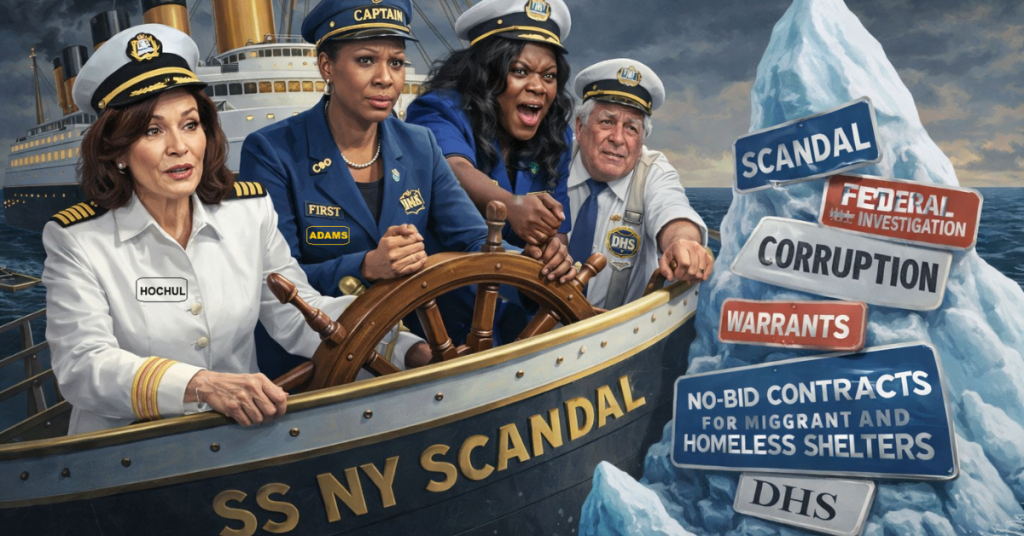
New York has seen this movie before—and it never ends the way the people hope it will.
From Eliot Spitzer to Andrew Cuomo, scandal has not been an interruption in Albany—it has been a recurring feature. Governors rise, scandals surface, pressure builds, and resignation becomes inevitable. What once felt like isolated implosions now looks more like a system revealing itself in cycles.
And now, once again, the ground is shifting.
A federal corruption probe tied to New York City’s migrant shelter contracts is widening, and the names emerging are not obscure bureaucrats—they sit deep inside the political infrastructure of the state’s dominant party. Among those reportedly caught in the widening net are local Brooklyn Councilmember Farah Louis, her sister Deborah Louis – a senior aide tied directly to Governor Kathy Hochul, and individuals closely connected to Rodneyse Bichotte Hermelyn and the Brooklyn Democratic Party apparatus.
Federal investigators are said to be examining bribery, money transfers, and the awarding of lucrative emergency contracts—millions of taxpayer dollars flowing through channels that appear, at minimum, politically entangled.
The scandals and investigations are coming out faster than water from a firehose with a broken valve. As of this writing, another controversy has surfaced—one that puts former NYC Council Speaker Adrienne Adams, now Hochul’s running mate for lieutenant governor, firmly in the crosshairs of scrutiny. Under her leadership, $435,000 in taxpayer-funded discretionary spending was directed to a migrant-shelter-linked nonprofit, BHRAGS, raising further questions about how public funds are being allocated in the name of crisis response.
This is how machines operate. Not chaotically, but efficiently—through relationships, access, and quiet understandings about who gets what.
The migrant crisis created urgency, and urgency creates opportunity. Contracts were fast-tracked, oversight loosened, and vast sums of public money deployed at speed. That alone is not corruption. But when the same names, networks, and political alignments repeatedly surface wherever large sums are moving, the question is no longer whether something is wrong—it’s how deeply rooted it is.
And that question does not stop at City Hall.
It reaches toward the top. While Kathy Hochul is not currently under investigation in this specific probe, the pattern raises serious questions about her judgment, associations, and the broader culture surrounding her administration. The appearance of impropriety is too blatant to ignore, particularly as her administration faces scrutiny of its own.
At the state level, Hochul’s team is already under intense examination over the restructuring of a multibillion-dollar Medicaid home care system. An $11 billion program, reshaped in a way critics argue steered outcomes toward a preferred vendor, has triggered lawsuits, legislative concern, and reported federal interest. The allegation is as serious as it is familiar: that decisions may have been made before the process ever began—that the appearance of competition masked a predetermined result.
Taken together, these are not isolated controversies. They are parallel tracks pointing in the same direction—toward a governing structure where access matters more than transparency, and where outcomes appear aligned long before the public is told a decision is still being made.
And while billions move through this system, ordinary New Yorkers are being squeezed tighter with every passing year. Taxes climb. Utility costs surge. Congestion pricing expands—introduced with careful political timing, delayed when elections loom, accelerated once the ballots are counted. The pattern is not subtle.
Even the state’s aggressive push into energy infrastructure raises uncomfortable questions. Lithium-ion battery storage sites are being approved at a rapid pace, often near residential communities, despite well-documented risks when these systems fail—fires that burn for days, toxic releases, and emergency responses that amount to containment – “let it burn” – rather than prevention. Yet approvals continue, incentives align, and the money flows. The only “green” that seems guaranteed is financial. Even Con Edison, once largely silent, has begun raising concerns that such rapid proliferation could strain the grid.
All of this is unfolding against the backdrop of an increasingly complex internal struggle within the Democratic Party. On one side stands Hochul, navigating power through alliances and calculated restraint. On the other, the rising influence of the Democratic Socialists, embodied by figures like Zohran Mamdani, whose vision for the city—and ultimately the state—leans far more aggressively ideological.
In contrast to that ascendant wing, Hochul has at times operated with a more pragmatic instinct—one rooted in the reality that New York’s economic survival depends on maintaining relationships with the real estate sector, financial institutions, and major developers who drive investment and growth. That dynamic inevitably leads to dealmaking, and in a functioning system, some level of negotiation is not only expected but necessary to avoid the state veering off the economic cliff.
But that same dynamic reinforces the very system that breeds distrust. When billion-dollar projects, energy initiatives, and development contracts consistently land in the hands of well-connected players, it raises a fundamental question: is this strategic governance, or simply a refined version of the insider politics New Yorkers have dealt with for decades? The line between pragmatism and favoritism becomes dangerously thin—especially when decisions involving billions of taxpayer dollars are made with limited transparency.
She has already backtracked on earlier rhetoric telling wealthy New Yorkers to “get the hell out of town,” now urging them to return and shoulder an even greater share of the tax burden to compensate for mounting fiscal pressures.
That same calculated approach is evident in her handling of congestion pricing and taxation. When elections approach, restraint becomes the message—policies are paused, concerns acknowledged, and the posture shifts toward protecting overburdened New Yorkers. But once the immediate elections are over, those same policies reemerge and implemented with renewed urgency. It creates the perception that delays are tactical, not principled, and that the real fiscal decisions—higher taxes, expanded fees, increased burdens—are deferred until after voters have cast their ballots. For middle-class families, homeowners, and small businesses already stretched thin, the fear is not hypothetical: what is held back today will be imposed tomorrow.
Hochul’s position depends on balancing these forces, and balance in politics is rarely free—it is negotiated. Her alignment with Adrienne Adams as lieutenant governor did more than unify a ticket; it neutralized opposition and secured party backing at a critical moment. But in a system built on leverage, every resolved challenge invites a deeper question: what was exchanged to make it disappear?
Because New York politics does not operate on coincidence. It operates on timing, pressure, and leverage.
And that brings us to the part few are willing to say out loud.
New York governors have a habit of not finishing their terms. It has happened before, and not long ago. When pressure becomes too great—when investigations widen, alliances shift, and staying becomes more damaging than stepping aside—the exit comes quickly. It has become almost commonplace for lieutenant governors to wake up as governor the next morning.
So it is not far-fetched to imagine a scenario in which the current trajectory continues. Investigations deepen. More connections surface. Pressure builds not just externally, but internally, as factions within the same party calculate their next move. And then, suddenly, the resignation arrives.
Governor Hochul steps aside. Governor Adrienne Adams steps in.
At that moment, power would not just remain in one party’s hands—it would consolidate further, aligning city and state leadership under a shared ideological direction with unprecedented cohesion. The Democratic Socialists would hold unprecedented influence across both city and state governance—a scenario that, for many, would mark a point of no return. A marriage of ideological dogma and unfettered corruption will emerge.
None of this requires conspiracy to understand. It requires pattern recognition.
One-party dominance does not always collapse under its own weight—it adapts. It absorbs scandal, redistributes power, and continues. The danger is not just corruption itself, but the normalization of it—the sense that this is simply how things work.
And that is where New York stands now.
The warning signs are no longer subtle: federal probes reaching into political networks, massive contracts under scrutiny, and a public increasingly burdened while billions circulate above them.
The Republican challenger, Bruce Blakeman, needs to seize upon this opportunity, along with the broader GOP apparatus. The Republicans face a critical test—whether to fully confront these issues and present a credible alternative, or risk irrelevance at a moment when public trust is already deeply eroded. The question remains whether the NY GOP has the will to do so—or as some suggest, perhaps they have their hands in the proverbial cookie jar as well?
Subscribe to DailyClout so you never miss an update!
One of our country’s most important freedoms is that of free speech.
Agree with this essay? Disagree? Join the debate by writing to DailyClout HERE.