



Trump Says Iran War “Very Complete” as U.S. Seeks Off-Ramp
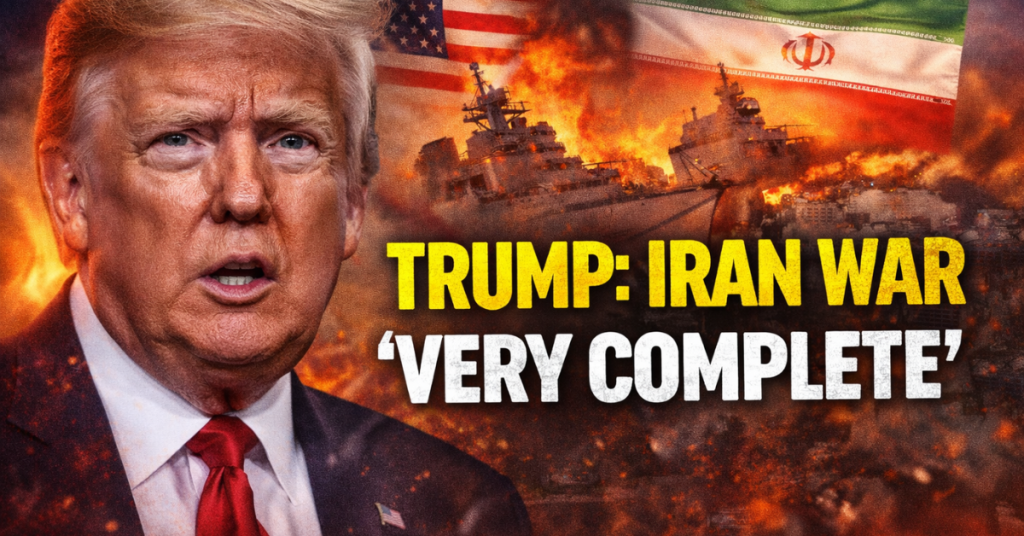
President Donald Trump said Monday that the U.S. military campaign against Iran has largely achieved its objectives, declaring the conflict “very complete” after weeks of strikes targeting Tehran’s military infrastructure.
Speaking to CBS News White House correspondent Weijia Jiang, Trump described Iran’s armed forces as severely degraded following joint U.S. and Israeli operations.
“I think the war is very complete, pretty much,” Trump said. “They have no navy, no communications, they’ve got no Air Force.”
The comments come amid mounting signs that Washington and its regional partners may be searching for a path to de-escalation even as the strategic outcome of the conflict remains unclear.
U.S. Campaign Severely Damaged Iranian Capabilities
The Trump Iran war complete remarks follow reports that U.S. and allied strikes targeted a wide range of Iranian military assets, including missile infrastructure, naval installations, and command-and-control systems.
Defense analysts say the campaign focused on crippling Iran’s ability to project force across the Persian Gulf and disrupt shipping lanes such as the Strait of Hormuz, one of the world’s most important energy chokepoints.
The Pentagon has previously warned that Iranian naval forces and missile systems posed a major threat to commercial shipping and regional energy infrastructure. Those assets were among the first targets of the American-led strike campaign.
Satellite imagery and defense briefings have indicated significant damage to Iranian naval bases and air defense networks, though Tehran has disputed claims that its military has been neutralized.
Leadership Transition in Tehran
The conflict has also coincided with major political upheaval inside Iran.
Following the reported death of longtime Supreme Leader Ali Khamenei during the opening phase of the conflict, Iranian authorities announced that his son, Mojtaba Khamenei, would assume leadership of the Islamic Republic.
Trump signaled little interest in communicating with Iran’s new leadership.
When asked whether he had a message for Mojtaba Khamenei, Trump responded bluntly that he had “no message.”
The leadership transition has created uncertainty about how Iran’s government will respond to the military setbacks and whether it will escalate or seek negotiations.
Earlier Calls for Regime Change
At the beginning of the conflict, Trump appeared to signal support for a more dramatic outcome inside Iran.
In several public statements, he called on the Iranian people to rise up against the Islamic Republic’s leadership. At one point, analysts also speculated that Kurdish forces from northern Iraq could potentially open a new front against Tehran.
Neither scenario ultimately materialized.
Instead, the conflict has remained largely defined by air and missile strikes, cyber operations, and regional proxy attacks rather than a full-scale ground invasion.
Focus Shifts to Oil Markets and Shipping
With major Iranian military assets reportedly damaged, the administration has begun shifting attention toward stabilizing global energy markets.
The Strait of Hormuz carries roughly a fifth of the world’s oil supply, making any disruption to the shipping corridor a major concern for international markets.
Trump has emphasized the need to reopen secure trade routes through the region while preventing Iran from targeting oil infrastructure across the Gulf.
Oil prices surged in the early stages of the conflict but have since stabilized somewhat as fears of a prolonged naval blockade eased.
Searching for an Exit
Despite Trump’s assertion that the conflict is nearing completion, the political endgame remains uncertain.
Several reports indicate that U.S. officials, Gulf governments, and Israeli leaders are quietly exploring possible off-ramps that could prevent the confrontation from expanding further.
However, Trump has simultaneously demanded Iran’s “unconditional surrender,” a position that could complicate diplomatic efforts if Tehran refuses to concede defeat.
Analysts say the situation leaves Washington in an ambiguous position: claiming a decisive military victory while still lacking a clearly defined political settlement.
A Conflict Without a Clear End State
The Trump Iran war complete declaration highlights a familiar dilemma in modern warfare.
Military objectives may be achieved quickly through advanced technology and overwhelming force, but translating those victories into lasting political outcomes can be far more complicated.
For now, the administration appears to be balancing two goals that are not easily reconciled: declaring success while avoiding a wider regional war.
Whether those goals can coexist may determine whether the Iran conflict truly is “very complete,” or merely entering its next phase.