



An Inconvenient Legacy: Two Decades of Failed Climate Predictions
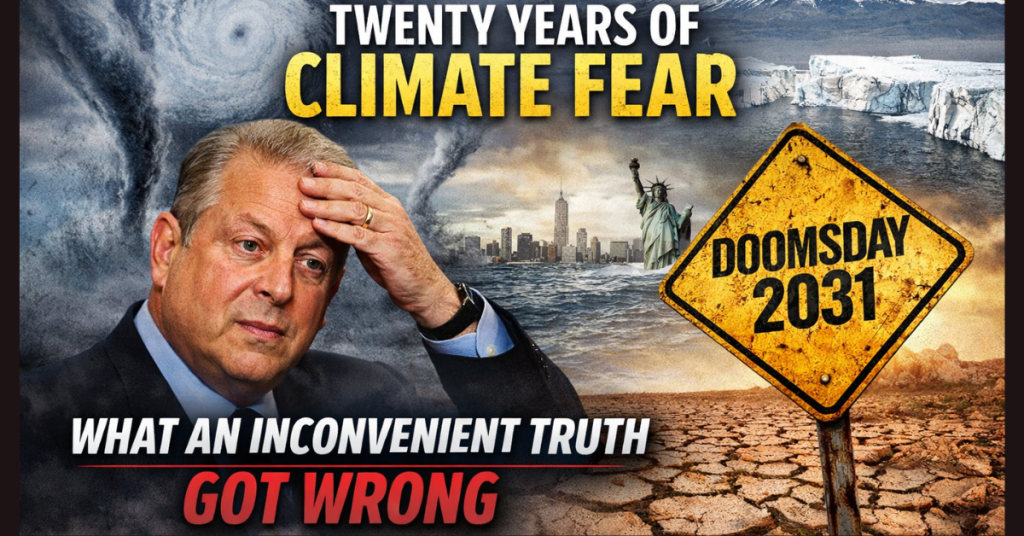
Twenty years ago, An Inconvenient Truth debuted at the Sundance Film Festival to a standing ovation. Released theatrically in 2006, the documentary—fronted by former Vice President Al Gore—became a cultural milestone. It helped propel climate change from a technical scientific debate into a dominant political and media narrative, shaping public perception for a generation.
The film’s core message was unmistakable: humanity was racing toward environmental catastrophe, driven by fossil fuels, and time was rapidly running out. Two decades later, it is worth asking a sober question that often goes unexamined: how well did the documentary’s most dramatic claims hold up—and what lessons should be drawn from where they did not?
Predictions That Didn’t Materialize
One of the most striking features of An Inconvenient Truth was its reliance on vivid, time-bound predictions. Among them was the claim that Africa’s Mount Kilimanjaro would lose its snowcap entirely by the mid-2010s. Yet well into the 2020s, glaciers—though diminished—remain visible atop the mountain, a fact reported by multiple international outlets.
A similar narrative unfolded in Montana’s Glacier National Park. Early projections suggested the park’s glaciers would disappear by 2020, prompting signage warning visitors they were witnessing ice on borrowed time. When the glaciers remained, those signs were quietly removed. The issue was not that glaciers never retreat—they do—but that precise, deadline-driven predictions were presented as near-certainty rather than probability.
Extreme weather claims followed a similar pattern. Hurricane Katrina was framed in the documentary as an early warning of climate-driven superstorms to come. Yet even today, the National Oceanic and Atmospheric Administration acknowledges that attributing long-term hurricane trends to greenhouse gases remains scientifically complex.
NOAA’s own summary notes that it is “premature” to conclude with high confidence that human-caused warming has produced hurricane activity outside natural variability—a far more cautious assessment than what entered popular discourse.
Arctic Ice and Model Uncertainty
Another widely circulated claim was that the Arctic would be ice-free in summer within a decade. That prediction, repeated publicly by Gore in 2009, did not occur. While Arctic sea ice declined sharply from the late 1970s into the early 2000s, satellite records show that the trend flattened in subsequent years—something many climate models failed to anticipate.
Meteorologists and climate analysts have since acknowledged that natural variability plays a larger role in polar ice dynamics than earlier public messaging suggested. This does not invalidate climate science, but it does highlight the limits of forecasting complex systems—and the risks of overstating confidence.
Media Amplification and Selective Memory
Perhaps the most enduring effect of An Inconvenient Truth was not any single prediction, but the style of communication it normalized. Dire forecasts received heavy media coverage, while failed or revised predictions often passed without notice.
The American West offers a recent example. In 2022, major outlets warned of a “megadrought” described as the worst in over a millennium. By early 2025, California was officially drought-free for the first time in decades, yet the earlier framing was rarely revisited or contextualized.
This asymmetry matters. As meteorologist Chris Martz and others have pointed out, most people do not read peer-reviewed journals. They form their understanding through headlines, speeches, and political rhetoric. When worst-case scenarios dominate coverage, public perception can drift far from the actual state of scientific consensus.
Fear, Extinction, and Public Belief
By the late 2010s, climate discourse had moved beyond environmental damage to existential threat. A 2017 survey found that 40 percent of Americans believed climate change could cause human extinction. Yet data from international disaster databases show that deaths from natural disasters have declined dramatically over the past century, largely due to improved infrastructure, forecasting, and emergency response.
This gap between perception and reality underscores the power—and danger—of apocalyptic framing.
The AOC Moment and Misread Science
That framing reached a political crescendo in 2019, when Rep. Alexandria Ocasio-Cortez stated that the world would end in 12 years if climate action was not taken. The comment was widely circulated and deeply influential, especially among younger audiences.
Yet the statement was based on a misinterpretation of a special report from the Intergovernmental Panel on Climate Change. The report did not predict global collapse or extinction. It argued that limiting warming to 1.5°C would require steep emissions reductions to reduce long-term risks—not that crossing the threshold would trigger immediate catastrophe.
Even under the report’s worst-case economic scenario, global GDP was projected to continue growing, albeit at a slower rate. Nuance, however, rarely survives translation into political soundbites.
What Twenty Years Should Teach Us
Two decades after An Inconvenient Truth, the lesson is not that climate change is a hoax, nor that environmental risks should be ignored. It is that precision, humility, and honesty matter—especially when science enters the political arena.
Overconfident predictions that fail erode trust. Apocalyptic rhetoric distorts public understanding. And when fear becomes the primary motivator, policy debates risk being driven more by urgency than accuracy.
Climate science, like all science, advances through uncertainty, revision, and correction. Treating it as settled dogma—or weaponizing worst-case scenarios for political ends—ultimately undermines the very credibility needed to address real environmental challenges.
Twenty years on, the question is no longer whether the planet is changing. It is whether public discourse can mature beyond spectacle and fear, and begin treating climate not as an end-times prophecy—but as a complex problem requiring proportion, realism, and restraint.
From our sponsors:
American Alternative Assets: Uncover the truth behind market turbulence. The Bellweather Signal reveals 7 hidden economic indicators flashing red right now. Get the free report and learn how to protect your savings with gold and silver. Download it today at https://www.CloutGold.com