



China’s Fishing Empire Is Emptying the Oceans and Stripping South America Bare
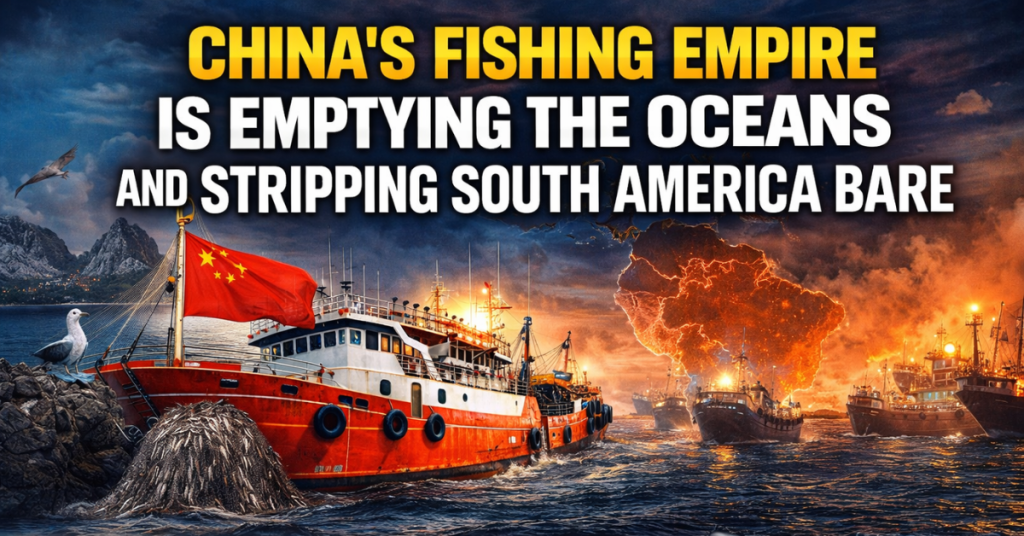
After severely depleting fish stocks in its own coastal waters in the late 1990s and early 2000s, China has effectively exported its fishing crisis to the rest of the world. Today, its distant-water fishing fleet — the largest on Earth — is ravaging marine ecosystems thousands of miles from Chinese shores, with South America emerging as one of the hardest-hit regions.
From Domestic Collapse to Global Expansion
China’s near-shore fisheries collapsed decades ago due to overfishing, pollution, and industrial runoff. Instead of dramatically scaling back, Beijing pursued a different strategy: massively expanding a state-subsidized distant-water fleet capable of operating indefinitely in foreign waters.
That fleet now numbers in the thousands, supported by fuel subsidies, floating refueling depots, and lax oversight. The result is a roaming armada that targets some of the world’s most productive fishing grounds — often with devastating consequences.
South America’s Waters Stripped Bare
Nowhere is the impact more visible than off the coasts of Argentina, Ecuador, and Peru. In recent years, Chinese vessels have accounted for over 80 percent of fishing activity in key areas of these waters, particularly near the edges of national exclusive economic zones (EEZs).
These fleets often operate just outside legal boundaries — or cross them outright — harvesting squid, anchovies, and other species at industrial scale. Local fishermen report dramatic stock collapses, shorter seasons, and shrinking catches that threaten coastal livelihoods.
Ecuador has repeatedly raised alarms over Chinese fleets operating near the Galápagos Islands, one of the most biologically sensitive marine environments on the planet.
The World’s Worst Offender in Illegal Fishing
China consistently ranks as the worst country globally in international assessments of illegal, unreported, and unregulated (IUU) fishing. Its fleet is routinely linked to:
-
Overfishing and stock depletion
-
Targeting of endangered shark species, often for fins
-
Illegal incursions into sovereign waters
-
Falsified licenses and catch documentation
-
Forced labor and human rights abuses aboard vessels
Many ships disable tracking systems, change names or flags, and operate under shell companies that make enforcement difficult. Crew members, often migrants from poorer countries, have reported abusive conditions, withheld pay, and physical coercion.
Environmental and Economic Fallout
The ecological damage is not theoretical. Entire food chains are being disrupted as industrial trawlers extract massive quantities of keystone species faster than they can reproduce. This accelerates biodiversity loss and destabilizes marine ecosystems that coastal nations depend on for food security.
Economically, local fishing industries are being squeezed out by a fleet that can operate at a loss thanks to state subsidies. Small-scale fishermen simply cannot compete with factory ships that stay at sea for months at a time.
A Global Problem Demanding Global Action
Despite growing awareness, enforcement remains fragmented and weak. Many affected nations lack the naval capacity to patrol vast maritime zones, while international mechanisms to penalize repeat offenders are slow and politically constrained.
China’s distant-water fishing empire is not just a regional issue — it is a global environmental crisis, one that illustrates how industrial overreach, weak regulation, and geopolitical power can combine to strip natural resources far from home.
Unless coordinated international pressure and enforcement emerge, the pattern is clear: the oceans will continue to be emptied — one coastline at a time.