



Wikipedia Co-Founder Larry Sanger Warns Site Has Been “Hijacked by Woke Ideology”
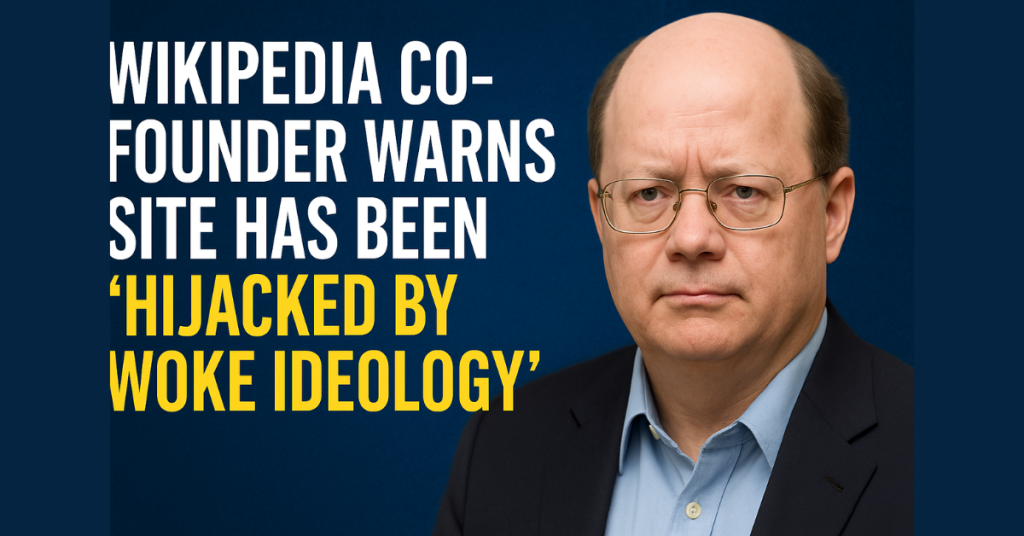
Larry Sanger, the 57-year-old co-founder of Wikipedia, has launched a blistering critique of the world’s largest online encyclopedia, accusing it of abandoning its original mission in favor of woke ideology and systemic censorship. In a detailed essay published on The Free Press, Sanger outlined how Wikipedia has, in his words, been “corrupted by a narrow, politically driven agenda” that suppresses dissenting views and silences conservative voices.
From Neutrality to Ideology
When Sanger and Jimmy Wales co-founded Wikipedia in 2001, their vision was to create a free, global platform where multiple perspectives—political, religious, and cultural—could coexist. But Sanger, who left the project in 2002, argues that in the 23 years since, that vision has been abandoned.
Instead of neutrality, Wikipedia now reflects what Sanger describes as GASP bias: Globalist, Academic, Secular, Progressive. He argues that this ideological consensus is enforced by a small group of powerful editors who dictate what counts as “reliable” information.
The Irina Zarutska Controversy
Sanger’s warnings have been underscored by recent controversies, including the case of Irina Zarutska, a 23-year-old Ukrainian refugee fatally stabbed on a North Carolina light rail train in August 2025.
When editors created an article about her killing, others quickly moved to delete it, arguing the murder didn’t meet Wikipedia’s “notability” requirements. References to the alleged attacker’s identity and criminal record were also scrubbed. The article underwent nearly 350 revisions in just 24 hours, sparking accusations that Wikipedia was downplaying the murder for political reasons.
For Sanger, this was a clear example of Wikipedia’s systemic bias at work—where uncomfortable facts are minimized or erased, especially if they conflict with the ideological preferences of its most influential editors.
Who Really Controls Wikipedia?
Though Wikipedia is volunteer-driven, only 62 accounts wield the greatest power to appoint or remove administrators and discipline contributors. Shockingly, Sanger notes, fewer than 15% of these powerful users disclose their real names—raising concerns about accountability in the shaping of global knowledge.
In addition, Sanger criticizes the “Reliable Sources” list created by anonymous editors in 2018. This list now determines which news outlets are allowed as citations. Conservative sources like The Daily Caller are marked “completely unusable,” while Fox News is deemed “generally unreliable.” Meanwhile, left-leaning outlets face no such blanket disqualifications, skewing millions of articles toward one ideological direction.
The Silencing of Dissent
Sanger also warns that dissenting editors face lifetime bans for trivial reasons—sometimes merely for having “unusual usernames” or questioning the approved narrative. Those who challenge consensus are often dismissed as “fringe” voices and edited out of the platform entirely.
He argues that what began as a project meant to “ignore all rules” and welcome new users has now devolved into an echo chamber of systemic censorship.
Sanger’s Solutions
In his essay, “I Founded Wikipedia. Here’s How to Fix It,” Sanger proposes sweeping reforms, including:
-
Abandoning the consensus model that suppresses minority viewpoints.
-
Eliminating the approved sources list in favor of broader citations that let readers judge reliability.
-
Creating a formal editorial legislature elected by the community to ensure accountability.
-
Adopting a Community Notes-style system (similar to X/Twitter) to contextualize disputed content.
-
Ending anonymity for top editors to restore transparency and trust.
Why It Matters
Wikipedia has become the largest written collection of knowledge in human history, used by millions of readers, students, and journalists every day. But if Sanger is correct, its dominance also makes it one of the most powerful gatekeepers of truth—capable of amplifying certain voices while erasing others.
His warnings highlight a larger debate about free speech, censorship, and the integrity of online knowledge. At a time when Big Tech platforms already face scrutiny for political bias, the idea that Wikipedia itself has been “captured” raises serious questions about who controls the flow of information in the digital age.
DailyClout.IO will continue to cover this story.
-
Larry Sanger’s Blog – “Wikipedia Is Badly Biased” (2020)
https://larrysanger.org/2020/05/wikipedia-is-badly-biased/ -
Fox News – “Wikipedia co-founder says site’s leftist bias has gotten out of control”
https://www.foxnews.com/media/wikipedia-co-founder-leftist-bias -
The Telegraph – “Wikipedia has become a one-sided ‘thought police’, says co-founder Larry Sanger”
https://www.telegraph.co.uk/technology/2021/07/16/wikipedia-become-one-sided-thought-police-says-co-founder/ -
UnHerd – “Larry Sanger: Wikipedia has been captured by the left”
https://unherd.com/2021/07/wikipedia-has-been-captured-by-the-left/