



The Charlie Kirk Assassination and the Rise of Political Violence
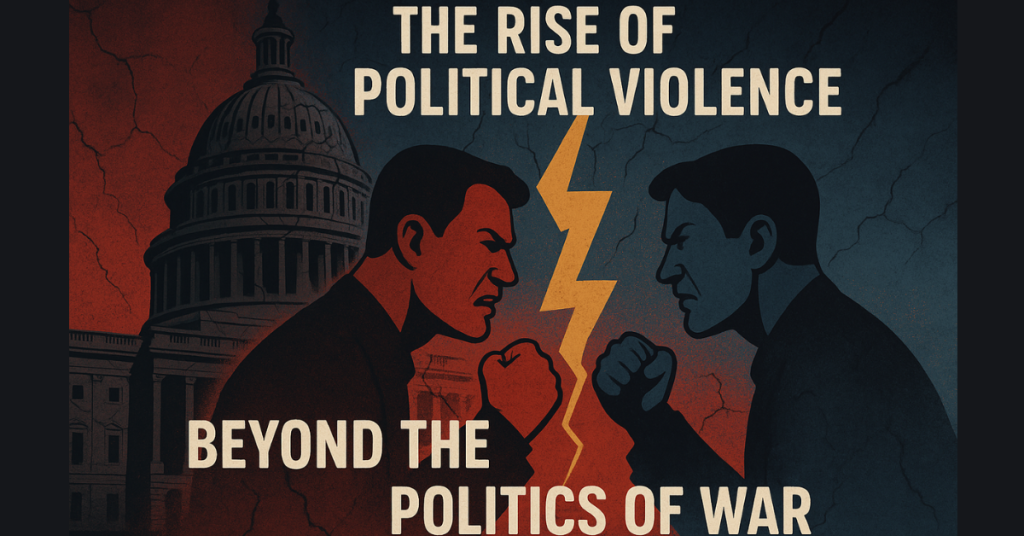
The assassination of Charlie Kirk has sent shockwaves through the nation. It is more than a personal tragedy or partisan talking point—it is a stark reminder that political violence in America is rising. While we are nowhere near the explosive unrest of the 1960s, the current trend is alarming enough to demand serious reflection. The question before us is not whether violence is dangerous—we know it is—but how to halt its rise without sliding into authoritarian extremes: a surveillance state, restrictions on the Second Amendment, or crackdowns on free speech and activism.
Diagnosing the Causes of Political Violence
Lasting solutions require an accurate diagnosis of what fuels this violence. The most pressing factor is not economic deprivation or social decay but the ideas we have adopted about politics itself. Increasingly, Americans see politics not as cooperation or rule-bound competition but as war.
This is evident in the way citizens now view their political rivals: not simply as opponents, but as enemies who are wicked, unjust, and undeserving of even basic respect. Once politics is framed as war, then assassination becomes imaginable as one of its tactics.
The Influence of Ideologies That Frame Politics as War
Why have Americans come to view politics in this way? Part of the answer lies in the influence of ideological systems that explicitly cast politics as war.
-
Marxism: Karl Marx and Friedrich Engels argued that political power is “merely the organized power of one class for oppressing another.” Mao Zedong put it even more bluntly: “Politics is war without bloodshed, while war is politics with bloodshed.”
-
Carl Schmitt: On the right, the German jurist Carl Schmitt insisted that politics is defined by the friend–enemy distinction, that existential conflict with “the other” is not just common but inevitable.
Americans don’t need to study Marx or Schmitt to absorb their influence. These ideas filter into education, culture, and media, shaping how we perceive rivals and conflicts. When rivals are seen as existential threats, ordinary politics morphs into war by other means.
Pluralism as a Source of Tension
Another root cause is pluralism. America’s history of freedom has produced radically different ways of life: religious devotion, pursuit of wealth, bohemian self-expression, and more. These differences can be tolerated, but too often they are absolutized. Citizens regard their chosen freedoms as untouchable and incompatible with others. This absolutism fuels the sense that those who differ from us threaten our very existence.
Pluralism need not lead to political warfare, but in the absence of tolerance and cooperation, it often does.
The Expanding Scope of Government
The growth of the federal government also drives division. The Founders envisioned a government limited in scope and divided by checks and balances. Today, Washington reaches into nearly every aspect of American life. When government becomes winner-take-all, elections turn into existential struggles.
Losing power no longer feels like a temporary setback—it feels like annihilation. Add the tendency of victors to punish their opponents, and the result is a politics that looks more like warfare than governance.
Social Media, News Bias, and the Perception Gap
Finally, social media and partisan media outlets have deepened polarization. Researchers have documented a “perception gap,” where citizens believe their opponents are more extreme and more numerous than they actually are. Ironically, this perception gap widens among the most educated and politically active, meaning that the people most engaged in politics are often the least accurate about the other side.
The distortion of reality encourages hatred, exaggeration, and in some cases, violence.
Possible Remedies
Solutions are not simple, but several directions stand out:
-
Reject ideological systems that reduce politics to war.
-
Relearn tolerance, which is not “live and let live,” but the hard discipline of living with those you dislike without making them into enemies.
-
Scale back the national government and revive federalism and localism, so that not every disagreement becomes a national crisis.
-
Take responsibility for our perception of reality by resisting media that thrives on distortion and division.
These solutions are easy to describe, but difficult to implement. They will require generational changes in education, civics, and culture.
The Role of Civics Education
If we are to turn back from the brink, education will be key. K-12 schools, universities, and graduate programs in education must begin teaching students the dangers of ideology, the value of pluralism, and the practice of toleration. This means training teachers who are not activists but genuine educators.
Promising programs, such as civics centers emerging on campuses, must be expanded. They should emphasize why pluralism is natural, why it is not relativism, and why living together requires toleration and cooperation.
Conclusion: Beyond the Politics of War
The Charlie Kirk assassination has brought into sharp focus the dangers of viewing politics as war. If politics is war, then violence becomes an acceptable weapon. If politics is cooperation, however strained, then assassination and brutality have no place.
America must choose whether it will continue down the road of ideological warfare or recover a political ethic rooted in freedom, equality, toleration, and federalism. The stakes could not be higher. The future of American politics may well depend on whether we can relearn how to live together without resorting to violence.
Please Support Our Sponsors:
The Wellness Company:
Use code OUTSPOKEN for 10% off!
NativePath: “Women 50+ Do THIS 1 Thing for Flabby Arms (NO WEIGHTLIFTING)… Visit https://getnativecreatine.com/DailyClout to Learn More”
Clarke For City Council: “If you live in District 46, every dollar you give to Athena Clarke’s City Council campaign will be matched eight-to-one — and if you live elsewhere, your donation still directly fuels her fight to bring real change to NYC.” https://contribute.nycvotes.org/campaigns/athenaclarke/contributions/new
Discover LegiSector! Stay up-to-date on issues you care about with LegiSector’s state-of-the-art summarizing capabilities and customizable portals. Try now for a free trial…Learn more at https://www.legisector.com